What Is GPT? Understanding GPT-4 and How It Works
SkillVeris Team
AI Research Team
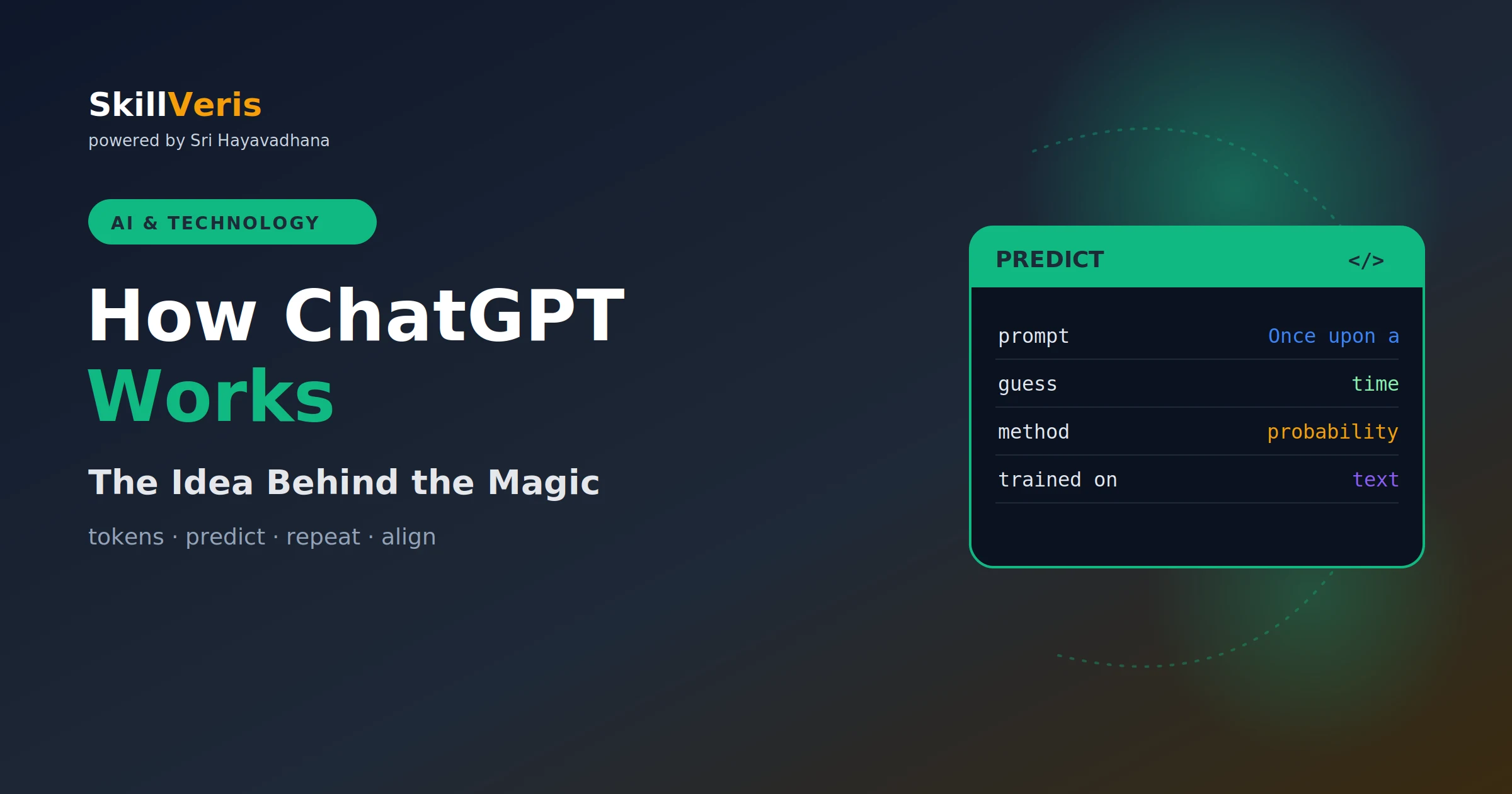
GPT stands for Generative Pre-trained Transformer, a neural network architecture designed to generate coherent text one token at a time.
In this guide, you'll learn:
- GPT models are pre-trained on vast amounts of text before being fine-tuned for specific behaviors like following instructions safely.
- The transformer architecture's self-attention mechanism lets the model weigh the relevance of every other word when predicting the next one.
- GPT-4 extends earlier GPT models with stronger reasoning, better instruction-following, and the ability to process images alongside text.
- GPT models don't retrieve facts from a database — they generate text based on statistical patterns learned during training, which is why they can be confidently wrong.
1What Is GPT?
GPT stands for Generative Pre-trained Transformer — a type of large language model that generates text by predicting, one token at a time, the most statistically likely next piece of text given everything that came before it. GPT-4 is a specific, more capable generation in this model family.
The name describes the approach: it's generative (it produces new text), pre-trained (it learns broad language patterns from huge datasets before any specific task), and built on the transformer architecture (the neural network design that made this scale of language modeling practical).
2How the Transformer Architecture Works
The transformer's key innovation is self-attention: for every word it's about to generate, the model considers every other word in its current context and weighs how relevant each one is to the prediction.
This lets a transformer capture long-range relationships — like connecting a pronoun back to a noun introduced several sentences earlier — far more effectively than older architectures that processed text strictly in sequence.
3Pretraining and Fine-Tuning
GPT models go through two broad phases. During pretraining, the model is exposed to an enormous volume of text and learns general language patterns, facts, and reasoning associations purely by predicting missing or next words.
After pretraining, the model is fine-tuned — often using human feedback — to follow instructions, refuse unsafe requests, and produce more helpful, structured responses. This second phase is what turns a raw language model into an assistant-like product.
💡
4What GPT-4 Adds Over Earlier Models
GPT-4 builds on earlier GPT generations with several practical improvements rather than a change in the underlying approach.
- Stronger reasoning on complex, multi-step problems compared to earlier GPT versions.
- Better instruction-following, producing outputs that more closely match what was actually asked.
- Multimodal input support in some versions, allowing the model to process images alongside text.
- A larger context window in later variants, letting it consider more text at once when generating a response.
5Limitations to Understand
GPT models don't look up facts in a database — every response is generated from statistical patterns learned during training. This is why they can produce fluent, confident-sounding text that's factually wrong, a behavior often called hallucination.
They also have a knowledge cutoff from their training data and no inherent awareness of events after that point unless given that information directly in the conversation.
6Using GPT Effectively
Getting useful output from GPT models depends more on how you prompt them than on understanding the underlying architecture.
- Be specific about the format and level of detail you want in the response.
- Provide relevant context directly in the prompt rather than assuming the model knows it.
- Verify factual claims independently, especially for anything time-sensitive or high-stakes.
- Break complex tasks into smaller steps to get more reliable, checkable output.
7Wrap-Up: Where to Go Next
GPT-4 and models like it represent the current state of large language models: transformer-based systems trained on massive text data and refined to follow instructions helpfully. Understanding pretraining, attention, and their limitations gives you a realistic picture of what these tools can and can't do.
If you want to go deeper into how these models are built and used in practice, a structured course on large language models and Python for AI is the natural next step.
Related Reading
Get The Print Version
Download a PDF of this article for offline reading.
About the Publisher
SkillVeris Team
AI Research Team
Our AI team covers the latest in machine learning, generative AI, and emerging tech — clearly and accurately.
View all postsRelated Posts
Never miss an update
Get the latest tutorials and guides delivered to your inbox.
No spam. Unsubscribe anytime.