What Is Generative AI and How Do You Learn It Free
SkillVeris Team
AI Research Team
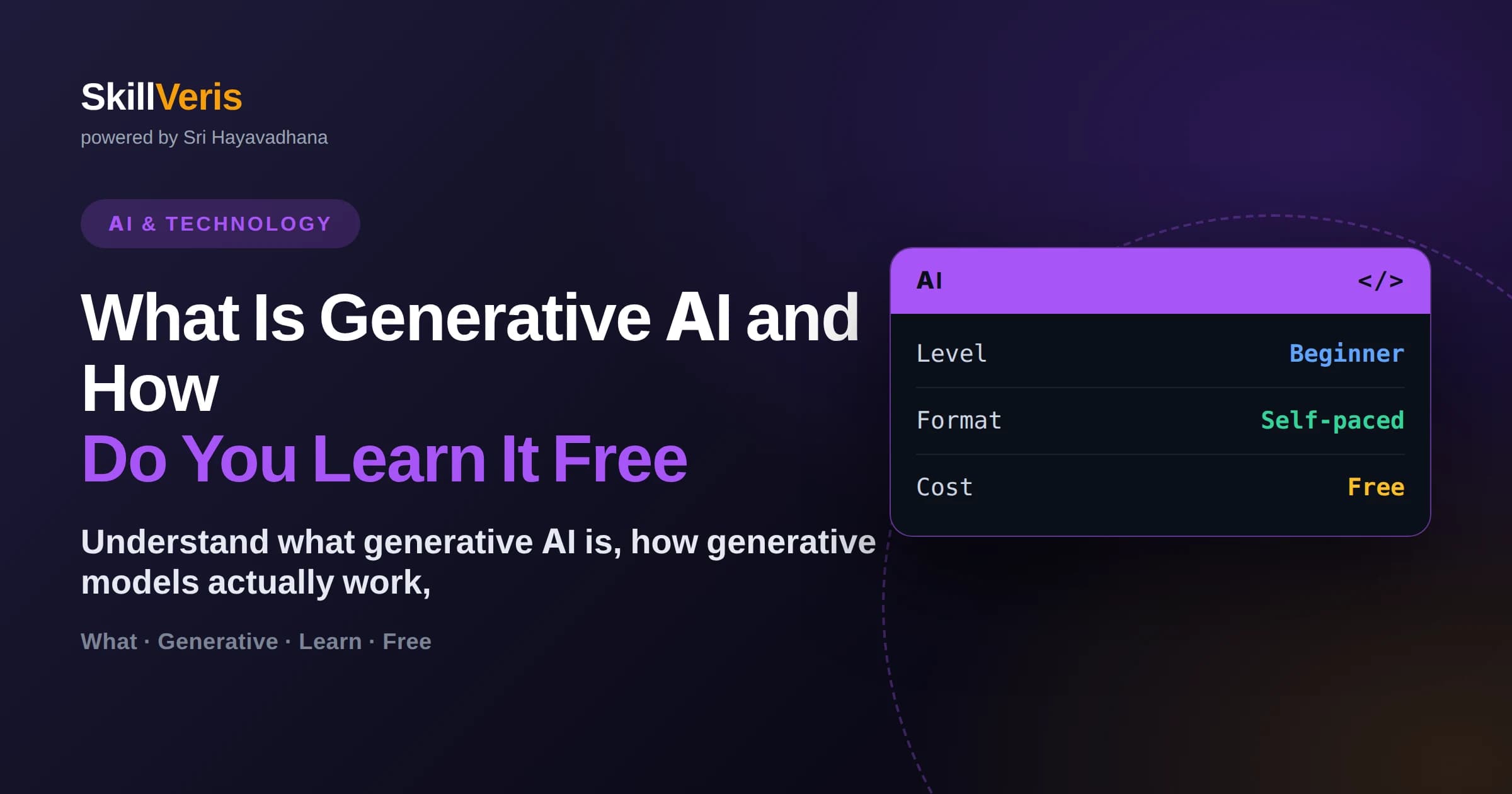
Generative AI is a class of models that produce new content such as text, images, audio, or code by learning patterns from large training datasets.
In this guide, you'll learn:
- Modern generative models are mostly built on the transformer architecture and are trained to predict the next piece of a sequence extremely well.
- You do not need a maths degree to start; you need curiosity, a browser, and a willingness to build small projects and read model outputs critically.
- A sensible free learning path moves from intuition, to prompting, to a little Python, to using APIs, and finally to fine-tuning or retrieval.
- Hands-on practice beats passive watching, so every stage of the path pairs a concept with a small thing you actually build or run.
1What Is Generative AI?
Generative AI is a category of artificial intelligence that creates new content, including text, images, audio, video, and code, by learning the statistical patterns in vast amounts of training data. Where older AI systems mostly classified or predicted from fixed options, generative models produce novel outputs that did not exist before, which is why they can write an essay, draw a picture, or complete a function.
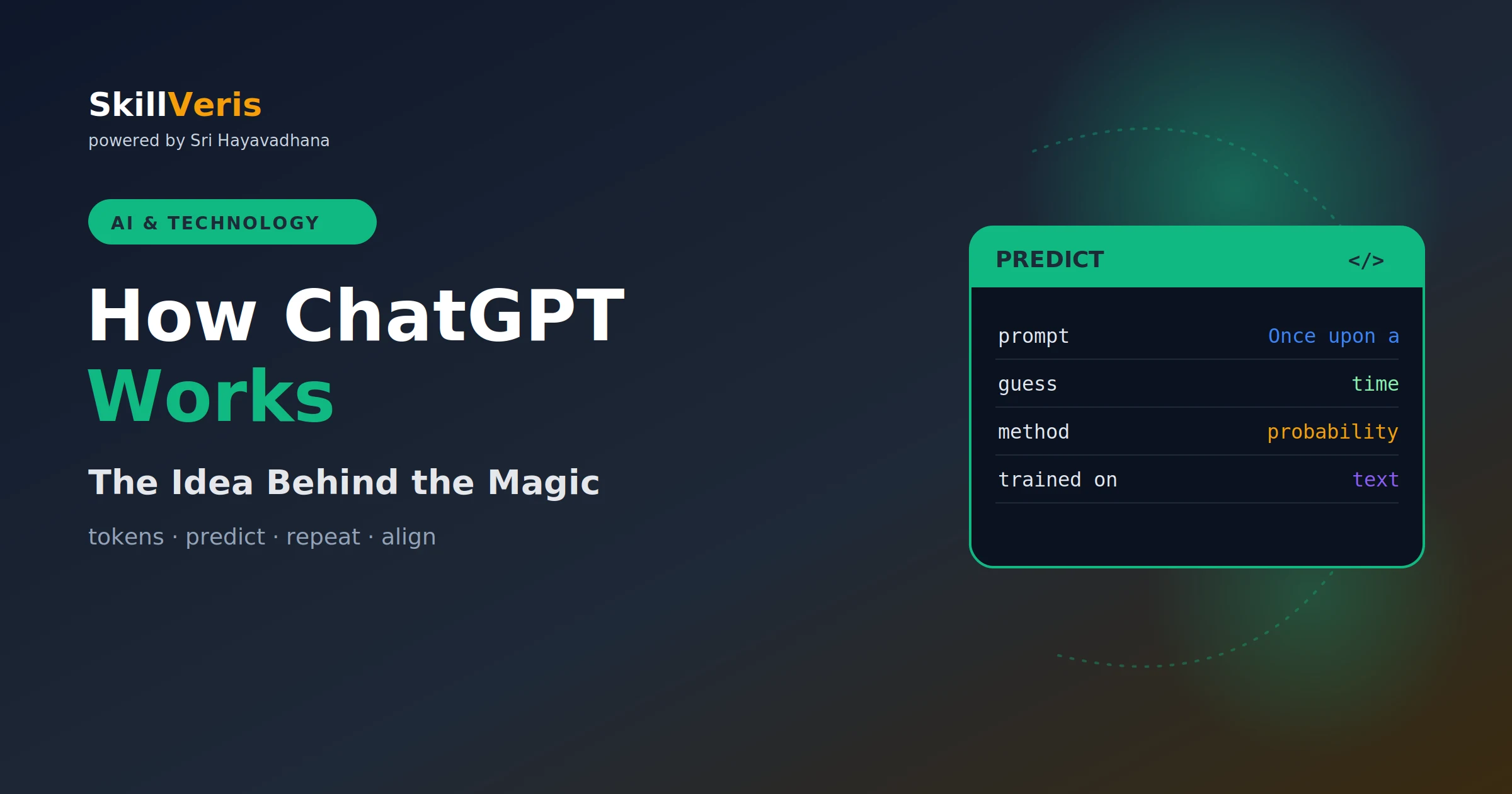
The defining trick is deceptively simple: these models learn to predict what comes next in a sequence. A language model predicts the next token of text; an image model learns to reverse a process of adding noise. Trained on enough examples, this next-step prediction produces outputs coherent enough to feel creative, even though the underlying mechanism is pattern completion at massive scale.
This article explains what generative AI actually is, how the main model types work at an intuitive level, and lays out a concrete free path you can follow to learn it properly rather than just admiring the demos.
2How It Differs From Traditional AI
Traditional machine learning is mostly discriminative: it draws boundaries and answers closed questions such as "is this email spam?" or "what number is in this image?" Generative AI is, as the name says, generative: it models the distribution of the data well enough to sample brand-new examples from it.
That shift changes what the technology is good for. Discriminative models excel at sorting and scoring; generative models excel at drafting, summarizing, translating, designing, and coding. Understanding this distinction early stops you from expecting the wrong thing, because a generative model is a fluent producer of plausible content, not a database of guaranteed facts.
3How Generative Models Work, Intuitively
Most of today's headline models, from chatbots to code assistants, are built on the transformer architecture. A transformer breaks input into small units called tokens and uses a mechanism called attention to weigh how much each token should influence every other token. This lets the model track context across a long passage, which is why it can stay on topic and follow instructions.
Training happens in stages. First the model reads enormous amounts of text or images and learns to predict missing pieces, absorbing grammar, facts, and style along the way. Then it is refined with human feedback so its outputs are more helpful and less harmful. Image generators work a little differently, learning to remove noise from a scrambled image step by step until a clean picture matching your prompt emerges.
- Tokens: the small chunks of text or data the model reads and predicts.
- Attention: the mechanism that lets each token consider the others to capture context.
- Pretraining: learning general patterns by predicting missing pieces of huge datasets.
- Fine-tuning and alignment: refining behavior with curated examples and human feedback.
4The Main Types of Generative Models
It helps to know the landscape so the jargon stops feeling intimidating. Large language models generate and understand text and code. Diffusion models generate images and increasingly video by iteratively denoising. Multimodal models combine several of these, accepting an image and text together and responding in kind.
You do not need to master the internals of each to be productive. Knowing which family a tool belongs to tells you roughly how it behaves, where it is strong, and how to prompt it, which is enough to start building useful things while you deepen your understanding.
5A Free Learning Path, Stage by Stage
You can learn generative AI to a genuinely useful level without spending money, provided you follow a structured path and build as you go. The path below moves from intuition to hands-on capability, and every stage pairs a concept with something small you actually do.
The Five Stages
Work through these in order; each one assumes the last and takes roughly one to three weeks of casual study.
Stage 1, intuition: learn what tokens, models, and training are without maths, and read a few clear explainers.
Stage 2, prompting: get fluent at writing clear prompts, giving examples, and iterating on outputs.
Stage 3, a little Python: learn enough to load data, call functions, and handle text.
Stage 4, APIs and tools: call a model programmatically and build a tiny app such as a summarizer.
Stage 5, going deeper: explore retrieval-augmented generation, fine-tuning, and evaluation.6Prompting Is the First Real Skill
Before you write any code, get good at prompting, because it is the highest-leverage skill and it teaches you how models actually behave. A strong prompt states the role, the task, the constraints, and the desired format, and often includes a worked example. You will quickly learn that vague prompts produce vague output and that showing the model an example is worth paragraphs of instruction.
Practicing prompting also builds your intuition for the model's limits. You will see it confidently state wrong facts, lose track of long instructions, or drift off format, and recognizing these patterns is exactly what makes you a competent, skeptical user later.
💡Learn by iterating
Keep a running document of prompts that worked and why. Comparing a weak prompt with the improved version teaches you more about model behavior than any single tutorial.
7Learn By Building Small Projects
Passive watching creates the illusion of understanding; building creates the real thing. Once you have a little Python, wire a model into a tiny project you care about. Good starter projects include a tool that summarizes articles you paste in, a study-flashcard generator, or a script that rewrites your notes into a quiz.
Each project forces you to confront practical realities the tutorials gloss over: handling errors, controlling output length, and dealing with the occasional nonsense response. These frustrations are the curriculum. Solving them is how abstract knowledge turns into skill you can put on a resume.
8Understand the Limits Before You Rely on It
Learning generative AI responsibly means learning where it breaks. Models hallucinate, producing fluent statements that are simply false, because they optimize for plausible text rather than truth. They can reflect biases present in their training data, and they have knowledge cutoffs, so they may be unaware of recent events unless connected to current sources.
None of this makes the technology useless; it makes verification part of the job. The most valuable practitioners are not those who trust the model most but those who know exactly when to double-check it, which is a skill you build by using it attentively and noticing its failure patterns.
⚠️Fluent is not the same as correct
A confident, well-written answer from a generative model can still be wrong. Always verify facts, figures, and code before relying on them for anything that matters.
9Where This Can Take You
Generative AI skills are increasingly valuable across roles, not just for engineers. Marketers use it for drafts, analysts for exploration, developers for coding assistance, and support teams for knowledge tools. The people who stand out are those who understand the technology well enough to use it judiciously and to explain both its power and its risks.
If you want to go professional, the deeper skills, prompting at scale, retrieval systems, evaluation, and fine-tuning, are all learnable for free with enough persistence. The barrier is rarely money; it is consistency and a willingness to build rather than just read.
10Frequently Asked Questions
What is generative AI in simple terms? It is AI that creates new content like text, images, or code by learning patterns from large amounts of data. Instead of only sorting or scoring inputs, it produces novel outputs that did not exist before.
Can I learn generative AI for free? Yes, SkillVeris offers free courses and study notes covering the foundations, prompting, and hands-on projects, and you can go a long way with only a browser and consistent practice.
Do I need to be good at maths to learn generative AI? No, you can reach a useful, practical level with intuition and coding rather than heavy maths. Deep research roles need maths, but building and using these tools does not.
How long does it take to learn generative AI? A focused beginner can reach comfortable practical use in two to three months of part-time study by following a staged path and building small projects. Depth in areas like fine-tuning takes longer.
What is the difference between generative AI and machine learning? Generative AI is a subset of machine learning focused on producing new content, while machine learning also includes tasks like classification and prediction. All generative AI is machine learning, but not the reverse.
Is generative AI the same as ChatGPT? No, ChatGPT is one product built on a generative language model, and generative AI also includes image, audio, video, and code models from many providers.
11Your Next Step
Generative AI is not magic and it is not out of reach. It is a set of pattern-learning models you can understand at an intuitive level and start using productively within weeks. The winning approach is to follow a structured path, from intuition to prompting to code to real projects, and to build something small at every stage rather than passively consuming content.
You can start today for free. Explore the free generative AI, Python, and prompt-engineering courses and study notes on SkillVeris, pick a tiny project, and let curiosity plus consistency carry you from asking what generative AI is to building things with it.
Related Reading
Get The Print Version
Download a PDF of this article for offline reading.
About the Publisher
SkillVeris Team
AI Research Team
Our AI team covers the latest in machine learning, generative AI, and emerging tech — clearly and accurately.
View all postsRelated Posts
Never miss an update
Get the latest tutorials and guides delivered to your inbox.
No spam. Unsubscribe anytime.