What Is ETL vs ELT in Data Engineering
SkillVeris Team
Data Science Team
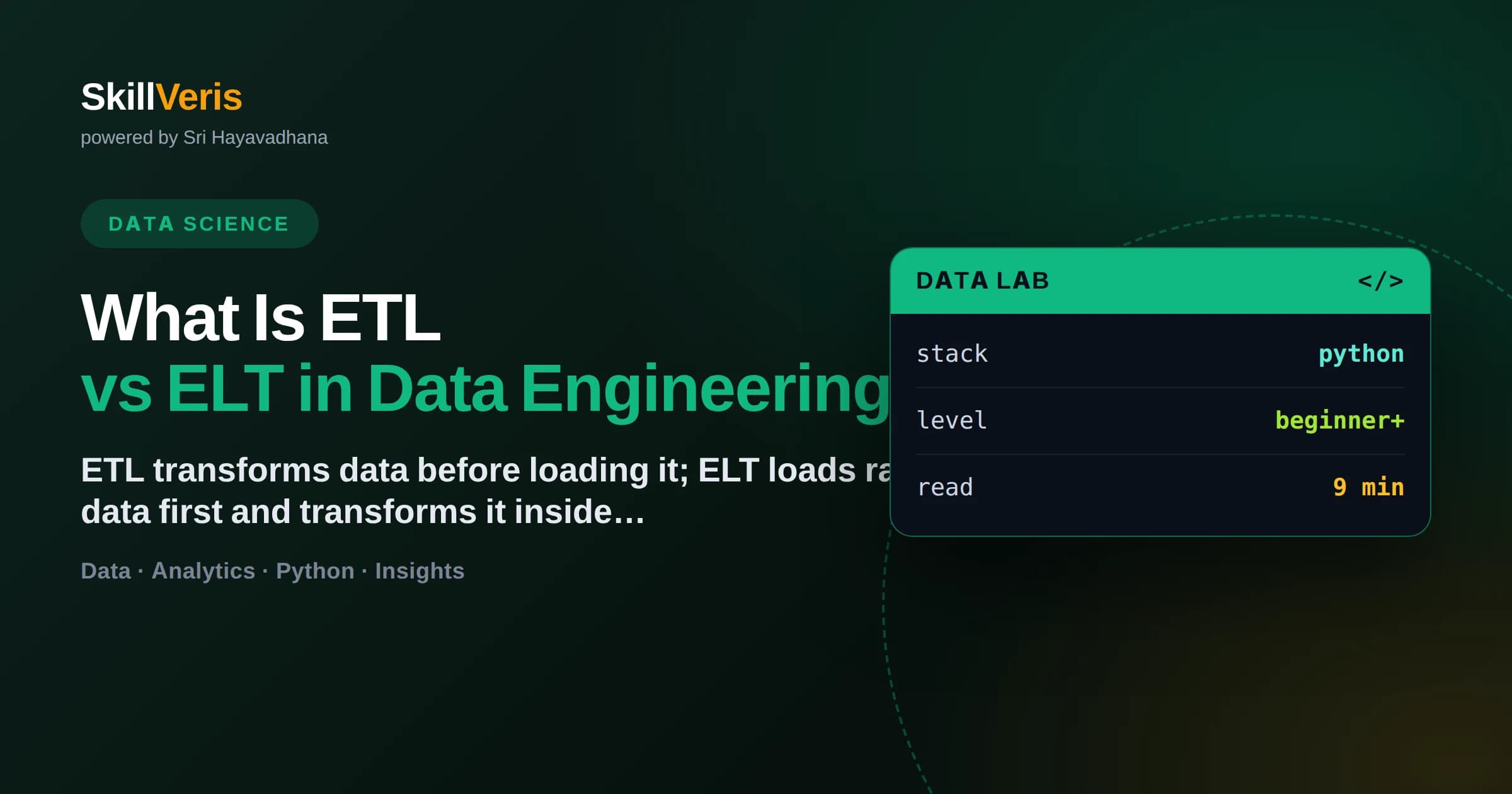
ETL extracts data, transforms it in a separate engine, then loads the clean result; ELT loads raw data first and transforms it inside the warehouse.
In this guide, you'll learn:
- The only difference is the order of the transform step, but that order shapes cost, flexibility, and tooling.
- ELT has become popular because cloud warehouses like Snowflake and BigQuery make in-warehouse transformation cheap and scalable.
- ETL suits strict compliance and heavy pre-load cleansing; ELT suits large volumes and evolving analytics needs.
- Both begin with extraction from sources like databases, APIs, and event streams.
1What Is ETL vs ELT?
ETL and ELT are two approaches to moving data from source systems into a central store for analysis. ETL stands for Extract, Transform, Load: you clean and reshape the data before loading it into the warehouse. ELT stands for Extract, Load, Transform: you load the raw data first, then transform it inside the warehouse.
The only real difference is when the transformation happens. That single change in order, however, has big consequences for cost, flexibility, and which tools you use. ELT has surged in popularity alongside powerful cloud data warehouses.
2The Three Steps Explained
Both patterns share the same three operations; they just reorder the middle one. Understanding each step clarifies why the order matters.
- Extract: pull data from sources like databases, APIs, files, and event streams.
- Transform: clean, join, aggregate, and reshape the data into an analysis-ready form.
- Load: write the data into the destination warehouse or data lake.
- The debate is simply whether transform comes before or after load.
🔑The One-Line Summary
ETL transforms before loading, using a separate processing engine. ELT loads raw data first, then transforms it using the warehouse's own compute.
3How ETL Works
In ETL, data flows through a dedicated transformation engine before it ever reaches the warehouse. The pipeline extracts from sources, applies cleaning and business logic in that engine, and loads only the polished result. Tools like Apache Airflow orchestrate these steps, often paired with a processing framework.
This approach was born when storage and compute were expensive and warehouses were less powerful. By transforming first, teams loaded only the data they needed in exactly the shape they wanted, keeping the warehouse lean. The downside is rigidity: changing a transformation means reprocessing and reloading.
4How ELT Works
In ELT, raw data lands in the warehouse first, and transformations run there using SQL against the warehouse's own compute. This became practical with cloud warehouses like Snowflake, BigQuery, and Redshift, which separate storage from compute and scale each independently.
The Modern Stack
A common ELT stack uses a tool to load raw data and a transformation framework to model it in SQL after loading. Because the raw data is retained, analysts can re-derive new tables anytime without re-extracting from the source.
Extract and load: tools like Fivetran or Airbyte move raw data into the warehouse.
Transform: dbt runs versioned SQL models directly in the warehouse.
Raw data stays available for new questions and re-processing.
The warehouse's elastic compute handles heavy transformations.5Choosing Between ETL and ELT
Neither approach is universally better; the right choice depends on your constraints. Consider volume, compliance, transformation complexity, and the power of your destination.
- Choose ETL when you must cleanse or mask sensitive data before it lands, for compliance.
- Choose ETL when the destination has limited compute or you load into a legacy system.
- Choose ELT when data volumes are large and your cloud warehouse can scale compute cheaply.
- Choose ELT when analytics needs evolve and you want raw data preserved for future questions.
- Many teams run a hybrid: light pre-load cleaning plus in-warehouse modeling.
💡Compliance Drives ETL
If regulations require you to strip or mask personal data before it enters the warehouse, ETL is often the safer pattern because the raw sensitive data never lands there.
6Extraction: The Shared Starting Point
Both ETL and ELT begin with extraction, pulling data out of source systems, so getting this step right matters regardless of which pattern you pick. Sources range from transactional databases and SaaS APIs to flat files and streaming event logs, each with its own quirks around rate limits, schema changes, and freshness.
Extraction usually runs in one of two modes. A full extract copies the entire dataset each run, which is simple but expensive at scale. An incremental extract pulls only new or changed rows since the last run, using timestamps or change-data-capture, which is far more efficient for large, frequently updated sources.
- Full extract: copy everything each run simple but heavy.
- Incremental extract: pull only changed rows since last run efficient at scale.
- Change data capture: stream row-level changes from the source database.
- Handle schema drift so a new source column does not break the pipeline.
7Common Mistakes to Avoid
Teams building either kind of pipeline run into a few recurring pitfalls.
- Assuming ELT is always better it can pile up compute costs on huge, poorly modeled queries.
- Loading sensitive data raw into the warehouse when compliance forbids it.
- Skipping data quality checks; validate at extraction and after transformation.
- Not versioning transformation logic treat SQL models as code with reviews and tests.
- Ignoring idempotency reruns should not create duplicates or corrupt the data.
8Key Takeaways
The essentials of ETL versus ELT come down to these points.
- ETL transforms before loading; ELT loads raw data and transforms in the warehouse.
- The difference is the order of the transform step, but it affects cost and flexibility.
- ELT thrives on cloud warehouses that scale compute independently of storage.
- ETL suits strict compliance and limited-compute destinations.
- Validate data quality and version your transformation logic in both patterns.
9Frequently Asked Questions
Q: What is the main difference between ETL and ELT? A: The difference is when the transformation happens. ETL transforms data in a separate engine before loading it into the warehouse, while ELT loads raw data into the warehouse first and transforms it there using the warehouse's own compute power.
Q: Why has ELT become more popular? A: Cloud data warehouses like Snowflake, BigQuery, and Redshift separate storage from compute and scale each cheaply, making it practical to transform huge volumes of data inside the warehouse. ELT also preserves raw data, so analysts can answer new questions without re-extracting.
Q: When should I still use ETL? A: ETL remains the better choice when you must cleanse or mask sensitive data before it lands for compliance reasons, when your destination has limited compute, or when you load into a legacy system that cannot perform transformations efficiently.
Q: Can I combine ETL and ELT? A: Yes, and many teams do. A hybrid approach applies light cleaning or masking before loading to satisfy compliance, then performs the bulk of modeling inside the warehouse with tools like dbt. This balances control with flexibility and scale.
Related Reading
Get The Print Version
Download a PDF of this article for offline reading.
About the Publisher
SkillVeris Team
Data Science Team
Our data team shares real-world analytics, ML, and SQL insights grounded in industry practice.
View all postsRelated Posts

Never miss an update
Get the latest tutorials and guides delivered to your inbox.
No spam. Unsubscribe anytime.