Data Analytics Roadmap for Beginners in 2026
SkillVeris Team
Data Science Team
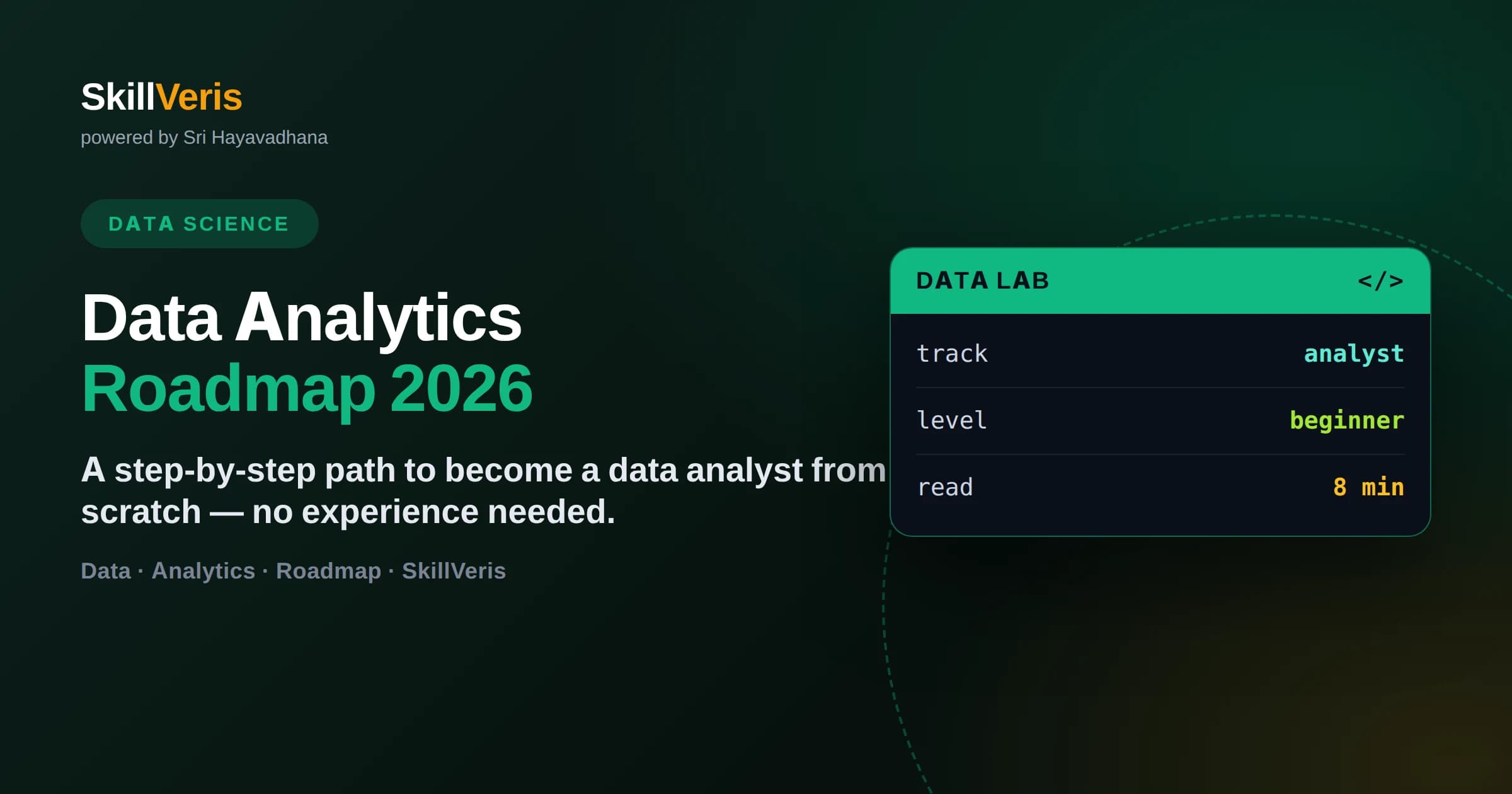
Data analytics is the most in-demand tech skill globally in 2026, per LinkedIn Talent Insights.
In this guide, you'll learn:
- Python and SQL are the two non-negotiable core skills — everything else builds on top of them.
- You can become job-ready as a data analyst in 6–9 months with consistent, structured practice.
- A portfolio of 3–5 real-world projects is more valuable to employers than any single certification.
- Data storytelling — communicating insights clearly to non-technical stakeholders — is what separates good analysts from great ones.
1Why Data Analytics Is the Skill of the Decade
Every company — from a local startup to a global enterprise — is generating more data than ever before, and desperately needs people who can make sense of it. The gap between data generated and data actually analysed and acted upon is enormous. Data analysts are the bridge between raw information and business decisions.
What makes this an especially exciting career moment is the democratisation of tools. Five years ago, serious data work required expensive software and specialist knowledge. Today, Python is free, SQL runs on every major database, and cloud platforms offer incredible power at negligible cost. The barriers to entry have collapsed.
This guide gives you the exact roadmap to go from zero to employable as a data analyst — the skills to learn, the order to learn them, the projects to build, and how to navigate the job market. Let's get into it.
2Phase One: Core Foundations (Months 1–2)
The foundation of data analytics is data manipulation — the ability to take messy, real-world data and organise it into something you can analyse. Two tools underpin this: SQL for database querying and Python with Pandas for in-memory data manipulation.
SQL is not glamorous, but it is essential. 90% of data analyst job descriptions list SQL as a requirement. Start with the basics — SELECT, WHERE, GROUP BY, ORDER BY, JOIN — and work up to window functions and CTEs. Mode Analytics' SQL Tutorial and W3Schools are both excellent free resources.
Once you have SQL foundations, turn to Python. Install Anaconda (which bundles Python with all the key data science libraries) and open Jupyter Notebook. Learn NumPy arrays, then Pandas DataFrames. The moment Pandas starts to feel natural — probably after about four weeks of daily practice — you will understand why data scientists love it.
- Week 1–2: SQL fundamentals — SELECT, WHERE, GROUP BY, JOINs
- Week 3–4: Advanced SQL — Window functions, CTEs, subqueries
- Week 5–6: Python basics — Variables, lists, dictionaries, loops, functions
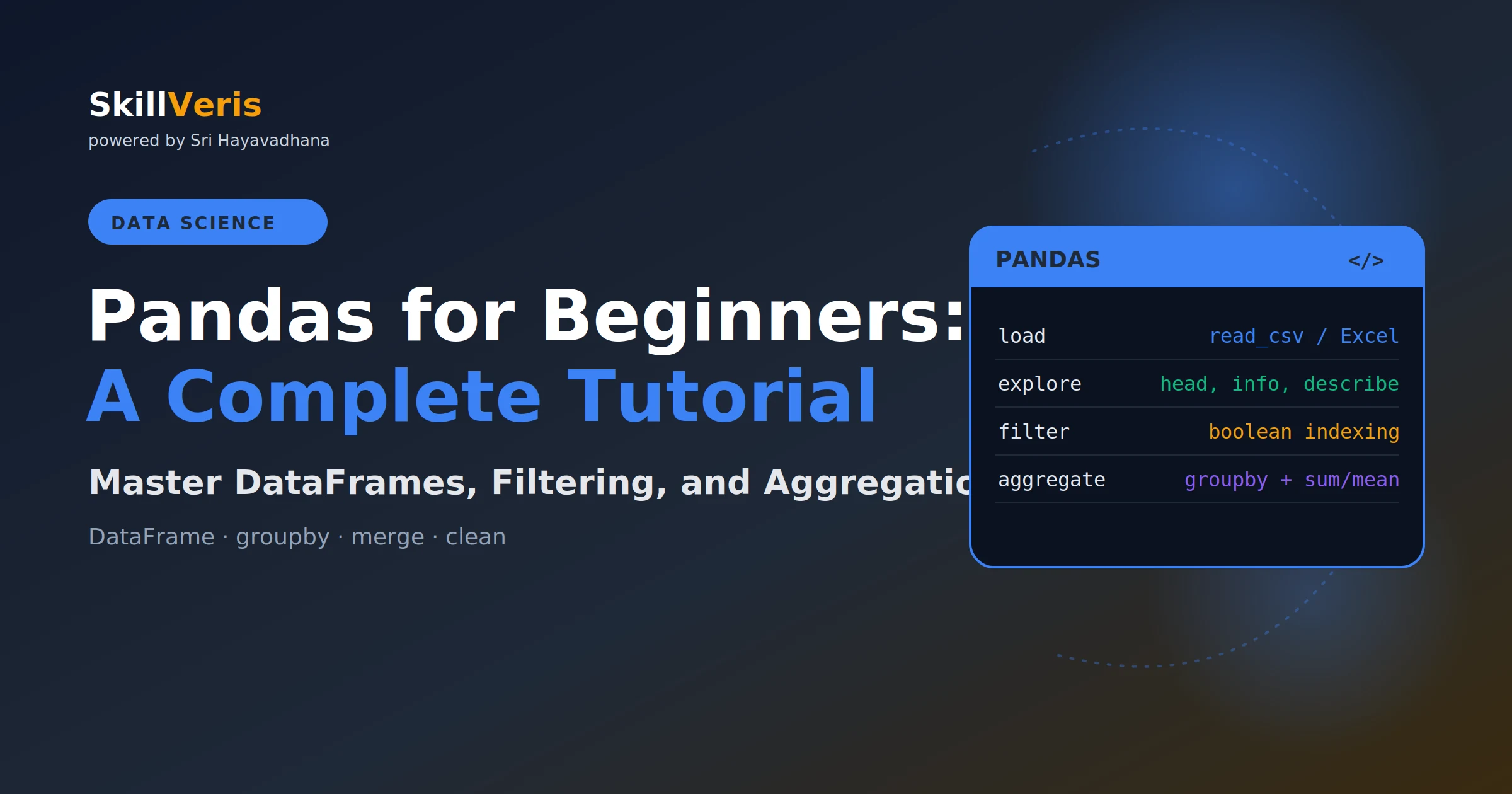
- Week 7–8: Pandas — DataFrames, data cleaning, groupby, merge
3Phase Two: Analysis and Visualisation (Months 3–4)
Data without visualisation is just numbers. Learning to communicate data visually is what transforms an analyst into someone a business actually wants to hire. The tools to learn here are Matplotlib and Seaborn for Python-based charts, and Tableau or Power BI for interactive dashboards.
Tableau Public (free) and Microsoft Power BI Desktop (also free) are the industry-standard BI tools. Learning one of them well will unlock a huge number of job opportunities, particularly in business intelligence roles. Connect them to sample datasets and build dashboards from scratch — the hands-on experience is irreplaceable.
Alongside visualisation, this phase is where you develop analytical intuition. Start with exploratory data analysis (EDA) on datasets from Kaggle. Ask questions of the data. What is surprising? What correlates with what? What would a business decision-maker want to know? This line of thinking is what separates analysts who produce charts from analysts who produce insights.
4Building a Portfolio That Gets You Hired
Certifications are table stakes. What differentiates you in the job market is a portfolio of real, documented projects that show you can solve actual business problems with data.
Aim for 3–5 polished projects on GitHub. Each should have a clear README explaining the business problem, your methodology, your findings, and the business recommendations you would make. Recruiters and hiring managers read these READMEs — make them compelling.
Excellent project ideas: a sales dashboard built from public retail data, a churn analysis for a hypothetical subscription business, a COVID trend analysis by state, an IPL win-probability model, or a real estate price predictor for your city. The best projects combine clean code with clear business storytelling.
💡Portfolio Tip
Choose at least one project in the industry you want to work in. Finance? Build a stock analysis tool. E-commerce? Analyse customer purchase behaviour. Healthcare? Explore patient outcome data. Domain-specific projects signal that you understand the business, not just the tools.
5Navigating the Data Analytics Job Market
The job market for data analysts is large and growing, but also increasingly competitive as more people make the transition into data roles. Standing out requires strategy, not just skills.
Tailor your resume ruthlessly for each application. Mirror the exact language of the job description. If they say "business intelligence analyst" and you write "data analyst", ATS systems may screen you out before a human sees your application. Keyword matching is not cheating — it is understanding how hiring works.
Network actively in the data community. Follow data professionals on LinkedIn and engage genuinely with their content. Join your local data meetup. Contribute to public datasets on Kaggle. Many entry-level data roles are filled through referrals — being visible in the community dramatically improves your odds.
6The Future Is Yours
Data analytics is not a destination — it is a starting point. Many of the most exciting career paths in technology begin with data analytics. From here, you can deepen into data science and machine learning, broaden into data engineering and architecture, or specialise in a domain like financial analytics, healthcare analytics, or product analytics.
The skills you build on this roadmap — statistical thinking, pattern recognition, clear communication, comfort with ambiguity — are transferable to virtually every technical and business role you might pursue. Invest in them seriously, and they will pay dividends for decades.
If you feel overwhelmed by the road ahead, remember: every senior data scientist or ML engineer started exactly where you are now. The roadmap is clear. The tools are free. The community is supportive. All that is required is consistent practice — one day at a time.
Related Reading
Get The Print Version
Download a PDF of this article for offline reading.
About the Publisher
SkillVeris Team
Data Science Team
Our data team shares real-world analytics, ML, and SQL insights grounded in industry practice.
View all postsRelated Posts
Never miss an update
Get the latest tutorials and guides delivered to your inbox.
No spam. Unsubscribe anytime.