What Is Edge AI and Why It Is Growing
SkillVeris Team
AI Research Team
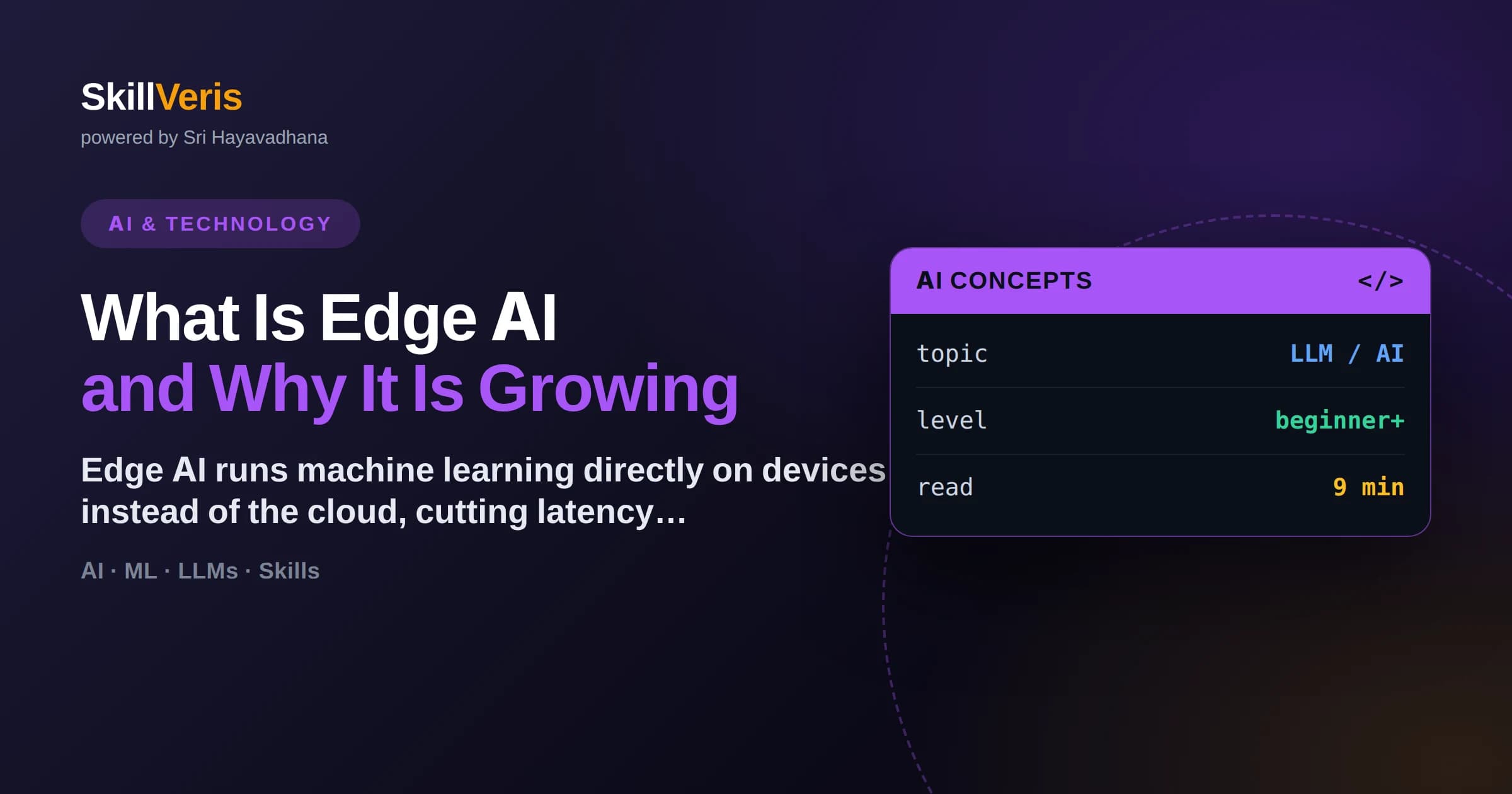
Edge AI runs machine learning models directly on local devices like phones, cameras, and sensors instead of sending data to a remote cloud server.
In this guide, you'll learn:
- Processing data on-device delivers near-instant responses, keeps sensitive data private, and works even without an internet connection.
- It is growing because faster mobile chips, smaller optimized models, and privacy regulation have made on-device inference practical and attractive.
- Techniques like quantization, pruning, and knowledge distillation shrink models enough to fit on constrained hardware without major accuracy loss.
- Common uses include smartphone cameras, wearables, industrial sensors, autonomous vehicles, and smart home devices.
1What Is Edge AI?
Edge AI is the practice of running machine learning models directly on the device where data is generated — a phone, camera, sensor, or vehicle — rather than sending that data to a distant cloud server for processing. The 'edge' refers to the edge of the network, close to the user.
The payoff is immediate. When inference happens locally, responses are near-instant, raw data never has to leave the device, and the system keeps working even with no internet connection. That combination of speed, privacy, and reliability is why edge AI is expanding so quickly.
2Edge AI vs Cloud AI
The distinction comes down to where computation happens, and each approach has clear strengths.
- Location: edge runs on the device; cloud runs in a remote data center.
- Latency: edge responds in milliseconds; cloud adds network round-trip time.
- Privacy: edge keeps data local; cloud transmits data over the network.
- Connectivity: edge works offline; cloud needs a stable connection.
- Compute: cloud offers near-unlimited power; edge is constrained by the device.
🔑It Is Not Either-Or
Many systems are hybrid: lightweight inference happens on the edge for speed, while heavy training and analytics run in the cloud.
3Why Edge AI Is Growing
Several trends have converged to move AI out of the data center and onto devices. None of them alone would be enough, but together they make edge AI compelling.
Hardware Got Powerful
Modern phones and single-board computers ship with dedicated neural accelerators — NPUs and TPUs — that run inference efficiently at low power, something impossible a decade ago.
Models Got Smaller
Optimization techniques and purpose-built small models mean useful accuracy now fits in a few megabytes, small enough to run on a microcontroller in some cases.
Privacy Became a Priority
Regulations and user expectations push companies to process personal data locally. Keeping data on-device sidesteps many privacy and compliance risks.
4How Models Are Made to Fit
Edge devices have limited memory, compute, and battery, so full-size models must be compressed. Three techniques do most of the work.
- Quantization: store weights as 8-bit integers instead of 32-bit floats, shrinking size and speeding math.
- Pruning: remove weights and connections that contribute little to accuracy.
- Knowledge distillation: train a small 'student' model to mimic a large 'teacher' model.
- Efficient architectures: use designs like MobileNet built for constrained hardware.
💡Start With Quantization
Post-training quantization often cuts model size roughly fourfold with minimal accuracy loss and requires no retraining — usually the fastest win for edge deployment.
5Real-World Uses
Edge AI already runs in devices most people touch daily, often without them noticing.
- Smartphones: face unlock, computational photography, and on-device voice typing.
- Wearables: heart-rhythm detection and fall alerts on watches and bands.
- Industrial IoT: sensors that predict machine failure on the factory floor.
- Autonomous vehicles: split-second object detection that cannot wait for the cloud.
- Smart cameras: local motion and person detection that avoids uploading video.
6The Trade-Offs
Edge AI is powerful but not free. Its constraints shape what is realistic to deploy.
The device sets a hard ceiling on model size, memory, and power draw, so you often accept a smaller, slightly less accurate model. Updating models across a fleet of devices is also harder than pushing a single change to a cloud endpoint, and debugging failures in the field can be tricky.
7Best Practices
A few habits keep edge AI projects practical and maintainable as they scale to many devices.
- Profile on real hardware early: emulator performance rarely matches the target device.
- Measure power, not just accuracy: battery drain can make a model unusable in practice.
- Use a runtime built for the edge: TensorFlow Lite, ONNX Runtime, or Core ML.
- Plan for updates: build a secure over-the-air path to ship improved models.
- Consider hybrid: offload heavy or rare tasks to the cloud when connectivity allows.
⚠️Watch Out
A model that runs fine on your laptop can be far too slow or power-hungry on a wearable. Never assume — always benchmark on the actual target hardware.
8Key Takeaways
The core ideas behind edge AI are straightforward once the trade-offs are clear.
- Edge AI runs models on local devices instead of the cloud.
- It delivers low latency, strong privacy, and offline operation.
- Better chips, smaller models, and privacy pressure are driving its growth.
- Quantization, pruning, and distillation shrink models to fit constrained hardware.
- The main limits are device compute, memory, power, and fleet-wide updates.
9Frequently Asked Questions
Q: Is edge AI more secure than cloud AI? A: In one important way, yes: keeping data on the device means sensitive information never travels over the network, reducing exposure. However, physical devices can be lost or tampered with, so edge deployments still need on-device security like encrypted storage and secure boot.
Q: Do I need special hardware for edge AI? A: Not necessarily, but dedicated accelerators such as NPUs, TPUs, or GPUs make on-device inference far faster and more power-efficient. Many everyday tasks run acceptably on standard mobile CPUs once the model is properly optimized with quantization.
Q: What frameworks are used for edge AI? A: Popular runtimes include TensorFlow Lite, ONNX Runtime, PyTorch Mobile, and Apple's Core ML. These are designed to run compressed models efficiently on phones, microcontrollers, and embedded boards, and they handle the hardware acceleration for you.
Q: Can large language models run on the edge? A: Increasingly, yes. Small language models with a few billion parameters, combined with quantization, now run on high-end phones and laptops. They trade some capability for privacy and offline use, and this area is advancing rapidly.
Related Reading
Get The Print Version
Download a PDF of this article for offline reading.
About the Publisher
SkillVeris Team
AI Research Team
Our AI team covers the latest in machine learning, generative AI, and emerging tech — clearly and accurately.
View all postsRelated Posts
Never miss an update
Get the latest tutorials and guides delivered to your inbox.
No spam. Unsubscribe anytime.