What Is Artificial General Intelligence? AGI Explained
SkillVeris Team
AI Research Team
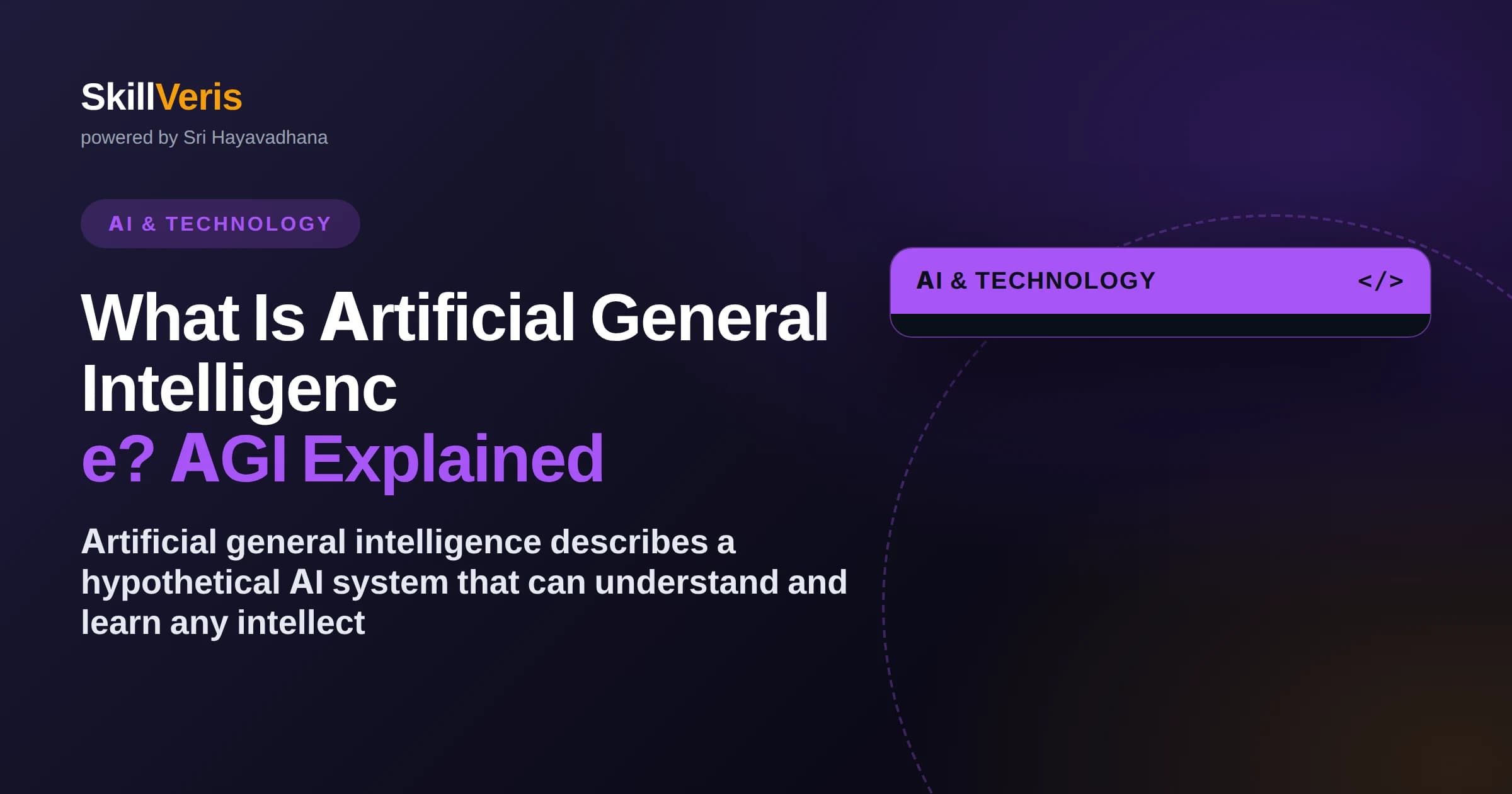
Artificial general intelligence describes a hypothetical AI system capable of understanding, learning, and applying knowledge across any intellectual task a human can perform.
In this guide, you'll learn:
- Today's widely deployed AI systems are narrow AI, excelling at specific tasks like language generation or image recognition without general reasoning across domains.
- AGI would need to transfer learning from one domain to a completely unrelated one, something current systems still struggle to do reliably.
- There is no agreed-upon test or benchmark that the AI research community universally accepts as proof that AGI has been achieved.
- Researchers disagree significantly on how close current AI progress actually brings us to AGI, and estimates vary widely.
1What Is Artificial General Intelligence?
Artificial general intelligence, or AGI, describes a hypothetical AI system that can understand, learn, and apply knowledge across any intellectual task a human can perform, rather than being limited to one narrow specialty.
AGI does not exist today; it remains a research goal and an active subject of debate about what it would actually require and how we would recognize it if it were achieved.
2AGI vs Narrow AI
The AI systems in wide use today, including language models, image recognition tools, and recommendation engines, are all forms of narrow AI, excelling at a specific task without general reasoning across unrelated domains.
A narrow AI system trained to generate text does not automatically know how to diagnose a mechanical problem or plan a research project the way a person could apply general reasoning to an unfamiliar situation.
- Narrow AI: excels at one task or a related family of tasks; the norm today.
- AGI: hypothetically able to learn and reason across essentially any intellectual task, the way a human can.
3What AGI Would Need to Do
A defining feature of general intelligence is the ability to transfer learning from one domain to a completely different, unrelated one without needing to be specifically retrained for it.
Humans do this naturally: someone who learns to play chess can apply related strategic thinking to an entirely different game or problem. Current AI systems still struggle to transfer learning this flexibly across unrelated domains.
4How Would We Know AGI Is Achieved?
There is no single, universally agreed-upon test that the AI research community accepts as definitive proof that AGI has been reached.
Various benchmarks and thought experiments have been proposed over the decades, but each has faced criticism for testing a narrow slice of intelligence rather than genuinely general capability, which is part of why the definition of AGI itself remains contested.
💡
5How Close Are We to AGI?
Researchers disagree substantially on how close current progress in AI actually brings the field to AGI, with estimates and opinions varying widely across the research community.
Some point to rapid recent progress in large language models as evidence of meaningful movement toward general capability, while others argue today's systems, however impressive, still lack the kind of grounded reasoning and transfer learning that true general intelligence would require.
6AGI Safety and Alignment
AGI safety research focuses on ensuring that any sufficiently capable AI system remains aligned with human intentions and stays controllable, rather than assuming capability alone guarantees safe behavior.
This field studies how to specify goals clearly, detect unintended behavior, and maintain meaningful human oversight, treating alignment as a problem to solve alongside capability rather than after the fact.
7Why AGI Concepts Matter to Learn
Studying AGI concepts helps clarify the real boundaries of what today's AI tools can and cannot do, which is genuinely useful even though AGI itself doesn't exist yet.
It also provides useful vocabulary and context for understanding ongoing debates in AI research, policy, and safety, all of which increasingly intersect with practical AI and machine learning work.
8Learning More About AI Concepts
Anyone curious about AGI benefits from first building a solid understanding of how current AI and machine learning systems actually work, since that foundation makes the distinction between narrow AI and hypothetical general intelligence much clearer.
From there, following how researchers debate transfer learning, reasoning, and alignment gives a grounded way to track this fast-moving area of AI and technology.
Related Reading
Get The Print Version
Download a PDF of this article for offline reading.
About the Publisher
SkillVeris Team
AI Research Team
Our AI team covers the latest in machine learning, generative AI, and emerging tech — clearly and accurately.
View all postsRelated Posts
Never miss an update
Get the latest tutorials and guides delivered to your inbox.
No spam. Unsubscribe anytime.