What Is an AI Context Window and Why It Matters
SkillVeris Team
AI Research Team
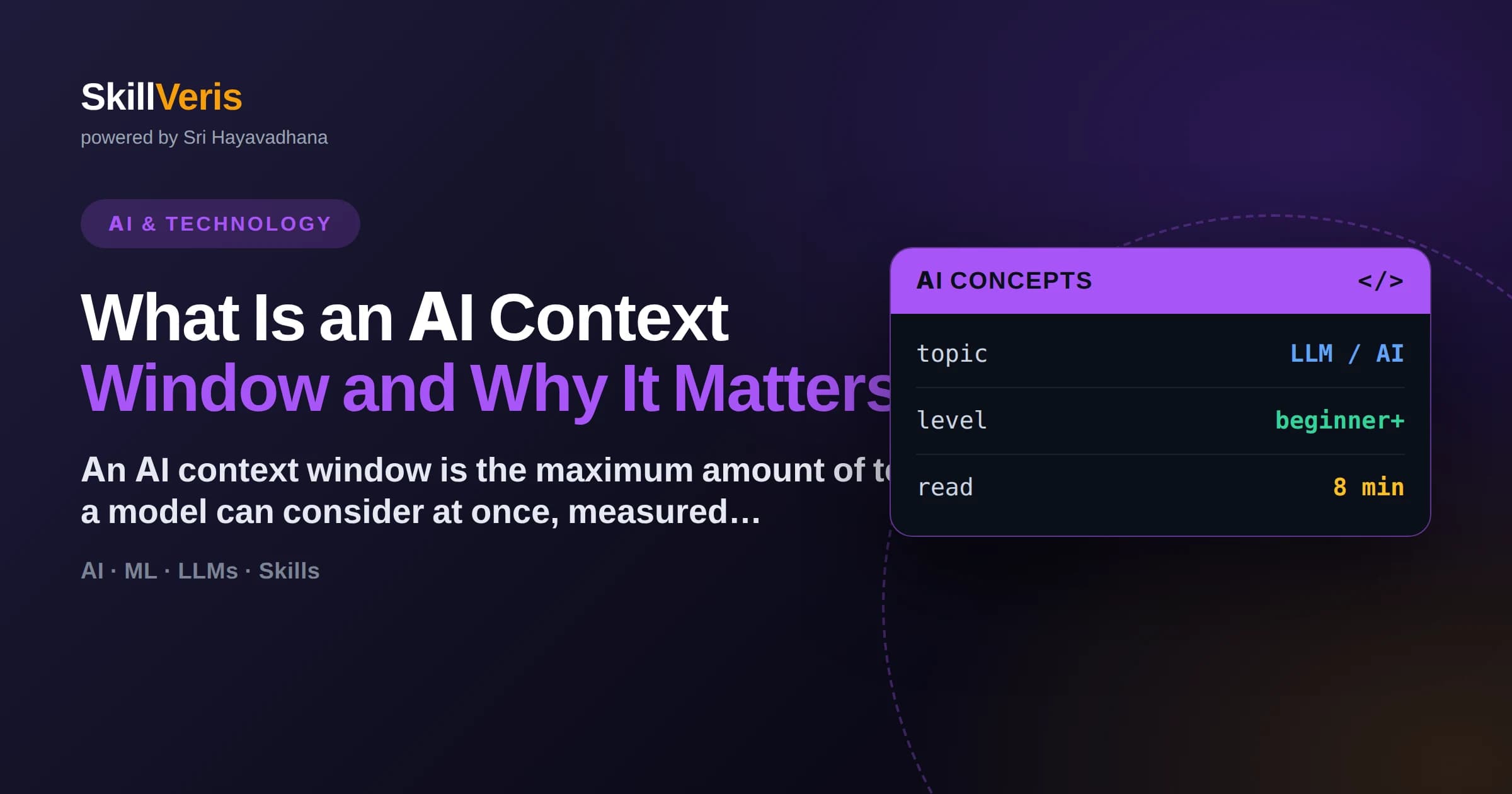
A context window is the maximum amount of text, measured in tokens, that a model can read and generate in a single request.
In this guide, you'll learn:
- It covers everything in the exchange: system prompt, conversation history, retrieved documents, your question, and the model's answer.
- Exceed the window and the oldest content is dropped or the request is rejected, which is why long chats seem to 'forget'.
- Bigger windows enable long documents and richer context but increase cost and latency and can dilute focus.
- Tokens are chunks of text roughly three-quarters of a word in English, so word counts and token counts differ.
1What Is an AI Context Window?
An AI context window is the maximum amount of text a model can consider at one time, measured in tokens. It is the model's working memory for a single request, and everything the model reads and writes in that request has to fit inside it.
Crucially, the window holds the entire exchange, not just your latest question. The system prompt, the conversation so far, any documents you attached, your new message, and the model's response all draw from the same budget. When people say a model has a '128k context window', they mean it can handle roughly that many tokens across all of it.
2Tokens, Not Words
Context windows are measured in tokens, not words or characters. A token is a chunk of text the model processes as a unit; in English it averages about three-quarters of a word, so 'unbelievable' might split into a few tokens while common short words are one each.
That gap matters for planning. A rough rule of thumb is that 1,000 tokens is around 750 English words, so a 128,000-token window fits roughly a short book. Code, numbers, and other languages tokenize differently, so always measure with the model's tokenizer rather than guessing from word counts.
💡Quick Estimate
Multiply your word count by about 1.3 to approximate tokens in English. For anything precise, use the model provider's tokenizer or token-counting endpoint.
3What Happens When It Fills Up
When a request would exceed the context window, something has to give, and the behavior depends on how the application handles it.
- Hard limit: the API rejects the request with an error if the input alone is too long.
- Truncation: chat apps often drop the oldest messages to make room, which is why long chats 'forget' earlier details.
- Squeezed output: if input nearly fills the window, there is little room left for the answer, so responses get cut off.
- Lost-in-the-middle: even within a large window, models can pay less attention to content buried in the middle.
Why Chats Seem to Forget
A chatbot has no true long-term memory between turns; it re-reads the recent conversation each time, up to the window limit. Once the history grows past that limit, the earliest turns get trimmed, so the model genuinely no longer sees them. Persisting important facts elsewhere and reinjecting them is how apps work around this.
4Why the Context Window Matters
The window size shapes what you can build and what it costs. It sets the ceiling on how much a model can reason over at once and influences accuracy, latency, and price.
- Capability: larger windows let you analyze long documents, big codebases, or lengthy conversations in one pass.
- Cost: you typically pay per token, so more context means a bigger bill on every request.
- Latency: processing more tokens takes longer, so huge prompts feel slower.
- Accuracy: overstuffed context can bury the key detail and dilute the model's focus.
- Design: knowing the limit tells you when to summarize, retrieve, or trim instead of pasting everything.
🔑Bigger Is Not Always Better
A larger window is a tool, not a free win. Filling it with marginally relevant text raises cost and can lower answer quality by diluting the signal.
5Managing the Context Window
Good applications treat the context window as a scarce budget and spend it deliberately. Rather than pasting everything and hoping, they curate what the model sees.
- Retrieve, do not dump: use RAG to pull only the most relevant chunks instead of whole documents.
- Summarize history: compress old conversation turns into a short summary to free up room.
- Trim aggressively: remove boilerplate, duplicated text, and irrelevant sections before sending.
- Put key info where it counts: place the most important content near the start or end, not buried in the middle.
- Count before you send: measure token usage so you leave room for the model's response.
Reserve Room for Output
The window is shared between input and output, so if you fill nearly all of it with context, the model has little space left to answer and may truncate its response. Always leave a comfortable margin, sizing your input so the expected answer fits within the remaining budget.
6Common Mistakes to Avoid
Most context-window problems come from treating the window as free space rather than a shared, paid-for budget.
- Pasting entire documents when a few relevant paragraphs would answer the question.
- Forgetting that output shares the window, then wondering why answers get cut off.
- Estimating length in words and being surprised when token counts are higher.
- Assuming a huge window means the model reads everything equally; the middle can get less attention.
- Relying on a chatbot to 'remember' facts across a long session without persisting them yourself.
7Context Windows Keep Growing
Context windows have expanded enormously over the past few years, from a few thousand tokens in early models to hundreds of thousands or more in current ones. That growth has changed what is practical, letting you feed whole documents, long transcripts, or large chunks of a codebase in a single request.
But a bigger window does not remove the need to curate. Larger contexts cost more and can dilute the model's attention, so retrieval and summarization remain valuable even when everything technically fits. Treat a growing window as more headroom to use wisely, not a reason to stop being selective.
💡Use the Room Wisely
A large window lets you include more, but relevant context still beats abundant context. Curate what you send even when it all fits.
8Key Takeaways
Here is what to keep in mind about context windows.
- The context window is the model's working memory, measured in tokens, for one request.
- It holds the whole exchange: prompts, history, documents, question, and answer.
- Exceeding it causes errors, truncated history, or cut-off responses.
- Bigger windows enable more but cost more, add latency, and can dilute focus.
- Manage it with retrieval, summarization, and trimming, and always leave room for the output.
9Frequently Asked Questions
Q: What is the difference between a context window and memory? A: The context window is short-term working memory for a single request, and it resets each time. Persistent memory across sessions is something the application adds by storing information and reinjecting relevant pieces into the window when needed.
Q: How many words fit in a context window? A: Roughly, 1,000 tokens is about 750 English words, so a 128,000-token window fits around 96,000 words. The exact count depends on the language and content, since code and non-English text tokenize differently.
Q: Does a bigger context window always give better answers? A: Not necessarily. A larger window lets you include more, but stuffing it with marginally relevant text raises cost and latency and can bury the key detail, sometimes lowering answer quality. Relevant context beats abundant context.
Q: Why does an AI chatbot forget earlier parts of a conversation? A: Because it only sees what fits in the context window each turn. Once the conversation grows longer than the window, the oldest messages are trimmed away, so the model no longer has access to them unless the app re-supplies them.
Related Reading
Get The Print Version
Download a PDF of this article for offline reading.
About the Publisher
SkillVeris Team
AI Research Team
Our AI team covers the latest in machine learning, generative AI, and emerging tech — clearly and accurately.
View all postsRelated Posts
Never miss an update
Get the latest tutorials and guides delivered to your inbox.
No spam. Unsubscribe anytime.