What Is AGI and How Close Are We?
SkillVeris Team
AI Research Team
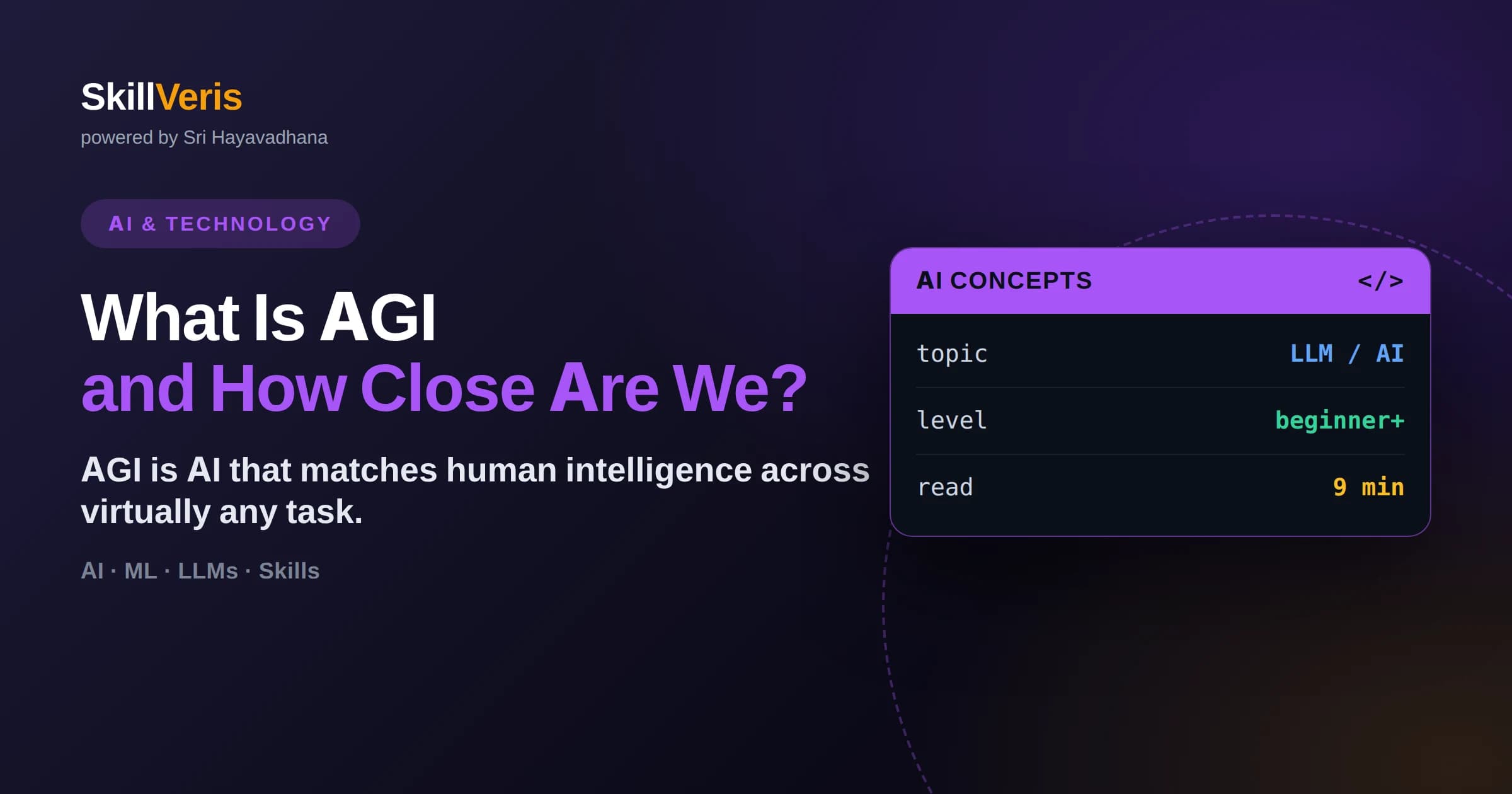
Artificial General Intelligence (AGI) is AI that can understand, learn, and perform virtually any intellectual task a human can, rather than excelling at just one.
In this guide, you'll learn:
- Today's systems are narrow or 'broad' AI: extremely capable within their training but lacking robust general reasoning, memory, and real-world grounding.
- There is no agreed definition or test for AGI, which is a major reason experts disagree so sharply on timelines.
- Recent large language models show surprising general ability, fueling optimism, but they still fail at reliability, planning, and true understanding.
- Predictions range from a few years to many decades or never, reflecting genuine scientific uncertainty rather than a settled answer.
1What Is AGI?
Artificial General Intelligence, or AGI, refers to an AI system that can understand, learn, and perform virtually any intellectual task that a human can. Unlike today's AI, which is trained for specific jobs, an AGI would flexibly transfer its abilities across completely different domains — reasoning about physics one moment and writing a novel the next.
This is the key contrast with the AI we have now. Current systems are extraordinarily capable within their training but brittle outside it. AGI implies human-level general competence: the ability to face a genuinely new problem, figure it out, and adapt without being specifically trained for it.
2Narrow, Broad, and General AI
It helps to place AGI on a spectrum of capability, because the lines between categories are blurry and much of the debate lives in that blur.
- Narrow AI: excels at one task — a chess engine or a spam filter — and nothing else.
- Broad AI: today's large models handle many tasks but lack robust general reasoning.
- General AI (AGI): matches human flexibility across essentially any intellectual task.
- Superintelligence: a hypothetical stage beyond AGI, exceeding humans at everything.
🔑Where We Are
Modern language models sit in an ambiguous 'broad' zone — impressively versatile, yet far from the reliable, adaptable general intelligence AGI describes.
3Why the Definition Is Contested
One reason people disagree about how close AGI is: there is no single agreed definition or accepted test for it. What counts as 'general' or 'human-level' varies by who you ask.
The Testing Problem
The old Turing test — fooling a human in conversation — is widely seen as insufficient today. Newer proposals emphasize solving novel problems, learning efficiently from little data, or performing economically valuable work across many jobs, but none is universally accepted.
Moving Goalposts
Capabilities once considered proof of intelligence, like beating grandmasters at chess or generating fluent essays, are now seen as narrow tricks. As AI improves, our definition of 'real' intelligence keeps shifting.
4The Case for Soon
Optimists point to the startling pace of recent progress. Large language models display abilities their designers did not explicitly program, hinting that scaling may keep unlocking generality.
They note that models now write code, pass difficult professional exams, reason through multi-step problems, and combine skills in flexible ways. If capabilities keep compounding as compute, data, and techniques improve, some researchers argue meaningful AGI could arrive within years rather than decades.
5The Case for Far Off
Skeptics counter that current systems, however impressive, still lack essentials of general intelligence. Fluency is not the same as understanding.
- Reliability: models still hallucinate and fail unpredictably on simple variations.
- Reasoning: long-horizon planning and consistent logic remain weak.
- Grounding: systems lack real understanding of the physical world.
- Learning: humans learn from a few examples; models need vast data.
- Memory: persistent, self-directed learning over time is largely missing.
⚠️Fluency Is Not Understanding
A model that writes a flawless essay can still fail a child's logic puzzle. Surface competence can mask deep gaps in genuine reasoning.
6So How Close Are We?
The honest answer is that nobody knows, and confident predictions in either direction should be treated with caution. Expert forecasts range from a handful of years to many decades or never.
This spread is not a failure of expertise — it reflects genuine scientific uncertainty about whether scaling current approaches leads to AGI or whether fundamental breakthroughs are still required. What is clear is that progress has been faster than many expected, which is precisely why the question feels urgent.
7Why It Matters Now
Regardless of exact timing, taking the possibility seriously has practical value today. Preparation does not require certainty about dates.
- Safety and alignment: ensuring powerful systems reliably do what we intend.
- Economic impact: planning for how advanced AI reshapes work and skills.
- Governance: developing norms and policy before, not after, capabilities arrive.
- Research direction: deciding which approaches to invest in and stress-test.
- Public understanding: cutting through hype so decisions rest on reality.
8Key Takeaways
The AGI question resists simple answers, but a few points anchor the discussion.
- AGI is AI with human-level general ability across virtually any intellectual task.
- Today's systems are broad but not general — versatile yet brittle and unreliable.
- There is no agreed definition or test, which drives much of the disagreement.
- Timeline estimates range from years to decades to never, reflecting real uncertainty.
- Safety, economic, and governance questions matter now regardless of exact timing.
9Frequently Asked Questions
Q: What is the difference between AI and AGI? A: Today's AI is narrow or broad — highly capable within its training but unable to generalize reliably to genuinely new tasks. AGI would match human flexibility across essentially any intellectual domain, adapting to unfamiliar problems without being specifically trained for them.
Q: Are large language models a form of AGI? A: No, though they show surprisingly general abilities that fuel the debate. They still struggle with reliability, long-horizon reasoning, real-world grounding, and learning efficiently from little data — capabilities considered essential for true general intelligence.
Q: When will AGI be achieved? A: Nobody knows. Credible expert estimates range from a few years to many decades or never. This wide spread reflects genuine uncertainty about whether scaling current methods is enough or whether new fundamental breakthroughs are still required.
Q: Why is AGI considered risky? A: A system with human-level or greater general intelligence could act in ways that are hard to predict or control, which is why alignment and safety research focuses on ensuring powerful AI reliably pursues intended goals. These concerns motivate preparation well before AGI actually arrives.
Related Reading
Get The Print Version
Download a PDF of this article for offline reading.
About the Publisher
SkillVeris Team
AI Research Team
Our AI team covers the latest in machine learning, generative AI, and emerging tech — clearly and accurately.
View all postsRelated Posts
Never miss an update
Get the latest tutorials and guides delivered to your inbox.
No spam. Unsubscribe anytime.