What Is a Token and How Pricing Works for LLMs
SkillVeris Team
AI Research Team
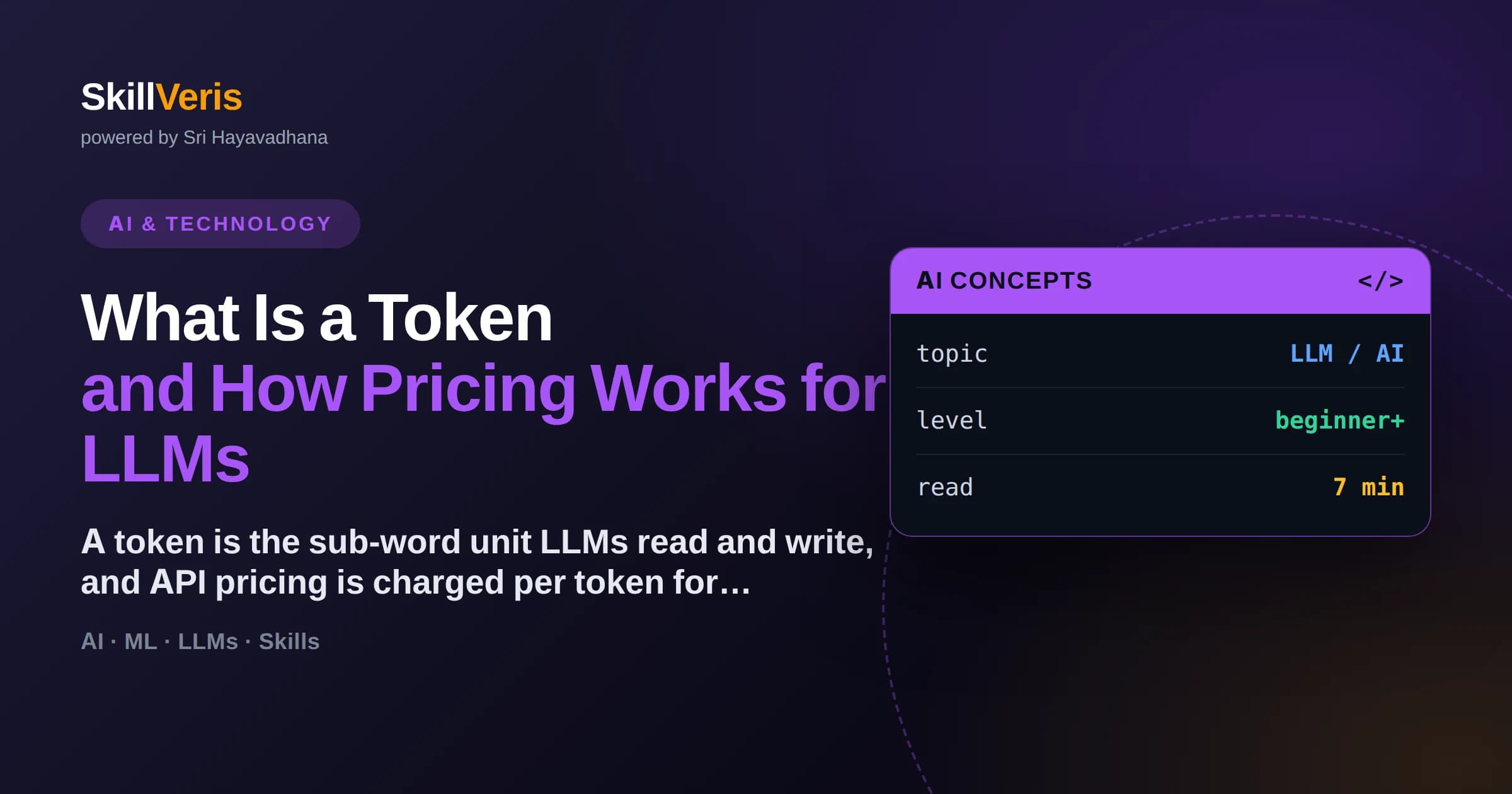
A token is a chunk of text — roughly a word or word-piece — that a language model reads and generates, and LLM APIs charge per token.
In this guide, you'll learn:
- As a rough guide, one token is about four characters of English, so 1,000 tokens is roughly 750 words.
- You pay for both input tokens (your prompt plus context) and output tokens (the model's reply), usually at different rates.
- Output tokens are often priced higher than input tokens because generation is more expensive.
- Long prompts, chat history, and retrieved documents all add input tokens and cost.
1What Is a Token?
A token is the basic unit of text a language model processes — usually a word or a piece of a word rather than a single character. The model's tokenizer splits your text into these units, converts them to numbers, and works entirely in tokens; it never sees raw letters the way you do.
As a practical rule of thumb for English, one token is about four characters or roughly three-quarters of a word, so 1,000 tokens is approximately 750 words. Common words are often a single token, while rare or long words split into several pieces.
2How Tokenization Works
Tokenizers use sub-word schemes that keep frequent words whole and break rare words into parts. This balances vocabulary size against the ability to represent any word, including ones never seen in training.
- 'cat' -> 1 token (common word)
- 'unbelievable' -> 'un' + 'believ' + 'able' -> 3 tokens
- Spaces and punctuation count too — ' the' is often its own token
- Code, emoji, and non-English text can use more tokens per character
🔑Key Point
Token count is not the same as word count. Numbers, code, and non-English scripts often use more tokens per character than plain English prose.
3How LLM Pricing Works
LLM APIs bill per token, and almost all separate input from output. Input tokens are everything you send — your prompt, system instructions, chat history, and any retrieved context. Output tokens are what the model generates in reply.
- Total cost = (input tokens x input rate) + (output tokens x output rate)
- Rates are typically quoted per million tokens.
- Output usually costs more per token than input, since generation is heavier.
- Larger, more capable models cost more per token than smaller ones.
Why Output Costs More
Generating each output token requires a full forward pass through the model, whereas input tokens are processed together more efficiently. That asymmetry is why long, chatty responses can dominate a bill.
4Estimating Your Costs
You can estimate costs before running anything by approximating token counts and multiplying by the published rates. Count the words in a typical prompt and expected reply, divide by 0.75 to get tokens, and multiply out.
- Estimate tokens: words divided by 0.75, or characters divided by 4.
- Multiply input tokens by the input rate and output tokens by the output rate.
- Multiply by the number of calls per day to project a monthly bill.
- Use provider tokenizer tools for exact counts on real prompts.
💡Measure, Don't Guess
Most providers offer a tokenizer or a usage field in the API response. Log actual token counts in production rather than relying only on estimates.
5What Drives Token Cost Up
Several common patterns quietly inflate token usage, especially in chat and retrieval applications where context accumulates.
- Long system prompts sent on every single request.
- Full conversation history resent each turn instead of being summarised.
- Large retrieved documents stuffed into the prompt for RAG.
- Verbose model responses when a short answer would do.
- Choosing a top-tier model for a task a smaller one handles fine.
6Common Mistakes to Avoid
Token pricing surprises usually trace back to a few oversights.
- Assuming tokens equal words and underestimating the bill by a third.
- Forgetting that input includes the entire chat history you resend each turn.
- Ignoring output pricing, which is often the higher rate.
- Using a large model everywhere when a cheaper one suffices for most calls.
- Not logging real token usage, so cost problems go unnoticed until billing.
⚠️Watch Out
In long chats, resending the full history every turn means token cost grows with conversation length. Summarise or trim old turns to keep it in check.
7Tokens and Context Windows
Tokens also define a model's context window — the maximum number of tokens it can consider at once, spanning both your input and its output. If a conversation plus its reply exceeds that limit, the model cannot fit it all and older content must be trimmed or summarised.
This ties directly to cost and design: a bigger context window lets you send more context but tempts you into sending more tokens than you need. Treat the window as a budget to spend deliberately, keeping only the context that actually improves the answer rather than filling it because you can.
8Key Takeaways
Understanding tokens is the foundation of controlling LLM cost.
- A token is a word-piece; roughly four characters or 0.75 words in English.
- APIs charge per token for both input and output, usually at different rates.
- Output tokens typically cost more than input tokens.
- Long prompts, chat history, and retrieved context all add to input cost.
- Estimate tokens up front and log real usage to predict and control bills.
9Frequently Asked Questions
Q: How many words are in a token? A: On average about 0.75 words in English, or roughly four characters, so 1,000 tokens is around 750 words. The exact ratio varies with the text — code and non-English scripts often use more tokens per character.
Q: Do I pay for both my prompt and the model's answer? A: Yes. Input tokens cover your prompt, system instructions, and any context you send, while output tokens cover the generated reply. Both are billed, usually at separate rates.
Q: Why is output more expensive than input? A: Each output token requires a full pass through the model to generate, while input tokens are processed more efficiently in bulk. That extra compute per generated token is reflected in the higher output price.
Q: How can I estimate cost before running a prompt? A: Approximate token counts by dividing characters by four or words by 0.75, then multiply by the input and output rates and your expected call volume. Provider tokenizer tools give exact counts for precise estimates.
Related Reading
Get The Print Version
Download a PDF of this article for offline reading.
About the Publisher
SkillVeris Team
AI Research Team
Our AI team covers the latest in machine learning, generative AI, and emerging tech — clearly and accurately.
View all postsRelated Posts
Never miss an update
Get the latest tutorials and guides delivered to your inbox.
No spam. Unsubscribe anytime.