What Is a Large Language Model? A Beginner's Guide
SkillVeris Team
AI Research Team
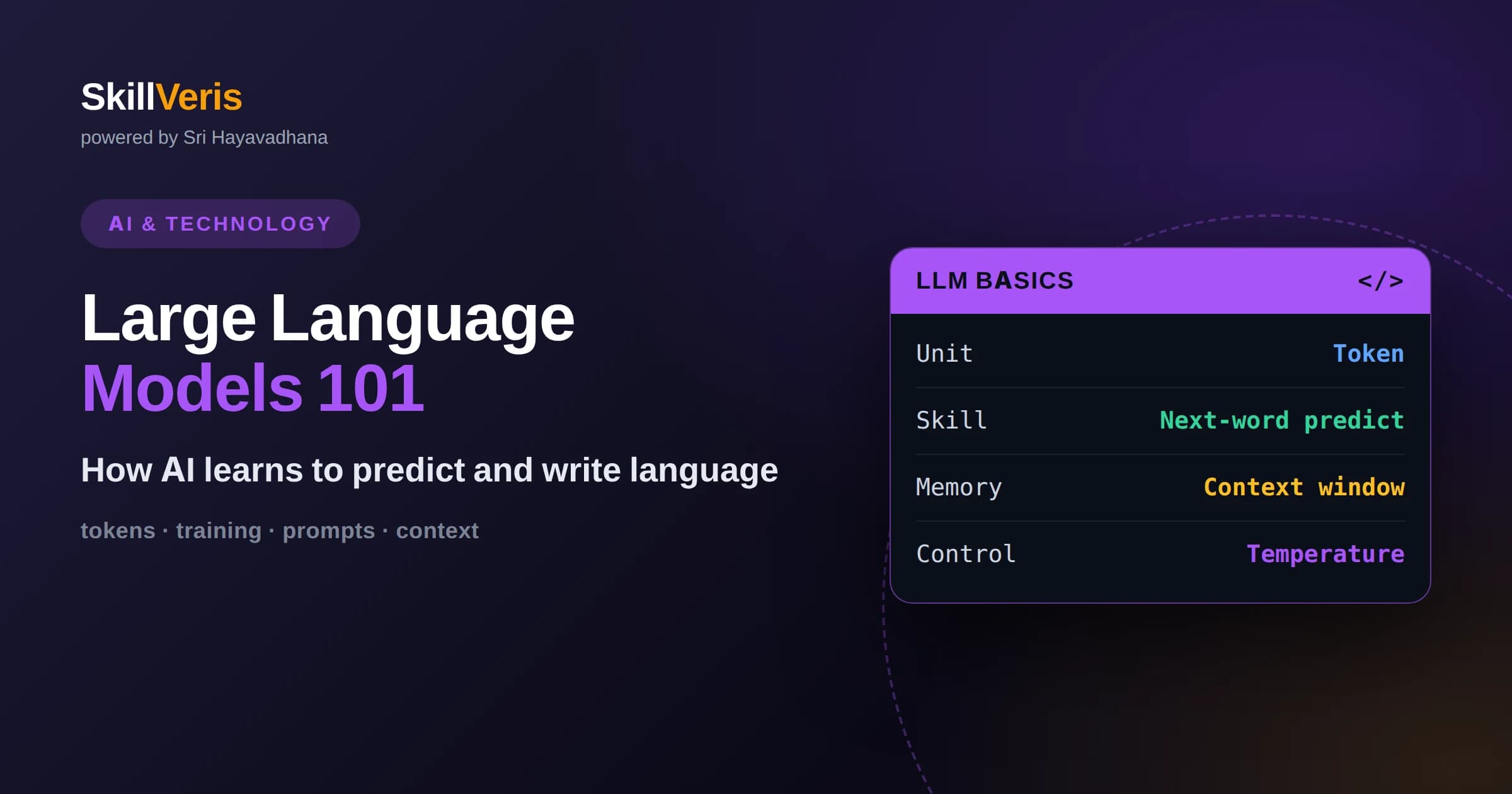
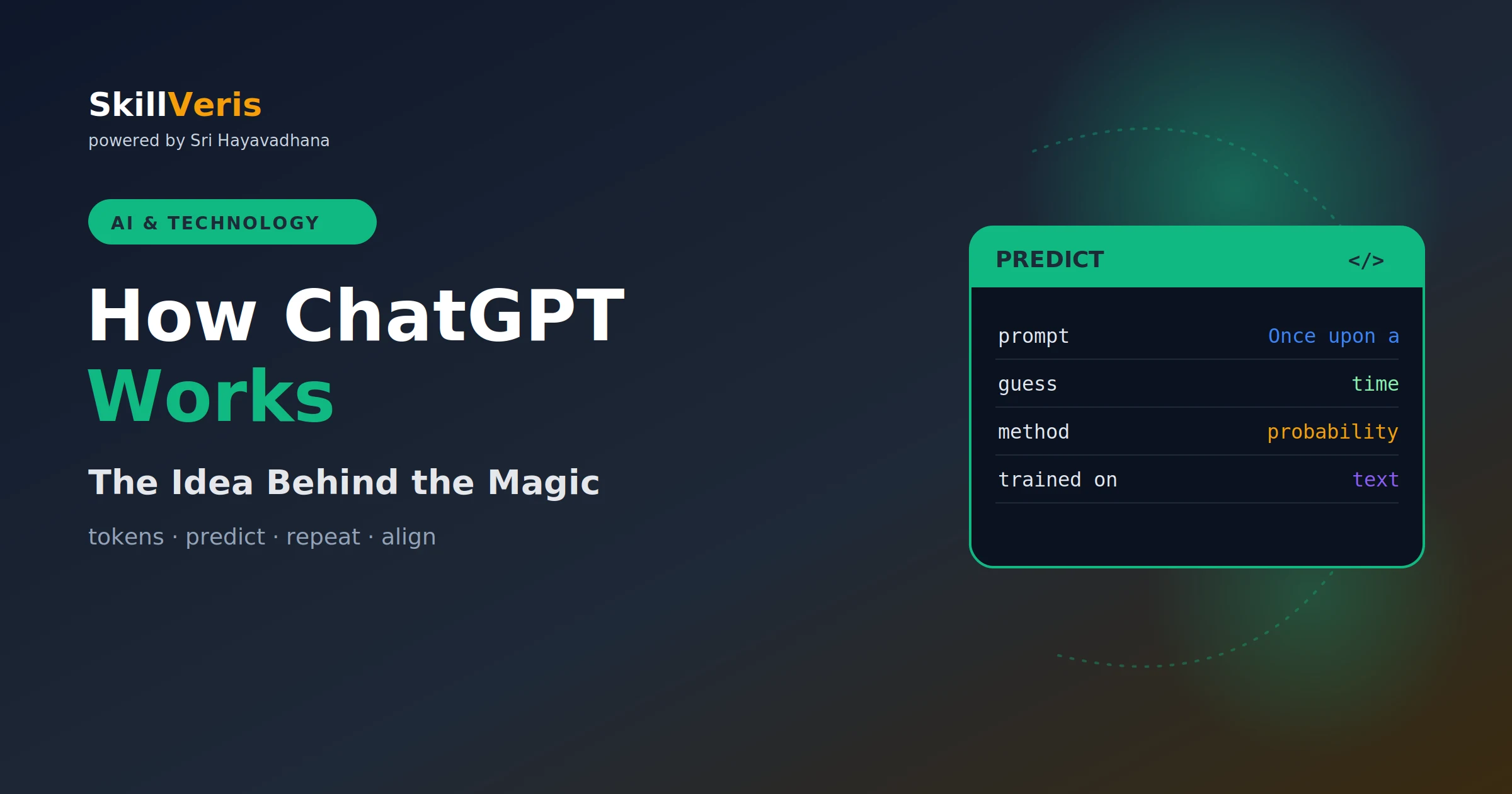
A large language model is a neural network trained to predict the next token in a sequence, which is enough to produce fluent, useful language.
In this guide, you'll learn:
- LLMs learn patterns from vast text collections rather than memorizing facts, so they generalize but can also make confident mistakes.
- Prompting, context windows, and temperature are the practical controls that shape what an LLM produces for you.
- Understanding tokens, training, and limitations helps you use LLMs effectively instead of treating them as magic.
1What Is a Large Language Model?
A large language model, or LLM, is an artificial intelligence system trained on enormous amounts of text so that it can predict the most likely next piece of language given everything it has seen so far. That single ability, predicting what comes next, turns out to be powerful enough to write essays, answer questions, translate languages, summarize documents, and generate working code. When you type a prompt and the model replies, it is repeatedly guessing the next word, then the next, until it has produced a complete response.
The word large is doing a lot of work in the name. These models contain billions of internal numbers, called parameters, that are adjusted during training. They are also large in the sense that they learn from very large text collections drawn from books, websites, documentation, and other written material. The combination of a big model and a big training set is what gives modern LLMs their broad, flexible competence across topics they were never explicitly programmed to handle.
It helps to separate what an LLM is from what it feels like. It feels like you are talking to something that understands you. Under the hood, it is a mathematical function that maps input text to a probability distribution over possible next tokens. There is no database of answers being looked up. Instead, knowledge is compressed into the model's parameters as statistical patterns, and those patterns are reconstructed on the fly every time you ask a question.
2Why Large Language Models Matter Now
LLMs matter because they lowered the barrier to building software that works with human language. Tasks that once required specialized machine learning teams, such as sentiment analysis, summarization, or question answering, can now be prototyped in an afternoon by describing what you want in plain English. This shift moved natural language from a hard research problem to an everyday building block for products.
They also generalize in ways earlier systems could not. A single model can draft an email, explain a legal clause, and refactor a function without being retrained for each task. That flexibility is why LLMs now sit behind chat assistants, coding tools, search features, and customer support systems. For a developer learning the field, understanding LLMs is quickly becoming as fundamental as understanding databases or web requests.
3How LLMs Learn From Text
Training an LLM starts with a simple game played billions of times. The model is shown a stretch of text with the next word hidden, it guesses that word, and its internal parameters are nudged based on how wrong the guess was. Repeat this across a massive amount of text and the model gradually captures grammar, facts, reasoning patterns, and stylistic conventions, all as a side effect of getting better at prediction.
This first stage is called pretraining, and it produces a model that is fluent but not necessarily helpful or safe. A second stage, often called instruction tuning or alignment, teaches the model to follow directions, stay on topic, and refuse harmful requests. Techniques here include supervised fine-tuning on curated examples and learning from human feedback, where people rank responses so the model prefers the better ones.
The result is a model with two kinds of memory. Its long-term memory lives in the fixed parameters set during training and does not change as you chat. Its short-term memory is the prompt and conversation you provide right now, which the model reads fresh each time. Knowing this distinction explains why an LLM can discuss what you told it a moment ago but has no memory of a conversation from yesterday unless that history is supplied again.
4Tokens: The Units LLMs Actually See
LLMs do not read whole words the way people do. They break text into tokens, which are chunks that can be whole words, parts of words, or even single characters and punctuation marks. A common word might be one token, while an unusual word could split into several. This is why model documentation talks about token limits rather than word or character limits.
Tokens matter for practical reasons. The amount of text a model can consider at once, called the context window, is measured in tokens, and most pricing for hosted models is calculated per token. Learning to think in tokens helps you estimate how much text you can fit into a prompt and why very long documents sometimes need to be split before an LLM can process them.
5The Context Window and Working Memory
The context window is the maximum amount of text an LLM can hold in its attention at one time, including both your input and its own reply. Everything the model knows about the immediate task must fit inside that window. When a conversation grows longer than the window allows, the earliest parts are dropped, which is why a long chat can seem to forget how it began.
Understanding the context window changes how you work with LLMs. Instead of assuming the model remembers everything, you learn to supply the relevant details it needs right now. This is also the foundation for more advanced patterns where external documents are fetched and inserted into the window so the model can reason over information it was never trained on.
6Prompting: Talking to the Model Effectively
A prompt is simply the text you give the model, and the quality of your prompt strongly shapes the quality of the response. Clear, specific instructions produce better results than vague ones. Telling the model who it should act as, what format you want, and what constraints to respect gives it the guidance it needs to be genuinely useful.
A powerful technique is showing examples. If you include a couple of sample inputs paired with the outputs you expect, the model infers the pattern and applies it to new inputs. This is often called few-shot prompting, and it lets you steer behavior without any retraining. Iterating on prompts, testing small changes and observing the effect, is one of the fastest ways to get comfortable with LLMs.
7Temperature and Other Generation Controls
Because an LLM produces a probability distribution over next tokens, it needs a rule for choosing among them. Temperature is the control that governs this choice. A low temperature makes the model pick the most likely tokens, producing focused and repeatable answers. A higher temperature allows more variety and creativity but also more risk of drifting off track.
Other settings adjust the same trade-off in different ways, such as limiting the pool of candidate tokens the model may sample from. For factual tasks like extracting data or writing code, lower randomness is usually safer. For brainstorming or creative writing, a bit more randomness can help. Knowing these knobs exist means you can tune output to fit the job rather than accepting whatever default a tool provides.
8What LLMs Cannot Do Well
LLMs are prediction machines, not truth machines, and that leads to their most famous weakness: they can produce confident, fluent statements that are simply wrong. This is often called hallucination. Because the model generates plausible-sounding text rather than checking a source, it may invent citations, functions, or facts that do not exist. Always verify important outputs.
They also struggle with tasks that require precise, multi-step calculation or up-to-date knowledge beyond their training. A model has no inherent awareness of today's date, recent events, or private data unless you supply that information. And because training freezes the model's knowledge at a point in time, anything newer must be provided through the prompt or an external tool.
Finally, LLMs reflect the text they learned from, including its biases and gaps. They do not have goals, understanding, or awareness in any human sense. Treating an LLM as a capable but fallible assistant, rather than an oracle, leads to far better results and fewer unpleasant surprises.
9Common Ways Developers Use LLMs
Developers use LLMs for a growing list of everyday tasks. Summarizing long documents into short briefs, drafting and editing text, translating between languages, and classifying content are all reliable applications. On the coding side, LLMs generate boilerplate, explain unfamiliar code, suggest fixes, and help write tests, which speeds up routine work considerably.
Beyond one-off tasks, LLMs increasingly power interactive systems. Chat assistants answer user questions, retrieval systems pull in relevant documents so the model can cite real sources, and agent-style setups let a model call tools to take actions. Starting with simple, well-defined tasks is the best way to build intuition before moving to these more elaborate patterns.
10Open Models Versus Hosted APIs
When you start building with LLMs, you will choose between calling a hosted model through an API and running an open model yourself. Hosted APIs are the fastest way to begin. You send text, you get text back, and the provider handles the heavy infrastructure. This is ideal for learning and for many production uses.
Open models that you download and run give you more control over privacy, cost at scale, and customization, but they require hardware and operational effort. Many teams mix both approaches. As a beginner, leaning on a hosted API removes friction so you can focus on prompting and application logic before worrying about deployment.
11A Simple Mental Model to Keep
The most useful mental model is this: an LLM is an extremely well-read assistant that has read almost everything but remembers none of it precisely, thinks only in the moment you are talking to it, and always tries to give you a plausible answer even when it is unsure. Hold that picture and most of its behavior stops being mysterious.
With that model in mind, your job becomes giving the assistant clear instructions, the right context, and a way to verify anything critical. The technology will keep improving, but these fundamentals of prompting, context, and healthy skepticism will remain the core skills for working with language models.
12How LLMs Keep Getting Better
Progress in LLMs comes from several directions at once. Larger models with more parameters, trained on more and cleaner data, tend to perform better across the board. But raw size is only part of the story. Better training techniques, higher-quality data, and smarter alignment methods have produced smaller models that punch well above their weight, which matters because smaller models are cheaper and faster to run.
Another major axis of improvement is connecting models to tools and external knowledge. A model that can search, run code, or consult a database overcomes many of its built-in limitations, since it no longer has to know everything from memory. This is why so much recent progress is less about the raw model and more about the system built around it.
For a learner, the practical implication is reassuring. You do not need the very largest model to do useful work, and the fundamentals you learn now, such as prompting and providing good context, carry forward as models evolve. Skills transfer even as specific models come and go.
13Getting Started Safely and Effectively
As you begin working with LLMs, a few habits pay off immediately. Be specific in your prompts, provide the context the model needs rather than assuming it remembers, and verify anything that matters before acting on it. These simple practices prevent most of the frustration beginners experience.
Be mindful, too, about what information you share with hosted tools, especially anything sensitive or private. Treat generated output as a draft to review rather than a final answer, particularly for factual, legal, or financial matters. Building these instincts early makes you both a more effective and a more responsible user of the technology.
14Start Practicing With LLMs
The fastest way to understand large language models is to use one deliberately and watch what happens. Try summarizing an article, then ask for the same summary in a different tone, then add an example and see how the output changes. Each experiment teaches you something no explanation can, because you feel the model's strengths and limits directly.
On SkillVeris you can move from these first experiments to structured, hands-on lessons that build real intuition step by step. Work through guided exercises on prompting, tokens, and context, then apply them to a small project of your own. Learning by building is what turns an abstract idea of an LLM into a tool you can use with confidence.
Related Reading
Get The Print Version
Download a PDF of this article for offline reading.
About the Publisher
SkillVeris Team
AI Research Team
Our AI team covers the latest in machine learning, generative AI, and emerging tech — clearly and accurately.
View all postsRelated Posts
Never miss an update
Get the latest tutorials and guides delivered to your inbox.
No spam. Unsubscribe anytime.