What Are AI Parameters? Model Size Explained
SkillVeris Team
AI Research Team
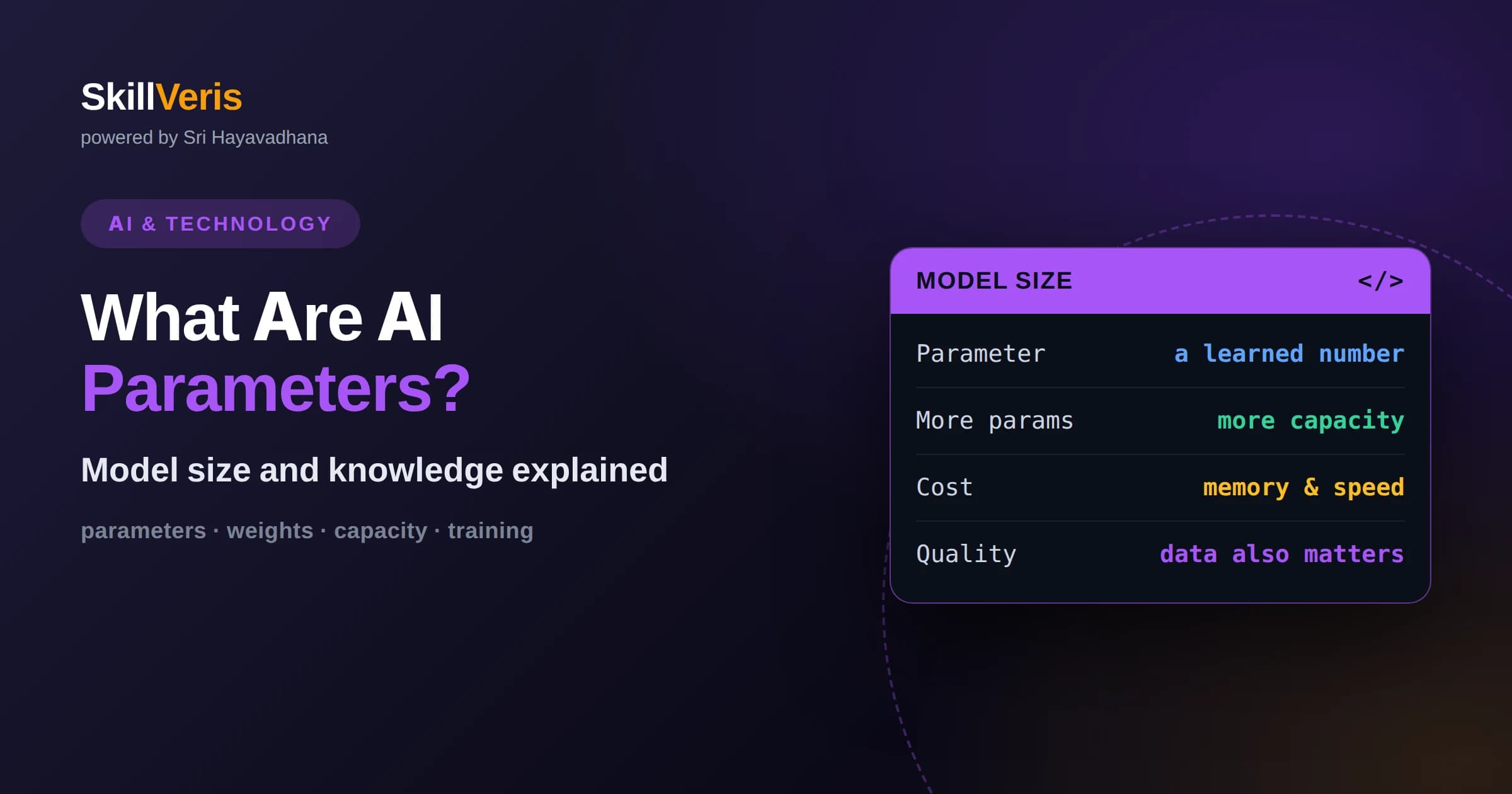
Parameters are the adjustable numeric values a model learns during training, and together they store everything the model knows.
In this guide, you'll learn:
- Model size, measured in parameter count, roughly tracks capacity but is far from the only thing that determines quality.
- More parameters generally mean more capability but also more memory, cost, and slower responses.
- Training data quality, architecture, and methods can matter as much as raw parameter count.
1What Are AI Parameters?
Parameters are the internal numeric values that an AI model adjusts during training, and together they hold everything the model has learned. When you hear that a model has billions of parameters, that number counts these individual learned values, each a tiny piece of the model's knowledge and behavior.
Concretely, a parameter is just a number. A model is a large mathematical function, and the parameters are the many coefficients inside that function that get tuned so the function produces useful outputs. Before training they start as essentially random numbers; after training they encode patterns learned from data.
So when people talk about a model's size, they usually mean its parameter count. It is the headline number because it roughly indicates how much capacity the model has to store patterns, though as we will see it is far from the whole story.
An analogy helps: imagine an enormous mixing board with billions of tiny sliders. Each slider is a parameter, and training is the long process of setting every slider so that the whole board, taken together, transforms inputs into useful outputs.
2How Parameters Are Learned
Training is the process of finding good values for all the parameters. The model makes a prediction, its error is measured against the correct answer, and the parameters are nudged slightly in the direction that would reduce that error. Repeated across enormous amounts of data, these small adjustments gradually shape the parameters into something useful.
No human sets these values by hand; there are far too many. Instead an optimization procedure does it automatically, guided only by the goal of making better predictions. This is why we say the model learns rather than being programmed with explicit rules.
The end result is that the model's knowledge is distributed across all its parameters at once. There is no single parameter for a particular fact; understanding emerges from the pattern of all of them together, which is part of why these models are hard to interpret.
This distributed, learned nature is also why these models can surprise us. Nobody wrote a rule for each behavior, so capabilities emerge from the training process itself, which is both the source of their flexibility and the reason they can be unpredictable.
3Weights, Biases, And What They Do
Most parameters are what are called weights, which control how strongly one part of the model influences another. A weight decides how much a given input contributes to a given output, and by tuning millions or billions of these, the model learns which patterns matter.
A smaller share of parameters are biases, which shift outputs up or down to give the model extra flexibility. Together, weights and biases let the model represent complex relationships between inputs and outputs.
You do not need to track which is which to understand model size. The important idea is that these numbers, taken together, are the dials the model turns to transform an input into a sensible output.
4Size And Capacity
Parameter count is a rough measure of capacity, meaning how much a model can potentially learn and store. More parameters give the model more room to capture subtle patterns, more facts, and more nuanced behavior, which is why larger models often feel more capable.
The relationship is real but not simple. Doubling the parameters does not double the capability, and beyond a point extra parameters bring smaller and smaller gains. Capacity is a ceiling on what a model could learn, not a guarantee of what it did learn.
It also helps to remember that capacity is only useful if it is filled with good learning. A large model trained poorly can underperform a smaller model trained well, which is why parameter count alone never tells the full story.
Think of capacity like the size of a container. A bigger container can hold more, but whether it actually holds anything useful depends on what you pour in, which is why training data and method matter as much as the container's size.
5The Costs Of More Parameters
Every parameter must be stored in memory and involved in computation, so more parameters mean higher memory requirements and more work for each response. This is why large models need powerful hardware and why they are more expensive to run.
Size also affects speed. A model with more parameters generally takes longer to produce each output, which matters for interactive applications where users expect quick replies. Bigger is not free; you pay for it on every single request.
These costs are why parameter count is an engineering concern, not just a bragging number. Choosing a size means balancing the capability you gain against the memory, money, and latency you spend.
These costs are why the industry cares so much about efficiency techniques. Anything that delivers the capability of a large model at the running cost of a smaller one is enormously valuable, which is exactly what much current research pursues.
6Why Parameter Count Is Not Everything
It is a common mistake to rank models purely by parameter count. Several other factors matter just as much, and sometimes more, including the quality and quantity of training data, the design of the model's architecture, and the methods used to train and refine it.
A model trained on carefully curated, high-quality data can outperform a larger model trained on noisy data. Likewise, better training techniques and post-training refinement can make a smaller model far more useful than its size alone would suggest.
So when comparing models, treat parameter count as one clue among several. The only reliable judge of quality is how a model actually performs on the tasks you care about.
7Making Sense Of The Numbers
Model sizes are usually described with shorthand for their parameter counts, such as a number followed by a letter indicating millions or billions. These labels give a quick sense of scale, letting you tell at a glance whether a model is compact or enormous.
Use these numbers for rough comparison, not precise judgment. Two models with similar counts can differ greatly in quality, and a smaller model can beat a larger one on a specific task. The number sets expectations; testing sets the truth.
It is also worth noting that the same model is often released in several sizes. This lets you pick the point on the size scale that best fits your needs rather than being forced into one option.
Treat the size label the way you would treat an engine's horsepower. It tells you something real about potential, but the car that actually suits you depends on how it performs on the roads you drive, not on the spec sheet alone.
8Parameters And Memory Footprint
There is a direct link between parameter count and how much memory a model needs, because each parameter is a number that must be stored. This is what determines whether a model fits on a given piece of hardware at all.
The precision used to store each parameter also affects the footprint. Storing parameters with lower numerical precision, a technique called quantization, shrinks the memory a model needs and can make a model that would not otherwise fit run on smaller hardware.
This is why you will see the same model offered in different precision formats. It is a way to trade a small amount of quality for a large reduction in memory and cost, which often makes the difference between usable and not.
9When Not All Parameters Are Used At Once
Some modern models are designed so that only a portion of their parameters is active for any given input, even though the total count is very large. This lets a model hold a huge amount of knowledge while doing less computation per request than the total size would suggest.
The practical effect is that total parameter count and the amount of work per response can differ. A model can be large in total capacity yet efficient to run, which complicates simple comparisons based on the headline number alone.
You do not need the details to take the lesson: parameter count is a useful signal, but always ask how it translates into the memory and speed you will actually experience.
10Choosing The Right Size For A Task
Picking a model size is a matter of matching capability to need. A simple, well-defined task rarely needs the largest model, and using one wastes memory, money, and time. A complex, open-ended task may genuinely require the extra capacity.
A sensible approach is to start smaller and increase size only if quality falls short, testing each candidate on your real data. This keeps costs down and ensures you pay for capability you actually use.
The best choice is the smallest model that meets your quality and latency targets. That mindset, rather than always reaching for the biggest number, is what separates thoughtful engineering from expensive guesswork.
This mindset scales to whole organizations. Teams that habitually match model size to task, rather than defaulting to the largest option, save substantial cost and build faster, more responsive products as a direct result.
11Common Misconceptions
A frequent misconception is that a bigger model is always smarter. In reality, size sets a ceiling on capability but does not guarantee it, and a well-trained smaller model routinely outperforms a poorly trained larger one on real tasks.
Another misconception is that parameters store facts in a lookup table you could inspect. Knowledge in these models is spread across all the parameters at once, which is why you cannot point to a single parameter as the home of any particular fact.
Understanding these points keeps you from being misled by marketing that leads with a large parameter count, and it helps you judge models on what actually matters: their performance on your work.
12How Scale Relates To Ability
As models grow in parameters and training, their abilities tend to improve in a fairly smooth way, which is part of why the field has pursued larger models. More capacity and more learning generally yield better performance across many tasks at once.
But this improvement comes with diminishing returns and rising costs. Each step up in size delivers a smaller gain while demanding more memory, computation, and money, so there is a practical limit to how far raw scaling makes sense for any given problem.
The useful takeaway is that scale is a lever, not a magic switch. It reliably buys capability up to a point, but treating it as the only lever ignores the equally powerful roles of data quality and training method.
13Comparing Models Fairly
Because parameter count is easy to quote, it dominates casual comparisons, but a fair comparison looks at how models actually perform on the specific tasks you care about. Two models with similar counts can differ sharply, and a smaller one can win.
The reliable method is evaluation on your own representative examples, measuring the quality, speed, and cost that matter to you. This grounds the decision in evidence rather than in a headline number that may not reflect real behavior.
Keeping this discipline protects you from marketing that leads with impressive-sounding sizes. The number is a starting hypothesis; your own testing is the verdict.
14Deepen Your Understanding On SkillVeris
Understanding parameters demystifies a lot of AI conversation, turning intimidating numbers into a concept you can reason about. Once you see parameters as the learned dials that store a model's knowledge, model size stops being magic and becomes an engineering variable.
SkillVeris offers hands-on lessons that connect these concepts to real practice, letting you experiment with models of different sizes and see how parameter count relates to memory, speed, and quality. Working with the tradeoffs directly is what makes the ideas stick.
Explore a small model and a larger one on the same task, watch how they differ, and you will understand model size far better than any single number could teach you. That hands-on comparison is the fastest path to real intuition.
Related Reading
Get The Print Version
Download a PDF of this article for offline reading.
About the Publisher
SkillVeris Team
AI Research Team
Our AI team covers the latest in machine learning, generative AI, and emerging tech — clearly and accurately.
View all postsRelated Posts

Never miss an update
Get the latest tutorials and guides delivered to your inbox.
No spam. Unsubscribe anytime.