What Are AI Agents Frameworks: LangChain vs LlamaIndex
SkillVeris Team
AI Research Team
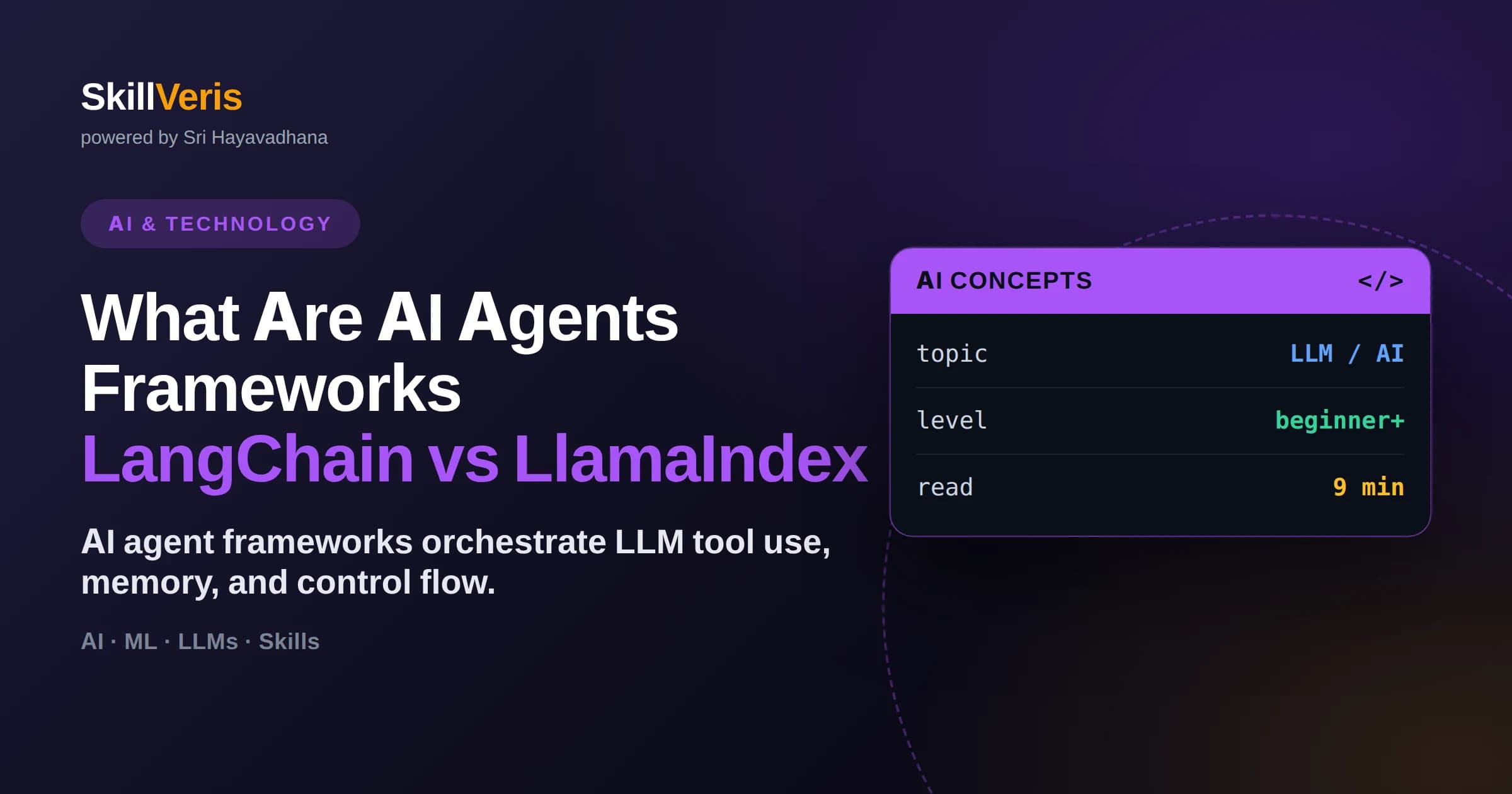
AI agent frameworks are libraries that orchestrate an LLM's tool use, memory, and multi-step reasoning so a model can plan and act, not just answer once.
In this guide, you'll learn:
- LangChain is a broad orchestration toolkit for chains, agents, and tool integrations; LlamaIndex focuses on connecting LLMs to your data through indexing and retrieval.
- Choose LangChain when your app is agent- and workflow-centric; choose LlamaIndex when it is retrieval- and data-centric — many teams use both together.
- Both frameworks share the same core primitives: LLM wrappers, tools, retrievers, and memory, so skills transfer between them.
- Frameworks speed prototyping but add abstraction; understand the underlying prompt and API calls so you can debug when they break.
1What Are AI Agent Frameworks?
AI agent frameworks are software libraries that let an LLM do more than produce a single reply — they orchestrate tool calls, memory, and multi-step reasoning so the model can plan, act, observe results, and continue toward a goal. Instead of one prompt and one answer, an agent runs a loop: decide what to do, use a tool, read the outcome, and repeat until the task is done.
LangChain and LlamaIndex are two of the most widely used frameworks in 2026. They overlap heavily but were born from different priorities, which is exactly why comparing them clarifies when to reach for each.
2Why Use a Framework at All?
You can call an LLM API directly, so frameworks earn their place by removing repetitive glue code around the hard parts of agent building.
- Tool integration: standard interfaces for search, code execution, databases, and APIs.
- Memory: helpers for conversation history and long-term storage.
- Retrieval: built-in connectors to vector stores and document loaders.
- Control flow: agent loops, retries, and structured output parsing out of the box.
🔑Key Idea
A framework is scaffolding, not magic. It saves you from rewriting the agent loop and tool plumbing, but the intelligence still comes from the model and your prompts.
3LangChain: The Orchestration Toolkit
LangChain started as a way to chain LLM calls together and grew into a broad toolkit for building agents and workflows. Its strength is breadth: a large catalogue of integrations, agent types, and composable components for almost any LLM application.
LangChain shines when your application is workflow-centric — an agent that plans, calls several tools, and coordinates multiple steps. Its expression language and graph-based orchestration make complex control flow explicit and testable.
- Best for: agents, multi-step workflows, and apps that call many different tools.
- Strengths: huge integration ecosystem, flexible agent and chain abstractions.
- Trade-off: breadth means more abstraction layers to learn and debug.
4LlamaIndex: The Data Framework
LlamaIndex focuses on the problem of connecting LLMs to your data. It provides rich tooling for loading documents, building indexes, and retrieving the right context — essentially a specialist for the RAG half of agent building.
If your application is data-centric — answering questions over a large document collection, structured retrieval, or complex query routing — LlamaIndex offers finer-grained control over indexing and retrieval than a general toolkit typically does.
- Best for: retrieval-heavy apps, question answering over large corpora, structured data queries.
- Strengths: sophisticated indexing, query engines, and data connectors.
- Trade-off: narrower focus, so complex non-retrieval agents may need extra glue.
6How to Choose Between Them
The decision comes down to where your application's complexity lives, not which framework is trendier. Map your dominant requirement to each framework's center of gravity.
Pick LangChain When
Your app is defined by workflow and tool use — an assistant that searches the web, runs code, queries an API, and coordinates several steps toward a goal. LangChain's agent and orchestration tooling is built for exactly this.
Pick LlamaIndex When
Your app is defined by data — retrieving precise answers from a large or structured document set. LlamaIndex's indexing and query engines give you more control over that retrieval than a general toolkit.
Use Both When
Many production systems use LlamaIndex for the retrieval layer and LangChain for agent orchestration. They interoperate, and combining them is a common, pragmatic pattern rather than a contradiction.
7Best Practices for Agent Frameworks
Whichever framework you choose, a few habits keep agent apps maintainable and debuggable as they grow.
- Log every step: capture the model's reasoning, tool calls, and results for debugging.
- Constrain tools: give an agent only the tools it needs to limit unexpected behaviour.
- Set step and cost limits: cap the agent loop so a stuck agent cannot run forever.
- Test prompts in isolation: verify each tool and prompt works before composing them.
- Understand the generated prompt: know what the framework actually sends to the model.
💡Pro Tip
Turn on verbose or tracing mode early. Seeing the exact prompts and tool calls a framework produces is the fastest way to understand and debug agent behaviour.
8Common Mistakes to Avoid
Framework choice is rarely the real problem — how you use it usually is.
- Choosing on hype instead of your actual use case.
- Treating the framework as a black box and being unable to debug it.
- Over-engineering: using a heavy agent when a single retrieval call would do.
- Giving agents unlimited tools or steps, which invites runaway loops and cost.
- Ignoring evaluation, so you cannot tell whether the agent is actually reliable.
9Key Takeaways
The LangChain versus LlamaIndex question has a practical answer once you know your workload.
- Agent frameworks orchestrate tools, memory, and multi-step reasoning around an LLM.
- LangChain is the broad orchestration toolkit; LlamaIndex specializes in data and retrieval.
- Match the framework to where your complexity lives — workflow versus data.
- Both share core primitives, so skills transfer, and combining them is common.
- Constrain tools, set limits, and log steps regardless of which you pick.
10Frequently Asked Questions
Q: Can I use LangChain and LlamaIndex together? A: Yes, and many teams do. A common pattern uses LlamaIndex for sophisticated retrieval and LangChain for agent orchestration and tool use. The two interoperate, so you are not forced into an either-or choice.
Q: Do I need a framework to build an agent? A: No. You can implement the agent loop and tool calls directly against an LLM API. Frameworks save time on plumbing and integrations, but building a small agent by hand first is a great way to understand what the framework does for you.
Q: Is LangChain only for agents? A: No. LangChain supports simple chains, retrieval pipelines, and structured output as well as full agents. Its agent tooling is a strength, but it is a general orchestration library, not an agents-only tool.
Q: Which is easier for a beginner? A: If your goal is question answering over documents, LlamaIndex gets you there with less to learn. If you want to explore tool-using agents broadly, LangChain's ecosystem and examples give you more to build from. Try a small project in each.
Related Reading
Get The Print Version
Download a PDF of this article for offline reading.
About the Publisher
SkillVeris Team
AI Research Team
Our AI team covers the latest in machine learning, generative AI, and emerging tech — clearly and accurately.
View all postsRelated Posts
Never miss an update
Get the latest tutorials and guides delivered to your inbox.
No spam. Unsubscribe anytime.