100% Free Forever
AI-Powered Learning
Industry Expert Content
Certificates & Badges
Learn At Your Own Pace
HomeBlogVector Databases Explained for Beginners
AI & Technology

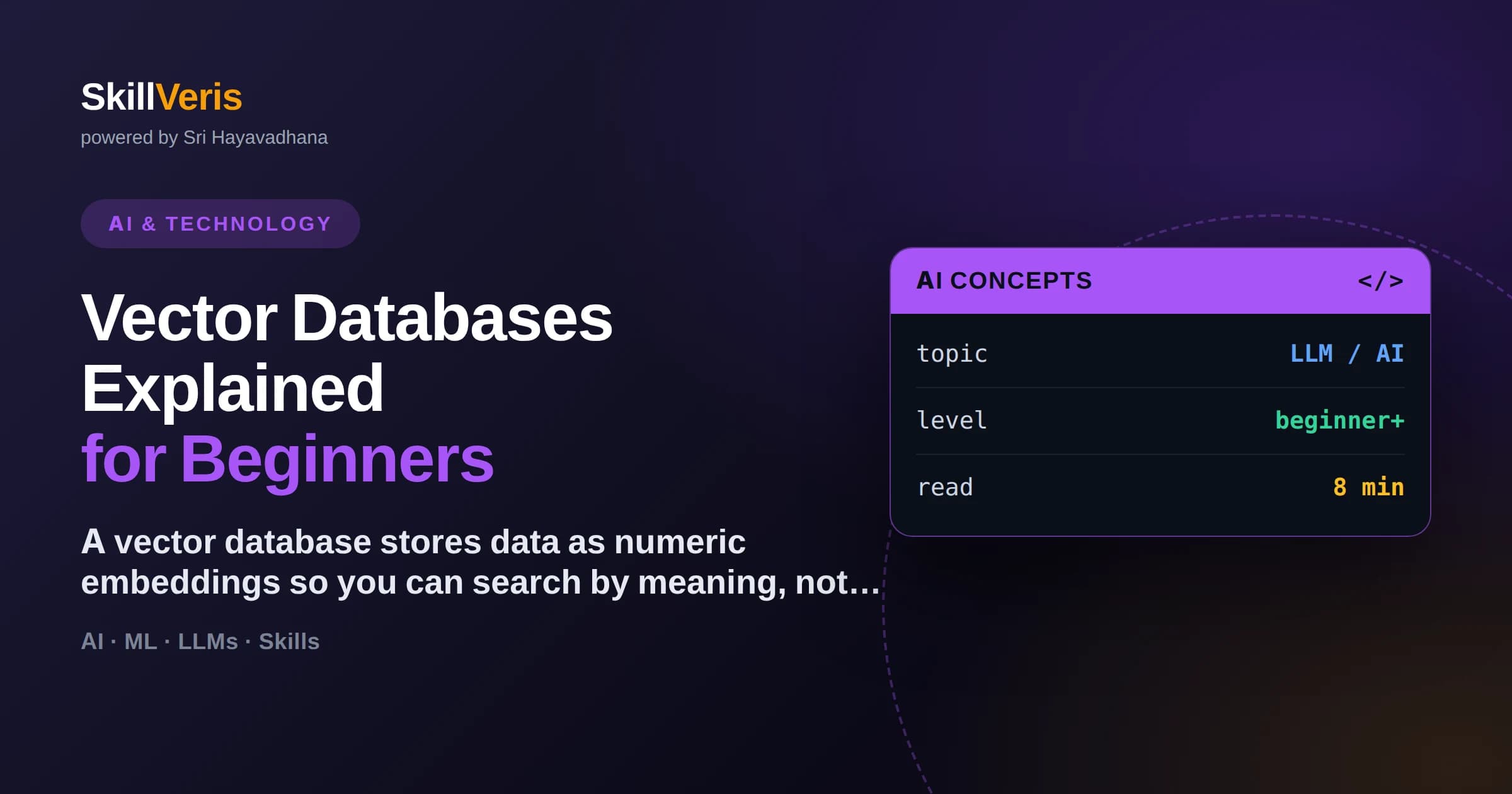
Vector Databases Explained for Beginners

SV

SkillVeris Team

AI Research Team

Jan 21, 2026 8 min read
Share:
Vector Databases Explained for Beginners
Key Takeaway

A vector database stores data as high-dimensional embeddings and finds results by semantic similarity rather than exact keyword matches.

In this guide, you'll learn:

  • It powers semantic search, recommendations, and retrieval-augmented generation by answering 'what is closest in meaning' at scale.
  • Similarity is measured with distance metrics like cosine similarity or Euclidean distance between embedding vectors.
  • Approximate nearest neighbor indexes such as HNSW make searching billions of vectors fast enough for real time.
  • Popular options include Pinecone, Weaviate, Qdrant, Milvus, and the pgvector extension for PostgreSQL.

1What Is a Vector Database?

A vector database is a specialized store that holds data as numeric vectors called embeddings and retrieves results by similarity of meaning rather than exact matches. Instead of asking 'which rows contain the word cat', it answers 'which items are closest in meaning to this query'.

This matters because AI models represent text, images, and audio as long lists of numbers that capture semantic meaning. A vector database is built to store those lists efficiently and to find the nearest ones to any given query in milliseconds, even across millions of records.

2Embeddings: The Fuel

Before a vector database is useful, something has to create the vectors. An embedding model turns a piece of content into a fixed-length array of numbers, often hundreds or thousands of dimensions long, positioned so that similar meanings land near each other in space.

The sentence 'a small dog' and 'a puppy' produce vectors that sit close together, while 'a tax return' lands far away. The database never needs to understand language itself; it only compares coordinates. Your job is to run content through an embedding model first, then store the resulting vectors.

💡Key Point

The database stores and searches vectors; a separate embedding model creates them. You need both. Use the same model for indexing and for queries.

3How Similarity Search Works

Searching a vector database means finding the vectors nearest to your query vector. 'Nearest' is defined by a distance metric, and the choice affects results, so most databases let you pick one per collection.

  • Cosine similarity: measures the angle between vectors; great for text where direction matters more than length.
  • Euclidean distance (L2): straight-line distance between points; common for image and general numeric data.
  • Dot product: fast and useful when vectors are normalized; often used with certain embedding models.
  • The smaller the distance (or higher the similarity), the more semantically related two items are.

Top-K Retrieval

In practice you rarely want a single result. You ask for the top K nearest neighbors, say the five most similar chunks, and use them together. In retrieval-augmented generation those top chunks become the context you feed to a language model so it can answer using your own data.

4Why Indexes Make It Fast

Comparing a query against every stored vector one by one is accurate but slow once you have millions of records. Vector databases use approximate nearest neighbor (ANN) indexes to trade a tiny bit of accuracy for enormous speed gains.

The most common index is HNSW, a graph structure that lets search hop toward the nearest region without checking everything. Others include IVF, which clusters vectors into buckets, and product quantization, which compresses vectors to save memory. You usually just pick an index type and tune a couple of parameters.

🔑Approximate, on Purpose

ANN search may occasionally miss the exact closest match, but it returns near-perfect results thousands of times faster, which is the right trade for real-time apps.

5What You Can Build With One

Vector databases sit behind many of the AI features people use every day. Anywhere 'find things like this' beats 'find this exact word', a vector store is a natural fit.

  • Semantic search: users find documents by meaning even without matching keywords.
  • Retrieval-augmented generation: fetch relevant context to ground an LLM's answers in your data.
  • Recommendations: surface products, articles, or songs similar to what a user already likes.
  • Deduplication and clustering: group near-identical or related items automatically.
  • Image and audio search: find visually or sonically similar media using multimodal embeddings.

6Getting Started in Code

A minimal workflow looks the same across tools: embed your content, upsert the vectors with some metadata, then query with an embedded question. Here is the shape of it using a generic client.

  • vec = embed("How do refunds work?") # turn text into a vector
  • db.upsert(id="doc1", vector=vec, metadata={"source": "faq"})
  • query_vec = embed("can I get my money back?")
  • results = db.query(query_vec, top_k=5, filter={"source": "faq"})
  • context = [r.metadata["text"] for r in results] # feed to your LLM

Metadata Filtering

Most vector databases let you attach metadata to each vector and filter on it during search. This lets you combine semantic similarity with hard constraints, for example 'most similar chunks, but only from documents this user is allowed to see' or 'only articles published this year'. Filtering is what makes vector search practical in real applications.

7Common Mistakes to Avoid

Beginners usually run into the same handful of pitfalls, and most are easy to sidestep once you know them.

  • Using different embedding models for indexing and querying, which makes distances meaningless.
  • Storing whole documents as one vector instead of chunking, so retrieval returns too much irrelevant text.
  • Ignoring metadata, then being unable to filter by permissions, date, or source.
  • Assuming a vector database replaces your primary database; it complements it, storing embeddings alongside your system of record.
  • Skipping evaluation, so you never notice that retrieval quality is poor until users complain.

⚠️Watch Out

If you change your embedding model, you must re-embed and re-index all your data. Old vectors from a different model are not comparable to new ones.

8Key Takeaways

Here is what to remember about vector databases as you get started.

  • A vector database searches by semantic similarity using embeddings, not keywords.
  • You need an embedding model to create vectors and the database to store and search them.
  • Similarity uses metrics like cosine distance; ANN indexes like HNSW make search fast.
  • They power semantic search, recommendations, and retrieval-augmented generation.
  • Chunk your content, keep the same embedding model, and use metadata filters.

9Frequently Asked Questions

Q: Do I need a vector database, or can I use a normal database? A: For small datasets you can compute similarities in memory or use an extension like pgvector inside PostgreSQL. A dedicated vector database earns its keep once you have large volumes, need low latency, or want built-in ANN indexing and scaling.

Q: What is the difference between a vector database and an embedding model? A: The embedding model turns content into vectors; the vector database stores those vectors and finds the nearest ones to a query. They work together, and neither replaces the other.

Q: Which vector database should a beginner start with? A: If you already use PostgreSQL, pgvector is the lowest-friction start. For a managed cloud service, Pinecone is beginner-friendly, while Qdrant, Weaviate, and Milvus are strong open-source options you can self-host.

Q: How is a vector database used in RAG? A: In retrieval-augmented generation, you embed a user's question, search the vector database for the most similar chunks of your documents, and pass those chunks to a language model as context so it answers using your data instead of guessing.

📄

Get The Print Version

Download a PDF of this article for offline reading.

About the Publisher

SV

SkillVeris Team

AI Research Team

Our AI team covers the latest in machine learning, generative AI, and emerging tech — clearly and accurately.

View all posts

Never miss an update

Get the latest tutorials and guides delivered to your inbox.

No spam. Unsubscribe anytime.

Frequently Asked Questions

21 categories · pick one to explore

Does SkillVeris have a tech blog, and what does it cover?
Yes, the SkillVeris blog has over 500 articles covering AI and machine learning, programming, web development, DevOps, cloud, security, databases and career guidance. Articles are practical and answer-first, and many use the Learn Through Hobbies approach, teaching technical concepts through cricket, music, gaming or cooking analogies. Everything is free to read.
What is the SkillVeris tech glossary and how big is it?
The SkillVeris glossary is a free reference of roughly 2,000-plus technology terms, each with a clear plain-language definition. It spans AI, programming, web, DevOps, cloud, security and database vocabulary, so whenever a lesson, article or job description uses jargon you do not recognise, the glossary gives you a fast, reliable answer.
Are the developer cheat sheets on SkillVeris free to download?
The cheat sheets are completely free to use, like everything else on SkillVeris. Each sheet condenses a language or tool into its essential syntax, commands and patterns for quick reference while coding. They are designed for rapid lookup during real work, complementing the deeper explanations found in study notes and courses.
Which programming references and cheat sheets are available?
Cheat sheets cover the platform's main domains, including programming languages, AI and ML tooling, web development, DevOps, cloud, security and databases, matching the topics of the 37 live courses. Each sheet lists related reading links and hashtags, so you can jump from a quick reference into fuller study notes or blog articles.
How do I find the meaning of a technical term quickly?
Search the SkillVeris glossary, which holds around 2,000-plus terms with concise, plain-language definitions. Each entry gets to the point in its first sentence, then links to related reading like blog posts or study notes for deeper context. It is faster and more consistent than sifting through scattered search results.
Is the SkillVeris blog good for beginners learning to code?
Yes, many blog articles are written specifically for beginners, and the Learn Through Hobbies style makes them unusually approachable: you might learn Python concepts through cricket or understand APIs through cooking. With 500-plus articles across skill levels, beginners can start with fundamentals and keep reading as they advance, entirely free.
Can cheat sheets replace full courses for learning a language?
No, cheat sheets are references, not teaching tools; they assume you already understand the concepts and just need syntax or commands fast. To actually learn a language, take a structured SkillVeris course with its 24–40 lessons and assessments, then keep the cheat sheet beside you while practising in Code Lab.
How often are new blog articles published on SkillVeris?
The blog grows regularly and already exceeds 500 articles, with new posts added as courses launch and technologies evolve. Topics track the platform's catalogue across AI, programming, web development, DevOps, cloud and security, so checking the Blog section periodically surfaces fresh tutorials, explainers and career-focused pieces, all free to read.
Does the glossary cover AI and machine learning terms?
Yes, AI and machine learning vocabulary is a major part of the roughly 2,000-plus term glossary, covering everything from foundational terms to modern concepts around LLMs, RAG and MLOps. Definitions are plain-language and answer-first, which helps when dense AI papers or course lessons throw unfamiliar jargon at you.
Are there cheat sheets for interview preparation?
Cheat sheets work well as interview-day refreshers because they compress syntax, commands and key concepts into scannable references. For dedicated preparation, combine them with the SkillVeris interview questions feature, which includes readiness scoring, plus study notes for depth. Reviewing a relevant cheat sheet just before an interview steadies recall under pressure.
Can I read the tech blog without signing up?
Yes, the blog is freely readable, and SkillVeris never charges for content. All 500-plus articles are open, covering tutorials, concept explainers and career advice. Creating a free account adds value elsewhere on the platform, like course progress tracking and certificates, but reading the blog requires no commitment at all.
How is the SkillVeris glossary different from Wikipedia?
The glossary is purpose-built for learners: definitions are short, plain-language and answer-first, sized for a quick lookup mid-lesson rather than a deep encyclopedic read. Entries also cross-link to related SkillVeris study notes, blog posts and courses, so a definition becomes a doorway into structured learning instead of a dead end.
Do blog articles use the Learn Through Hobbies method?
Many blog articles teach technical topics through hobby analogies, a hallmark of the SkillVeris blog, so you will find articles explaining programming through cricket, machine learning through music, or system design through cooking. The analogy is the teaching device; the article still delivers the real technical concept underneath.
Where can I find quick programming references while coding?
Open the SkillVeris cheat sheets, which are built exactly for that moment: compact, scannable references for syntax, commands and common patterns across languages and tools. Keep the relevant sheet in a browser tab while you work in Code Lab or your own editor, and dip into the glossary for terminology.
Is there a glossary entry for terms I meet in job descriptions?
Very likely yes, with roughly 2,000-plus terms across AI, programming, web, DevOps, cloud, security and databases, the glossary covers most jargon that appears in tech job descriptions. Decoding a listing this way helps you judge role fit honestly and prepares you to discuss those terms in interviews.
Are the blog articles written for the Indian tech audience?
The blog serves Indian learners plus a worldwide audience. Content stays globally relevant while acknowledging realities that matter in India, such as free access being essential for students and freshers, and career guidance that connects naturally to the SkillVeris jobs portal, which aggregates roles across India, UK, USA, Germany and Remote.
Can I suggest a topic for the blog or glossary?
SkillVeris content grows in response to what learners need, so feedback is welcome through the platform's support channels. If a term is missing from the glossary or a topic deserves an article, telling the team helps prioritise it. Meanwhile, the AI Mentor can answer the question immediately, 24/7, at any depth.
Do cheat sheets and glossary entries link to deeper learning?
Yes, every cheat sheet and glossary entry carries related reading links into study notes, blog articles and courses, plus concept hashtags for discovering similar content. This cross-linking means a thirty-second lookup can smoothly become a structured learning session whenever you decide you want more than a quick answer.
What makes SkillVeris programming references trustworthy?
The references are written to strict internal quality standards, kept consistent with the platform's 37 live courses, and never padded with invented statistics or hype. Definitions and cheat sheets are reviewed against the same content contracts that govern courses, and the answer-first style makes any inaccuracy easy to spot and correct.
How do the blog, glossary and cheat sheets fit into my learning routine?
Use them as satellites around your main course: read blog articles for context and motivation, hit the glossary the instant jargon appears, and keep cheat sheets open while coding. Together with study notes, Code Lab and the 24/7 AI Mentor, they turn passive reading into a complete, free learning system.

What Learners Say

Real journeys from the SkillVeris community — swipe for more.

SkillVeris taught me Python through Cricket. Now I’m building real projects and feeling confident!
Arjun S. · B.Tech Student
The best platform for hobby-based learning. Concepts finally stick.
Priya R. · Data Analyst
I went from zero coding to a portfolio of projects — all by learning through my love for gaming. Landed my first internship!
Kabir M. · CS Undergraduate
Trending Topics50 popular tags — tap to explore
Trending CoursesAll 37 free courses — tap to browse