UI vs UX Design: What's the Actual Difference?
SkillVeris Team
AI Research Team
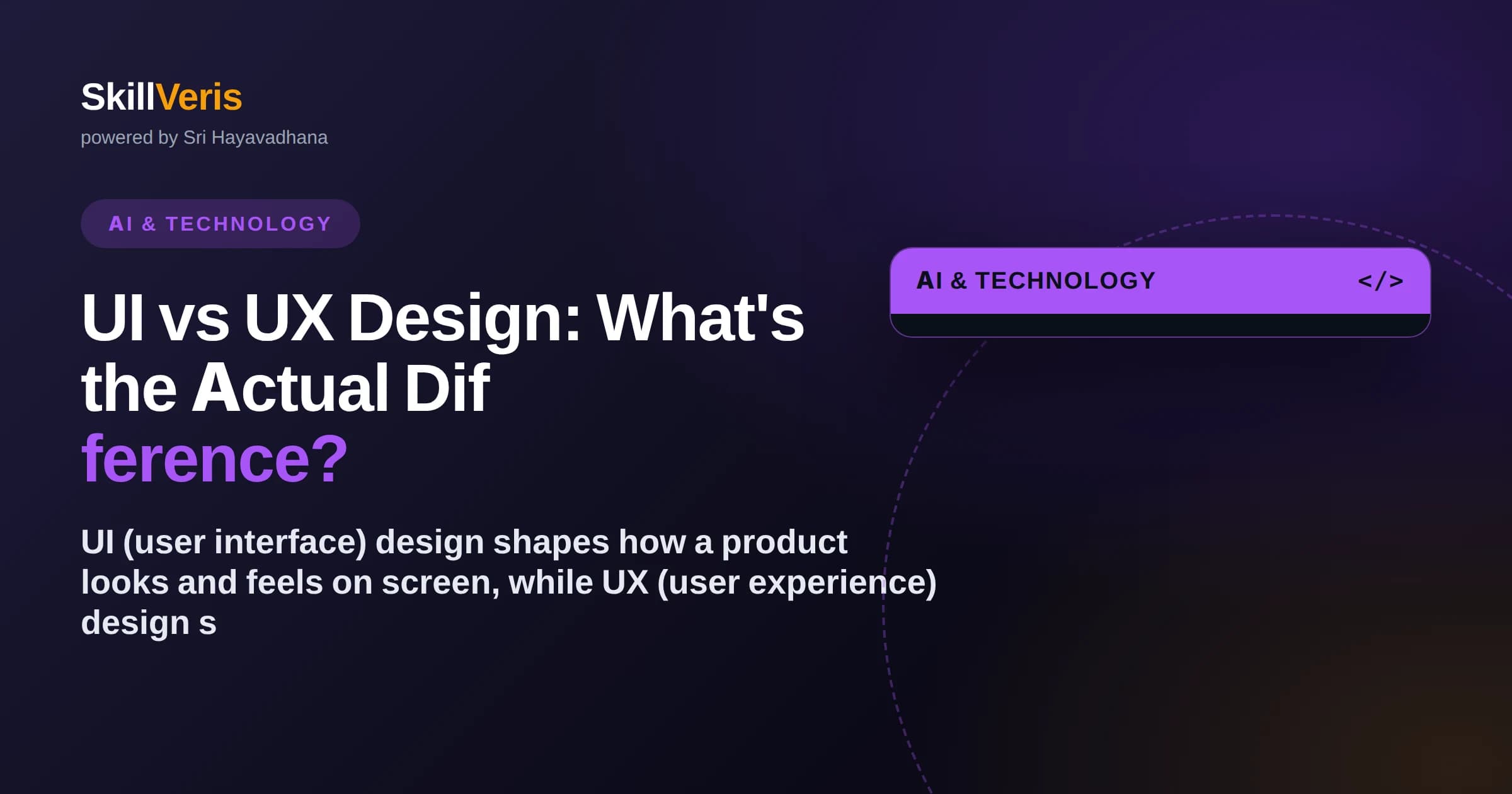
UI design focuses on the visual and interactive surface of a product — layout, color, typography, and components; UX design focuses on the entire journey a user takes to accomplish a goal.
In this guide, you'll learn:
- A product can have a beautiful UI and still fail if the UX is confusing, and a product can have excellent UX with a plain, unpolished UI.
- UX design typically starts earlier in the process, with research and user flows, before UI design applies visual styling to those flows.
- Common UX deliverables include user research, personas, journey maps, and wireframes; common UI deliverables include mockups, style guides, and design systems.
- Many professionals work as hybrid UI/UX designers, especially at smaller companies, but the underlying skill sets and thinking modes remain distinct.
1What Is UI Design?
UI (User Interface) design is the practice of shaping the visual and interactive surface of a product — the buttons, layouts, colors, typography, icons, and micro-interactions a user actually sees and touches.
Good UI design makes an interface feel consistent, legible, and pleasant to use, applying visual hierarchy and design system principles so users know where to look and what to click without conscious effort.
2What Is UX Design?
UX (User Experience) design is the practice of shaping the entire journey a user takes to accomplish a goal with a product, from the moment they discover a need through completing a task and beyond.
UX design is concerned with structure and flow before visuals: does the checkout process make sense, is the information architecture logical, can a new user find the feature they need without instructions?
3The Key Differences, Side by Side
The clearest way to separate the two is by what question each discipline answers.
- UI answers: how does this look and feel? UX answers: does this work, and does it make sense?
- UI deliverables: mockups, component libraries, style guides, design systems.
- UX deliverables: user research, personas, journey maps, wireframes, information architecture.
- UI is largely visual craft; UX is largely research and structural problem-solving.
- UI is typically applied after UX has defined the flow; the two are sequential as often as they're parallel.
4Why Both Matter Together
A product with a polished UI but poor UX will look great in a screenshot and frustrate users the moment they try to complete a real task — the classic case of style without substance.
Conversely, a product with excellent UX but a plain, dated UI can lose users' trust before they even try it, since visual polish is often the first (and sometimes only) signal of quality a user judges before engaging.
💡
5The Typical Design Process
A well-run design process moves through UX-first stages before layering on UI.
- User research: interviews, surveys, and analytics to understand real user needs and pain points.
- Information architecture: organizing content and features into a logical structure.
- Wireframing: low-fidelity sketches of screen layouts focused on flow, not visuals.
- UI design: applying color, typography, and visual components to the wireframes.
- Prototyping and usability testing: validating the design with real users before development.
6Hybrid Roles and Specialization
At smaller companies and startups, one person often handles both UI and UX under a single 'product designer' title, moving fluidly between research and visual polish depending on what the project needs.
At larger companies, the two roles usually split into dedicated UX researchers/designers and UI/visual designers, each going deeper into their respective craft and collaborating through shared design systems.
7Skills Each Discipline Requires
UX design leans on research methods, empathy mapping, structured problem-solving, and familiarity with tools like user flow diagrams and usability testing frameworks.
UI design leans on visual design principles — color theory, typography, spacing, grid systems — plus fluency in tools like Figma and an eye for consistency across a design system.
8Getting Started in Either Field
If you're drawn to research, psychology, and problem structure, UX is the natural entry point; if you're drawn to visual craft and aesthetics, start with UI fundamentals and build a portfolio of interface redesigns.
Either path benefits from understanding both sides at a working level — explore SkillVeris's glossary and topics to build a shared vocabulary across design and the surrounding tech stack it ships on.
Related Reading
Get The Print Version
Download a PDF of this article for offline reading.
About the Publisher
SkillVeris Team
AI Research Team
Our AI team covers the latest in machine learning, generative AI, and emerging tech — clearly and accurately.
View all postsRelated Posts


Never miss an update
Get the latest tutorials and guides delivered to your inbox.
No spam. Unsubscribe anytime.