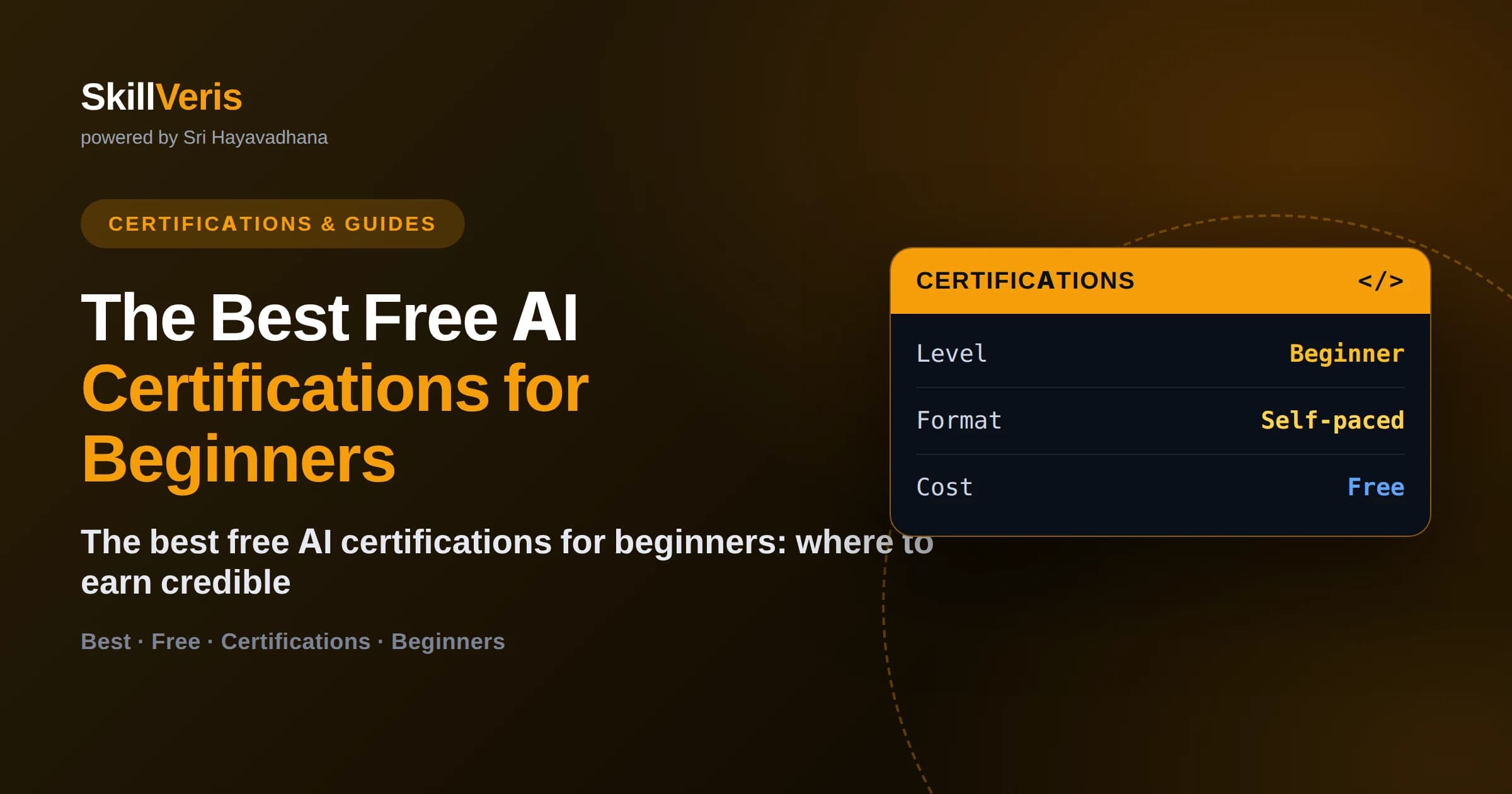
The Best Free AI Certifications for Beginners
SkillVeris Team
Learning Team
Credible free AI certifications come mainly from major tech vendors and reputable learning platforms whose names hiring managers recognize.
In this guide, you'll learn:
- The strongest beginner path starts with AI fundamentals and Python before jumping into deep learning or generative AI.
- Vendor credentials from cloud providers signal familiarity with the AI tools companies actually deploy in production.
- A certification proves you studied a topic; a project proves you can apply it, and employers weigh the project more.
- Prompt engineering and generative AI literacy are increasingly valuable and available through free, credible short courses.
1Where to Earn Credible Free AI Certifications
The best free AI certifications for beginners come from two trustworthy sources: major technology vendors like Microsoft, Google, and IBM, whose AI credentials employers recognize, and reputable learning platforms offering free courses in AI fundamentals, machine learning, and generative AI. A free AI certification is worth pursuing when the issuer is credible and the skills it teaches, Python, core machine learning concepts, or working with modern AI tools, map to what the field actually uses.
It helps to be honest up front: in a fast-moving field like AI in 2026, no certificate alone makes you an AI engineer. The value of these credentials is that they give beginners a structured, credible way to learn foundational concepts and signal genuine effort, while the real differentiator remains what you can build and demonstrate. Treat certifications as a learning scaffold and a resume signal, not as a finish line.
This guide covers which free AI certifications are genuinely worth your time, the sensible order to pursue them as a beginner, and how to convert a certificate into demonstrable skill so it actually helps your career rather than just decorating your resume.
2Start With AI Fundamentals, Not the Hype
The most valuable first step is a solid grounding in what AI and machine learning actually are, how models learn from data, what problems they solve, and where they fail, before you touch a neural network. Several major vendors offer free AI fundamentals courses and certifications aimed squarely at beginners, and these are an excellent, credible starting point because they build accurate mental models rather than buzzword familiarity.
AI fundamentals credentials typically cover the core categories of machine learning (supervised, unsupervised, and increasingly generative AI), key concepts like training data and evaluation, and the responsible-use and ethics considerations that employers now take seriously. This conceptual foundation makes everything you learn afterward click into place, and it protects you from the common beginner trap of using powerful tools without understanding them.
Resist the urge to skip straight to the flashy topics. A beginner who understands what a model is doing and why it might be wrong is far more employable than one who can run a fancy notebook but cannot explain or trust the output. Fundamentals first is not the slow path; it is the path that actually works.
💡Concepts before code
A free AI fundamentals certification that teaches how models learn, where they fail, and how to use them responsibly is worth more to a beginner than a certificate in a tool you don't yet understand. Build the mental model first.
3Build the Python Foundation
Almost all practical AI work runs on Python, so a beginner serious about AI should certify or at least solidify Python early. Free Python certifications and courses are abundant and credible, and Python is the language of the core AI libraries, so this skill underpins everything else you will do, from data preparation to model building to working with AI APIs.
You do not need to become a software engineer, but you do need to be comfortable with the essentials: variables and data structures, loops and functions, and working with data using common libraries. A free Python-for-data or Python-for-AI credential that pushes you to write real code, not just watch it, gives you a foundation that makes every later AI course dramatically easier.
Pair Python with a little data literacy, how to load, clean, and explore a dataset, since real AI work is mostly working with data, not just calling models. Beginners who can confidently manipulate data in Python progress far faster into machine learning than those who skipped this step and constantly get stuck on the basics.
4Credible Free Vendor AI Certifications
Vendor AI certifications are valuable because they signal familiarity with the platforms companies actually deploy, and several offer free learning paths even where the proctored exam carries a fee. The learning content itself teaches transferable concepts, so you benefit even if you never sit the paid exam. For beginners, the fundamentals-level vendor certifications are the right entry point.
Microsoft offers beginner-friendly AI fundamentals learning paths covering core concepts and its AI services. Google provides free AI and machine learning learning content, including introductions to generative AI, through its cloud and learning platforms. IBM offers accessible AI and machine learning courses that teach both concepts and hands-on tools. Each of these carries name recognition that reassures a hiring manager the credential means something.
Choose vendor paths that match where you want to work. If your target roles mention a particular cloud platform, a fundamentals credential from that vendor is a smart, recognizable signal. The goal is not to collect every badge but to earn one or two credible, relevant ones and then apply the skills in a project.
- Microsoft AI fundamentals learning paths covering core AI concepts and services.
- Google's free AI and machine learning content, including generative AI introductions.
- IBM's accessible AI and machine learning courses with hands-on components.
- Reputable platform certifications in machine learning foundations.
- Free introductory deep learning courses from well-known educators.
5Don't Skip Generative AI and Prompt Engineering
Generative AI literacy has become a genuinely valuable, employer-relevant skill, and credible free short courses now teach it well. Understanding how large language models work at a conceptual level, what they can and cannot do, and how to prompt them effectively is increasingly expected across many roles, not just technical ones. For a beginner in 2026, this is a high-leverage area to invest in.
Prompt engineering, the practice of crafting clear, well-structured instructions to get reliable results from AI models, sounds simple but rewards real study. Free courses from reputable AI educators and vendors cover techniques like giving context, specifying format, breaking tasks into steps, and iterating on outputs. These skills apply immediately whether you become an analyst who uses AI tools or an engineer who builds with them.
Just as important is learning the limits: hallucinations, bias, and the need to verify outputs. Employers value people who use generative AI effectively and responsibly, not those who trust it blindly. A free credential that covers both the how and the cautions of generative AI is a strong addition to a beginner's resume.
🔑A skill that transfers everywhere
Generative AI and prompt engineering literacy is useful in nearly every role, technical or not. A credible free short course here can pay off faster than a narrow, specialized certificate, because you can apply it the same week you finish it.
6Certifications Prove Study, Projects Prove Ability
As with every credential, the honest reality is that a project beats a certificate in the eyes of most employers. In AI especially, where the field moves fast and hype runs high, the ability to actually build something, a model, an analysis, a small application using an AI API, is what separates candidates. Certifications get you the knowledge; projects prove you can wield it.
The winning approach is to interleave them: earn a free certification to learn a concept in a structured way, then immediately build a small project that applies it. Trained a simple classifier after a machine learning course, built a prompt-powered tool after a generative AI course, analyzed a dataset after a Python course, each project turns abstract learning into concrete evidence you can show and discuss.
This matters even more in AI because employers are wary of people who can only recite terminology. Being able to explain what you built, why, and what its limitations are demonstrates real understanding. Let each certification lead directly into a project, and your resume tells a story of applied learning rather than passive study.
7A Sensible Free Path for Beginners
If you want a concrete order, here is a sensible free progression that avoids the common mistake of jumping to advanced topics too early. Each step builds on the last, and each should be paired with a small project so learning turns into demonstrable skill.
Start with AI fundamentals to build accurate mental models, then solidify Python and basic data skills so you can actually work with data and tools. Move into core machine learning concepts and a hands-on introduction, then add generative AI and prompt engineering literacy, which is broadly applicable and quick to pay off. Throughout, keep building: the certificates structure your learning, but the projects are what make you employable.
The recommended sequence
Follow this order and pair each stage with a project before moving on.
AI fundamentals: concepts, categories of ML, responsible use.
Python and data basics: code and manipulate real datasets.
Core machine learning: how models train, evaluate, and fail.
Generative AI and prompt engineering: high-leverage, broadly applicable.
Portfolio projects: apply each skill and document what you built.8Frequently Asked Questions
Are free AI certifications actually credible? Yes, when they come from recognized vendors like Microsoft, Google, or IBM, or reputable learning platforms. Credibility comes from the issuer's recognition and whether the skills map to real AI work, not from whether you paid.
Which free AI certification should a complete beginner start with? Begin with an AI fundamentals certification to build accurate mental models, then solidify Python. Jumping straight to deep learning or generative AI without these foundations tends to leave beginners stuck and confused.
Can a free certification get me an AI job? Not by itself. In a fast-moving field, employers hire on demonstrated ability, so projects matter most. Use certifications to structure learning and signal effort, then pair them with projects that prove you can apply the skills.
Is learning prompt engineering worth it for beginners? Yes. Generative AI and prompt engineering literacy is increasingly valuable across many roles, technical or not, and credible free short courses teach it well. You can often apply these skills the same week you learn them.
Do I need to know Python for AI? For nearly all practical AI work, yes. Python is the language of the core AI libraries and tools, so a comfortable foundation in Python and basic data handling makes every later AI course dramatically easier.
How do I make a free AI certification count on my resume? Pair each certification with a small project that applies the skill and link to it, list the issuer clearly, and be ready to explain what you built and its limitations. Applied evidence turns a credential into an interview.
9Your Next Steps
The best free AI certifications for beginners come from credible vendors and reputable platforms, and they work best in a sensible order: fundamentals first, then Python, then core machine learning, then generative AI and prompt engineering. But in AI more than anywhere, the certificate is the scaffolding and the project is the proof. Learn a concept, build something with it, and repeat.
You can learn AI fundamentals, Python, machine learning, and generative AI concepts for free on SkillVeris, and turn each topic into a project that demonstrates real, applied skill. Explore the free AI and Python courses and study notes, follow the beginner path in order, and let your growing portfolio, backed by a few credible certifications, tell the story of someone who does not just study AI but can actually use it.
Related Reading
Get The Print Version
Download a PDF of this article for offline reading.
About the Publisher
SkillVeris Team
Learning Team
Our learning specialists map the fastest paths to industry-recognised certifications.
View all postsRelated Posts
Never miss an update
Get the latest tutorials and guides delivered to your inbox.
No spam. Unsubscribe anytime.