Prompt Engineering in 2026: Techniques That Actually Work
SkillVeris Team
AI Research Team
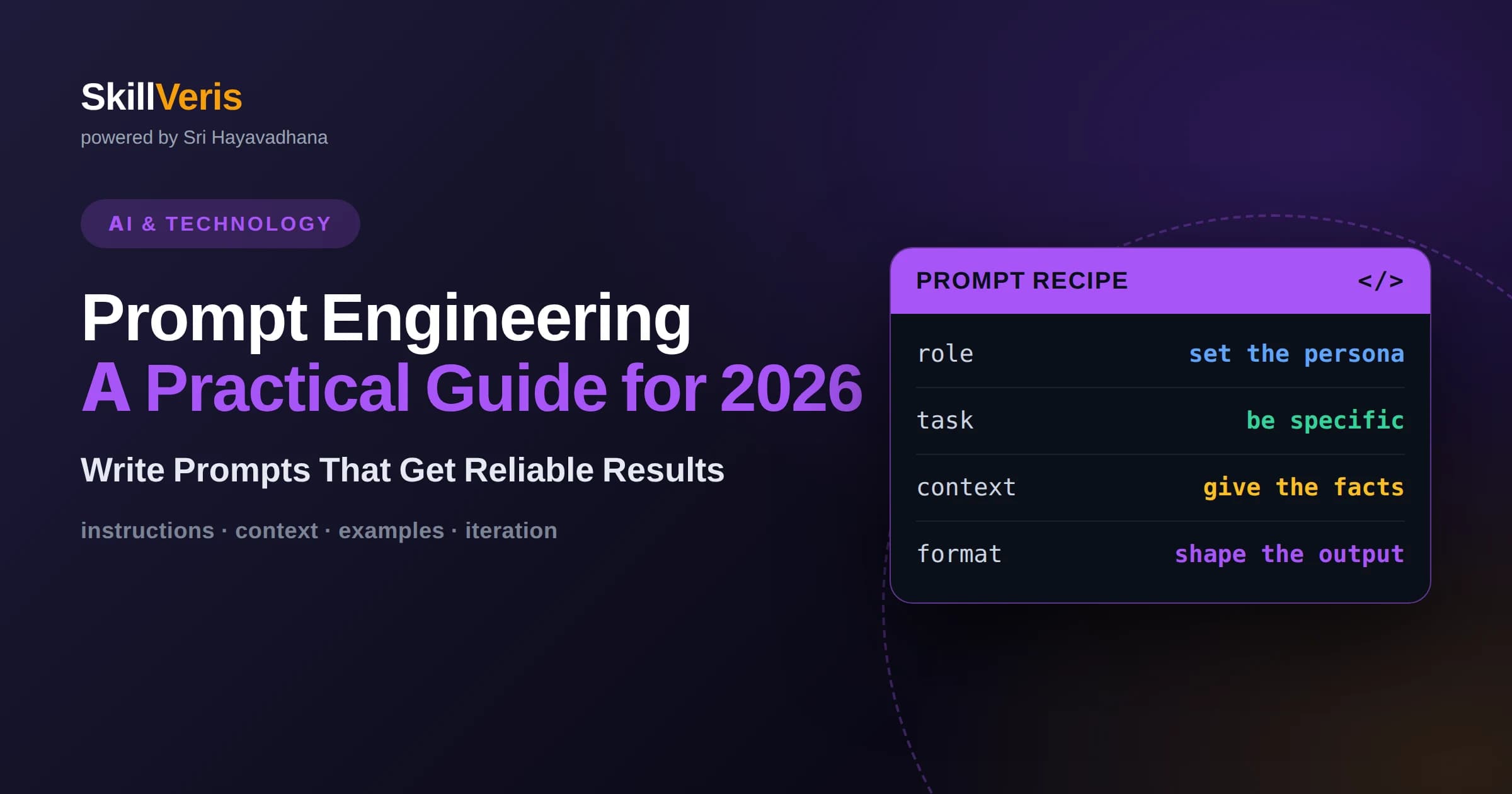
Prompt engineering is the practice of designing the input to a language model so it produces accurate, relevant, and reliably formatted output for a specific task.
In this guide, you'll learn:
- The techniques that hold up in 2026 are about clarity and structure, giving the model a clear role, precise instructions, useful examples, and a defined output format, rather than clever tricks.
- Advanced methods like chain-of-thought reasoning, few-shot examples, and prompt chaining improve results on complex tasks by decomposing them into steps the model can handle well.
- Reliable prompting is an iterative, evaluation-driven discipline: you test prompts against real cases, measure results, and refine, rather than trusting a prompt because it worked once.
1What Is Prompt Engineering?
Prompt engineering is the practice of carefully designing the text you send to a language model so that it produces the output you actually want. In one sentence: it is the craft of turning a vague request into precise instructions a model can follow reliably. Because a language model does exactly what its input steers it toward, the quality of that input largely determines the quality of the result.
It helps to think of a language model as an extremely capable but very literal collaborator that has no memory of your intentions and no context beyond what you provide. It will not ask clarifying questions unless told to, and it will fill any ambiguity with its own assumptions. Prompt engineering is how you remove that ambiguity and communicate your intent clearly.
In 2026, prompt engineering has matured from a bag of tricks into a genuine engineering discipline. The flashy hacks that circulated in the early years have largely faded, and what remains are durable principles about clarity, structure, examples, and evaluation. The good news is that these principles are learnable and transfer across models, so time invested in them keeps paying off.
2Why Prompt Engineering Still Matters
As models have grown more capable, some people assumed prompt engineering would become unnecessary, that you could simply ask and receive. In practice the opposite has happened. More capable models are used for harder, higher-stakes tasks, and on those tasks the difference between a careless prompt and a well-designed one is enormous. Better models raise the ceiling, but you still need skill to reach it.
Prompt engineering also matters because it is the cheapest and fastest lever you have. Changing a prompt takes seconds and no retraining, so it is almost always the first thing to improve when output is disappointing. Teams that treat prompting seriously often solve problems that others assume require expensive fine-tuning or larger models.
There is a reliability dimension too. A prompt that works once in a demo but fails one time in ten is not good enough for a real product. Prompt engineering, done properly, is about consistency across many inputs, not a single impressive result. That shift from lucky output to dependable output is what separates hobby prompting from professional practice.
3Start With Clarity and Specificity
The single most effective technique is also the least glamorous: say exactly what you want. Vague prompts produce vague results because the model has to guess at your intent. Instead of asking for a summary, specify how long it should be, who it is for, what to emphasize, and what to leave out. Every ambiguity you remove is a decision the model no longer has to make on your behalf.
Specificity applies to constraints as much as content. If you need output in a particular format, in a particular tone, or within a particular length, state it plainly. Telling the model what to avoid can be as valuable as telling it what to include, because it heads off the common failure modes before they happen.
A useful habit is to imagine handing your prompt to a competent stranger with no context. If that person would have questions, the model will too, and it will answer them with assumptions you may not like. Reading your own prompt through that lens catches most of the ambiguity that causes disappointing results.
4Give the Model a Role and Context
Assigning the model a clear role focuses its behavior. Telling it to act as an experienced editor, a patient tutor, or a careful financial analyst primes it to draw on the right patterns, adopt an appropriate tone, and apply relevant standards. The role is not magic, but it meaningfully shapes the style and depth of the response, and it costs nothing to include.
Context is equally important. Models perform far better when you supply the background they need rather than assuming they can infer it. Who is the audience, what has already been decided, what is the goal, and what does success look like are all details that, when provided, steer the output toward what you actually need. A model working with rich context makes far fewer wrong assumptions.
The balance to watch is relevance. Piling in unrelated background can distract the model and bury the important signal. Good context is targeted: enough to orient the model on the specific task, without drowning the instruction in noise. Curating what you include is itself a skill worth developing.
5Show, Don't Just Tell: Few-Shot Examples
Some things are easier to demonstrate than to describe. Few-shot prompting means including a small number of examples of the input-output pairs you want, so the model can infer the pattern directly. When you need a specific structure, a particular labeling scheme, or a consistent style, two or three good examples often outperform a paragraph of instructions.
The examples you choose carry a lot of weight, so pick them deliberately. They should reflect the range of cases you expect, including any tricky edge cases you care about, because the model will generalize from what you show it. Sloppy or inconsistent examples teach sloppy, inconsistent behavior, so the quality bar for examples should be high.
Few-shot prompting does have a cost in prompt length, and for simple tasks a clear instruction alone may be enough. The art is knowing when a task is pattern-shaped, where examples shine, versus rule-shaped, where a plain instruction is cleaner. Trying both and comparing results is usually faster than debating it in the abstract.
6Chain-of-Thought and Structured Reasoning
For problems that require multiple steps, prompting the model to reason through the problem before giving its final answer improves accuracy substantially. This chain-of-thought approach works because it gives the model room to break a hard problem into smaller pieces rather than jumping straight to a conclusion. Complex logic, math, and multi-part analysis all benefit from this deliberate unfolding.
In 2026, many capable models perform this kind of step-by-step reasoning more readily on their own, but guiding the structure still helps. Asking the model to first identify the relevant facts, then weigh the options, then commit to an answer imposes a discipline that raises quality on genuinely hard tasks. You are essentially giving the model a thinking scaffold.
One practical refinement is separating the reasoning from the final output. You can let the model reason at length and then produce a clean, concise answer, so the user sees only the conclusion while the model still benefits from working through the problem. This keeps the interface tidy without sacrificing the accuracy gains that reasoning provides.
7Control the Output Format
When a model's output feeds into another system, format control becomes essential. Specifying the exact structure you want, whether a labeled list, a table, or structured data with named fields, makes the output predictable and machine-readable. Vague formatting instructions produce inconsistent output that breaks downstream code, so precision here pays off directly in reliability.
The most reliable way to enforce format is to show it. Providing a template or an example of the exact structure removes ambiguity far better than describing it in words. Many modern platforms also offer structured output modes that constrain the model to a defined schema, which is worth using whenever your output must be parsed programmatically.
It also helps to tell the model what not to include. If you want only the structured result with no preamble, apologies, or commentary, say so explicitly. Left unconstrained, models often wrap useful output in conversational padding that complicates parsing, and a single clear instruction usually eliminates it.
8Prompt Chaining for Complex Tasks
Not every task should be a single prompt. Prompt chaining breaks a complex job into a sequence of smaller prompts, where each step's output feeds the next. For example, one prompt might extract the key facts from a document, a second might analyze them, and a third might write a polished summary. Each step is simpler, easier to get right, and easier to debug than one giant prompt trying to do everything.
Chaining improves reliability because each stage has a narrow, well-defined job. When something goes wrong, you can see exactly which step failed and fix that link without disturbing the rest. This modularity is the same principle that makes good software easier to maintain, applied to language model workflows.
The trade-off is added complexity and more model calls, so chaining is not free. The judgment is to decompose only as far as the task genuinely benefits. A good rule of thumb is that if a single prompt is trying to juggle several distinct objectives and doing all of them poorly, it is a candidate for chaining into focused steps.
9Common Prompt Engineering Mistakes
The most common mistake is being too vague and then blaming the model for guessing wrong. When output disappoints, the first question should be whether the prompt actually specified what was wanted, because more often than not the ambiguity was on the input side. Precision in, quality out.
Another frequent error is overloading a single prompt with too many instructions at once. When a prompt tries to enforce a dozen rules simultaneously, the model tends to satisfy some and drop others. Prioritizing the instructions that matter most, or splitting the task into stages, produces far more consistent results than an ever-growing wall of demands.
A subtler mistake is trusting a prompt because it worked in one lucky test. A prompt that succeeds on an easy example may fail on harder or unusual inputs, and without testing across a range of cases you will not know until it breaks in production. Treating a single success as proof of reliability is one of the most expensive assumptions in this field.
10Iteration and Evaluation
Professional prompt engineering is fundamentally iterative. You write a prompt, test it against real examples, observe where it fails, and refine it, then repeat. The engineers who get the best results are not the ones with a magic first draft but the ones with a disciplined loop of testing and improvement. Expecting perfection on the first try is the wrong mindset.
Evaluation is what makes iteration meaningful. Without a set of test cases and a clear notion of what a good answer looks like, you are just changing wording and hoping. A small collection of realistic inputs with known-good outputs lets you tell whether a change actually helped or merely shifted the failures somewhere else. This turns prompting from guesswork into measurable engineering.
As systems grow, teams increasingly automate this evaluation, sometimes using a capable model to grade output against criteria at scale. However you do it, the principle is the same: measure before and after every meaningful change. A prompt you cannot evaluate is a prompt you cannot confidently improve.
11Prompting Inside Larger AI Systems
Much prompt engineering in 2026 happens not in a chat window but inside applications, where prompts are assembled by code and combined with retrieved data or tool outputs. In a retrieval-augmented system, for instance, the prompt must clearly separate the user's question from the supplied source material and instruct the model to answer only from that material. Prompting and system design blur together here.
This context makes robustness matter even more. A prompt used by thousands of users across unpredictable inputs must handle cases the author never imagined, including irrelevant, empty, or even adversarial input. Defensive prompting, such as telling the model how to respond when it lacks enough information, becomes an important part of building something dependable.
It also raises the importance of clear boundaries between trusted instructions and untrusted user or document content. When external text is inserted into a prompt, it should be clearly framed as data to be processed rather than instructions to be obeyed. Designing prompts with this separation in mind is now a core part of building safe, production-grade AI features.
12Adapting Prompts Across Models
Different models respond to prompts differently, and a prompt tuned for one may need adjustment for another. Rather than memorizing per-model quirks, it is more durable to internalize the underlying principles, since clarity, structure, examples, and evaluation transfer everywhere. When you understand why a technique works, adapting it to a new model becomes straightforward.
That said, when you switch models it is worth re-testing your prompts rather than assuming they carry over unchanged. Behavior around formatting, verbosity, and reasoning style can shift, and a quick pass through your evaluation set will reveal anything that needs tuning. Treating a model change as a reason to re-evaluate is a healthy default.
The broader lesson is to stay principle-driven rather than trick-driven. Specific hacks age quickly as models evolve, but the fundamentals of communicating intent clearly have proven remarkably stable. Investing in those fundamentals is what keeps your prompt engineering skills valuable as the technology keeps changing.
13How to Get Good at Prompt Engineering
The fastest way to improve is deliberate practice with feedback. Pick real tasks you care about, write prompts for them, examine the output critically, and refine. Keep a personal collection of prompts that worked well and note why, because patterns you can name are patterns you can reuse. Volume of thoughtful practice, not talent, is what builds intuition here.
It also pays to understand what is happening beneath the surface. Knowing how language models generate text explains why clear instructions and examples work, and understanding how prompts fit into larger systems like retrieval pipelines and agents shows you where prompting ends and architecture begins. This deeper context turns prompt engineering from trial and error into informed design.
SkillVeris offers courses that build exactly this foundation, including a Large Language Models course that explains how these systems actually work, along with courses on Retrieval-Augmented Generation and AI Agents and Agentic Workflows that show prompting in the context of real applications. Learning the fundamentals alongside hands-on practice is the surest path to prompts that work reliably rather than just occasionally.
Related Reading
Get The Print Version
Download a PDF of this article for offline reading.
About the Publisher
SkillVeris Team
AI Research Team
Our AI team covers the latest in machine learning, generative AI, and emerging tech — clearly and accurately.
View all postsRelated Posts

Never miss an update
Get the latest tutorials and guides delivered to your inbox.
No spam. Unsubscribe anytime.