Overfitting and Regularization Explained
SkillVeris Team
Data Science Team
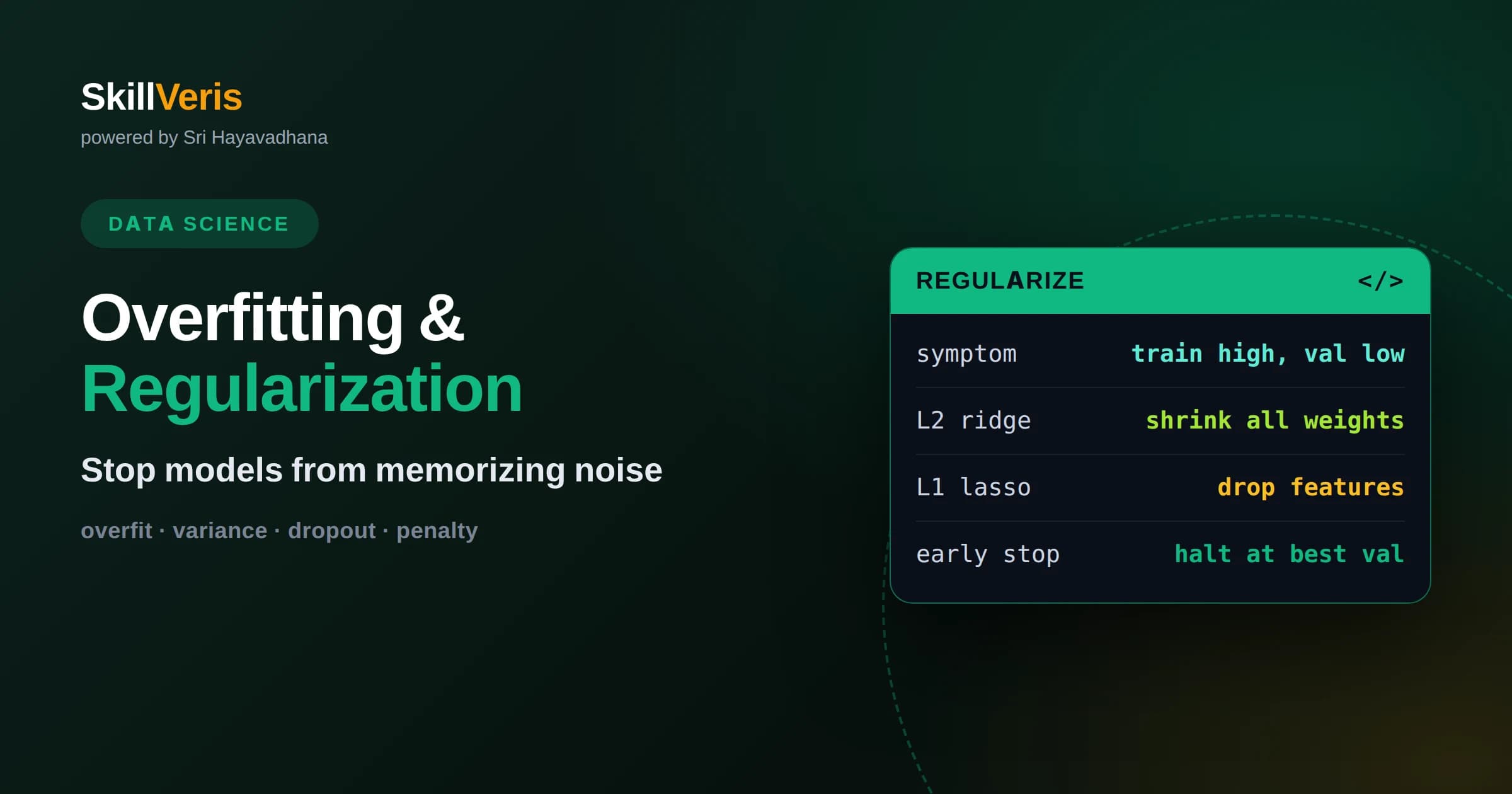
Overfitting happens when a model learns noise and quirks in the training data, scoring high on it but failing on new, unseen data.
In this guide, you'll learn:
- The telltale sign is a large gap between strong training performance and weak validation performance.
- Regularization techniques like L1, L2, dropout, and early stopping constrain a model so it favors simpler, more general patterns.
- The right cure depends on the model, but more data, simpler models, and honest validation are the most reliable defenses.
1What Is Overfitting
Overfitting is when a machine learning model learns the training data too well, capturing not just the real underlying patterns but also the random noise and quirks specific to that particular sample. As a result it scores impressively on the data it was trained on yet performs poorly on new, unseen data, which is the only performance that actually matters. The model has memorized rather than generalized.
A useful mental image is a student who memorizes the exact answers to last year's exam questions instead of understanding the concepts. Given the identical questions again, they ace the test. Given slightly different questions, they are lost. An overfit model is that student: brilliant on the familiar, helpless on the novel.
Overfitting matters because the entire point of building a model is to make good predictions on data you have not seen yet. A model that only performs on its training set is worse than useless, because it hides its weakness behind flattering training scores. Recognizing and preventing overfitting is therefore one of the core skills in all of applied machine learning.
2The Bias-Variance Tradeoff
Overfitting is best understood through the bias-variance tradeoff. Bias is error from a model being too simple to capture the real pattern, like trying to fit a straight line to a curved relationship. Such a model underfits: it is wrong in a consistent, systematic way regardless of the data it sees.
Variance is error from a model being too sensitive to the specific training data, changing wildly if you had trained it on a slightly different sample. High variance is the signature of overfitting. The tradeoff is that reducing one tends to increase the other: simplify a model to cut variance and you risk adding bias; add complexity to cut bias and you risk adding variance.
The goal is the sweet spot in the middle, where total error is lowest, capturing the real signal without chasing the noise. Regularization is largely about deliberately nudging a model toward slightly higher bias in exchange for a large reduction in variance, trading a little flexibility for a lot of stability.
3How To Spot Overfitting
The clearest symptom of overfitting is a large gap between training performance and validation performance. If your model scores very high on the data it trained on but noticeably lower on a held-out validation set, it has learned things that do not generalize. A small gap is normal; a wide and growing one is a warning.
Learning curves make this visible over time. If you plot training and validation error as training progresses, an overfitting model shows training error continuing to fall while validation error flattens and then starts to rise. That divergence point is the moment the model stops learning general patterns and starts memorizing noise.
You can only spot overfitting if you hold data back in the first place. That is why splitting your data into training, validation, and test sets is non-negotiable. Without a clean held-out set, an impressive training score tells you nothing about whether the model will work in the real world.
4What Causes Overfitting
Several conditions make overfitting more likely. A model that is too complex for the problem, with too many parameters relative to the amount of data, has enough flexibility to fit noise. Training for too long lets a model keep refining itself past the point of learning genuine patterns. And too little data gives the model so few examples that memorizing them all becomes feasible.
Noisy or messy data compounds the problem, because a flexible model happily fits the errors along with the signal. Having many irrelevant features also invites overfitting, since the model can latch onto coincidental correlations that vanish in new data. Recognizing which of these conditions applies to your situation points you toward the right cure.
5What Is Regularization
Regularization is any technique that constrains or penalizes a model to discourage it from becoming too complex, steering it toward simpler patterns that generalize better. Instead of letting the model minimize only its training error, regularization adds a preference for simplicity, so the model must justify every bit of complexity by a real reduction in error.
The intuition is that simpler explanations tend to generalize better than complicated ones. By tilting the model toward simplicity, regularization sacrifices a little training accuracy for a meaningful gain in performance on new data. It is one of the most reliable levers you have for turning an overfit model into a useful one.
It helps to see regularization as a conversation between two competing goals. One goal wants the model to fit the training data as closely as possible; the other wants it to stay simple. The regularization strength is the dial that sets who wins. Turn it too high and the model becomes so simple it underfits, missing real patterns; turn it too low and it overfits again. Finding the balance is the whole art, and it is why tuning that strength carefully matters so much.
6L2 Regularization: Ridge
L2 regularization, often called ridge, adds a penalty proportional to the sum of the squared weights to the loss function. Because large weights are punished heavily, the model is pushed to keep all its weights small and spread influence across many features rather than relying heavily on a few. This shrinks the model's sensitivity to any single input and reduces variance.
L2 rarely drives weights exactly to zero; instead it makes them small. That makes it a good default when you believe most features carry at least a little useful information and you simply want to prevent any of them from dominating. The strength of the penalty is controlled by a tuning parameter that you adjust to balance fit against simplicity.
7L1 Regularization: Lasso
L1 regularization, known as lasso, penalizes the sum of the absolute values of the weights rather than their squares. This seemingly small change has a striking effect: it drives some weights all the way to zero, effectively removing those features from the model. L1 therefore performs automatic feature selection alongside regularization.
That property makes L1 valuable when you suspect many of your features are irrelevant and you want a sparse, interpretable model that uses only the ones that matter. The two penalties can also be combined, blending L2's smooth shrinkage with L1's feature selection, giving you a dial between the two behaviors depending on what your problem needs.
A model that has zeroed out most of its features is not just less prone to overfitting; it is also easier to explain and cheaper to run. When someone asks which inputs actually drive a prediction, an L1-regularized model gives a short, honest answer instead of a tangle of tiny weights across every column. That interpretability is often as valuable as the accuracy gain itself.
8Dropout For Neural Networks
Dropout is a regularization technique designed for neural networks. During training it randomly switches off a fraction of the units in a layer on each pass, so the network never sees the same full architecture twice. Because any unit might disappear, the network cannot lean on a single unit or path and must learn redundant, robust features that survive the random deletions.
The effect is a bit like training a huge ensemble of slightly different networks and averaging them, which is a powerful defense against overfitting. At prediction time dropout is turned off and all units participate, with their outputs scaled to account for the training-time thinning. Choosing how aggressively to drop units is a tuning decision, with heavier dropout for larger, more overfit-prone networks.
What makes dropout appealing is how cheap and general it is. It adds almost no computational cost, requires no change to your loss function, and slots into most network designs with a single extra layer. For many practitioners it is the first thing to reach for when a network memorizes its training set, and it often works well enough on its own that heavier interventions become unnecessary.
9Early Stopping
Early stopping is one of the simplest and most effective ways to fight overfitting in iterative models. You monitor validation performance during training and stop as soon as it stops improving, even if training error would keep falling. This halts the model at the point where it has learned the general patterns but before it begins memorizing noise.
In practice you watch the validation error, keep the best-performing version of the model, and give the training a little patience so a brief plateau does not trigger a premature stop. Early stopping costs almost nothing to implement and pairs well with other regularization methods, which is why it is a staple of neural network training.
10More Data And Data Augmentation
Often the single most effective cure for overfitting is more data. With more examples, the model has less room to memorize and more incentive to learn patterns that hold across the whole dataset. Noise averages out, and coincidental correlations that fooled the model on a small sample fade away.
When gathering more real data is impractical, data augmentation can help, especially for images. By applying label-preserving transformations such as rotations, flips, crops, or small color changes, you generate new training examples from existing ones and teach the model to ignore irrelevant variations. Augmentation effectively enlarges the dataset and makes the model more robust without collecting anything new.
The guiding rule for augmentation is that each transformation must preserve the label. Flipping a photo of a cat still shows a cat, so a horizontal flip is safe, but flipping an image of a handwritten digit could turn one digit into another and teach the model something false. Choosing transformations that reflect the real variation your model will meet, and no more, is what makes augmentation a genuine cure rather than a source of new confusion.
11The Role Of Cross-Validation
Regularization introduces tuning parameters that control how much to constrain the model, and choosing them well requires honest evaluation. Cross-validation, which repeatedly trains on part of the data and tests on the rest, gives a more reliable estimate of how a setting will generalize than a single split can.
By comparing cross-validated performance across a range of regularization strengths, you can pick the setting that best balances fit and generalization. This turns regularization from guesswork into a measured decision. Keeping a final untouched test set aside ensures that even this tuning process does not quietly leak into your estimate of real-world performance.
12A Practical Anti-Overfitting Checklist
When a model overfits, work through a short checklist. First, confirm the problem by comparing training and validation performance. Then try the cheapest fixes: simplify the model, add regularization, and use early stopping. If the gap persists, seek more data or apply augmentation, and prune irrelevant features that give the model room to memorize.
Above all, resist the temptation to judge a model by its training score. Build the discipline of always evaluating on held-out data, tuning regularization with cross-validation, and reporting the final number only on a test set you never touched during development. That discipline, more than any single technique, is what protects you from shipping a model that looks great and fails in production.
13Practice Preventing Overfitting
Overfitting becomes intuitive once you deliberately cause it and then cure it. Train a flexible model on a small dataset until its validation error diverges, then watch each regularization technique pull the two curves back together. Feeling that effect firsthand is far more convincing than reading about it.
On SkillVeris you can work through hands-on lessons that let you overfit a model on purpose, plot learning curves, and apply L1, L2, dropout, and early stopping to see exactly how each one changes the picture. Building this instinct through practice means you will recognize and fix overfitting quickly in your own projects.
Related Reading
Get The Print Version
Download a PDF of this article for offline reading.
About the Publisher
SkillVeris Team
Data Science Team
Our data team shares real-world analytics, ML, and SQL insights grounded in industry practice.
View all postsRelated Posts


Never miss an update
Get the latest tutorials and guides delivered to your inbox.
No spam. Unsubscribe anytime.