Open-Source LLMs: A Practical Guide for 2026
SkillVeris Team
AI Research Team
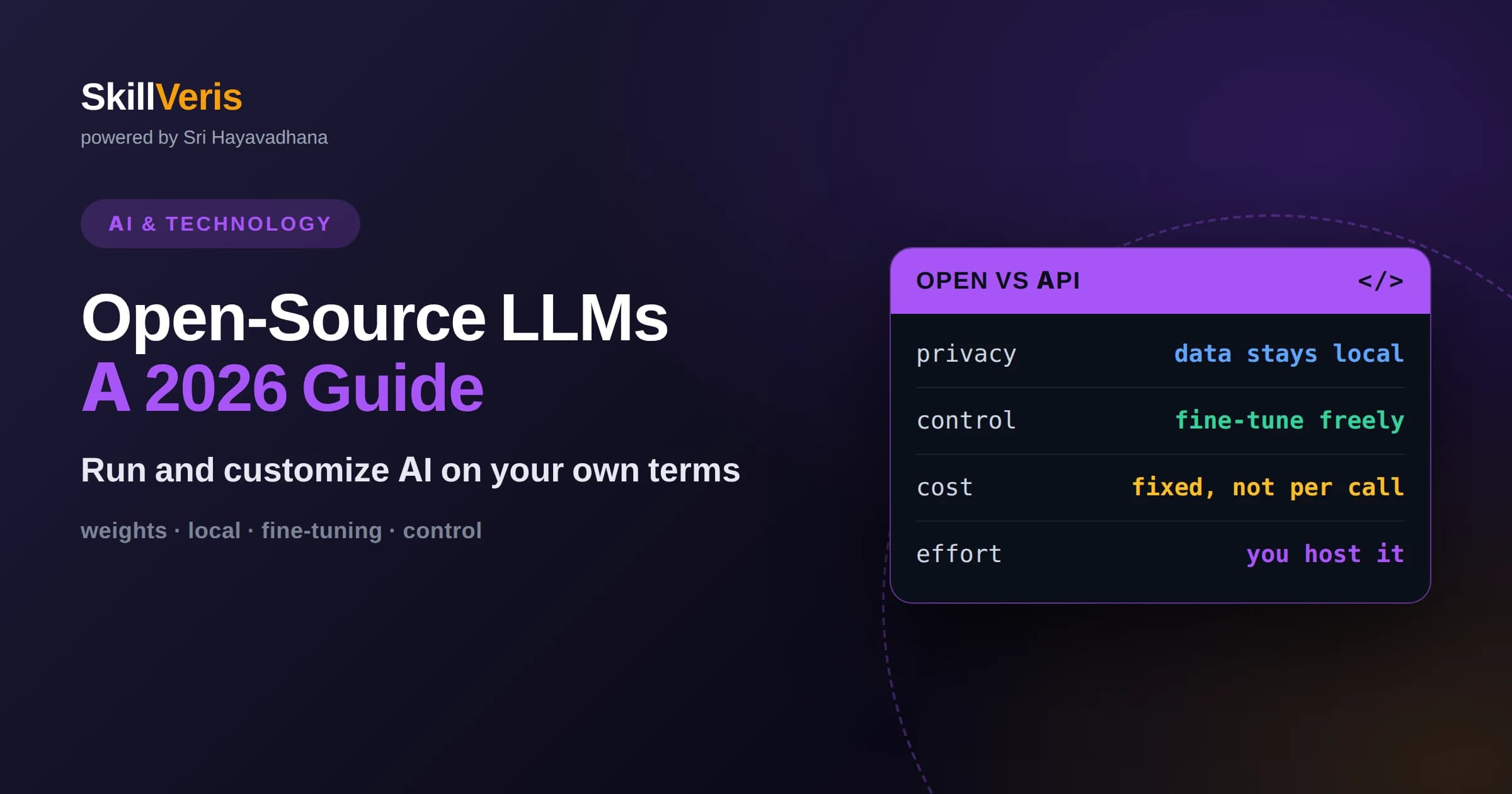
Open-source models can be downloaded and run on your own hardware, giving you control over privacy, cost, and customization.
In this guide, you'll learn:
- The main trade-off is convenience: you take on the work of hosting and maintaining that a hosted API handles for you.
- Open weights let you fine-tune a model on your own data and run it fully offline, which closed APIs cannot offer.
- Choosing between open and closed models is a practical decision driven by your needs for control, cost, and capability.
1What Open-Source Actually Means for Models
An open-source language model is one whose trained weights, the numbers that make up the model, are released publicly so anyone can download, run, and modify them. This is a fundamental difference from closed models, which you can only access through a provider's service and never hold in your own hands. With open weights, the model becomes something you possess rather than something you merely rent.
It is worth being precise about terminology, because the phrase open-source means different things across the field. Some models release only the weights under a permissive license, letting you use and adapt them freely. Others add the training code or even the data. For most practical purposes, the decisive property is whether you can download the weights and run the model yourself, which unlocks everything else this guide discusses.
This distinction shapes real choices. When you run a model you downloaded, your data never leaves your control, you decide exactly how it behaves, and your costs depend on your own hardware rather than a per-request price. Those properties are the reasons teams reach for open models, and they are unavailable with a closed service.
2Why Teams Choose Open Models
Privacy is often the first reason. If you work with sensitive data, sending it to an external service may be unacceptable for legal or competitive reasons. Running an open model on your own infrastructure means the data stays entirely within your walls. For regulated industries, this can be the deciding factor.
Control is the second. With the weights in hand, you can fine-tune the model on your own data to specialize it, adjust its behavior, and run it exactly as you wish without depending on a provider's roadmap or pricing changes. You are not subject to a service being deprecated or a rate limit imposed. The model does what you make it do.
Cost predictability is the third. A hosted service charges per use, which can be efficient at low volume but expensive at scale. Running your own model turns cost into a fixed investment in hardware plus running expenses, which can be far cheaper for heavy, steady workloads. You trade a variable bill for a capital and operational one.
3The Trade-Offs You Take On
Nothing is free, and the price of openness is responsibility. When you run a model yourself, you become the operator. You must provision hardware, keep the serving software running, handle scaling when demand rises, and fix things when they break. A hosted API absorbs all of that for you; with open models, it becomes your job.
There is also a capability consideration. The very largest and most capable models are often the closed ones, backed by enormous training investments. Open models have closed much of the gap and many are excellent, but at the absolute frontier of capability, a closed model may still lead. Whether that gap matters depends entirely on whether your task needs frontier performance or whether a strong open model is more than enough.
Weighing these trade-offs honestly is the heart of the decision. Openness buys control, privacy, and cost predictability at the price of operational effort and, sometimes, a modest capability step down. Neither choice is universally right; the correct answer depends on what your project values most.
4Running a Model on Your Own Hardware
Running an open model requires hardware capable of holding it in memory and performing its computations quickly, which usually means a capable graphics processor for larger models. The bigger the model, the more memory and compute it demands. This is why model size, usually described by the number of parameters, is such a practical concern: it directly determines what hardware you need.
Fortunately, tooling has matured enormously. User-friendly software now lets you download and run many open models on a personal computer with a single command, handling the technical details behind the scenes. This has made experimenting with open models accessible to individuals, not just organizations with server farms. You can try a capable model on a laptop and only scale up if your needs grow.
5Making Models Fit With Quantization
A key technique that makes open models practical to run is quantization, which shrinks a model by storing its numbers at lower precision. This dramatically reduces the memory a model needs, often letting a model that would not fit on your hardware suddenly run comfortably, with only a small loss in quality. It is one of the main reasons capable models can run on modest machines.
Because of quantization, the choice of what you can run is more flexible than raw model size suggests. A large model in a compressed form may run where its full-precision version would not. This flexibility is central to the open-model experience and is worth understanding in depth, which is why it has become a core topic for anyone deploying these models.
6Customizing With Fine-Tuning
One of the most compelling advantages of open weights is the ability to fine-tune: to continue training the model on your own examples so it specializes in your domain, tone, or task. A general model can be adapted into an expert on your product's documentation or your company's writing style. Closed services offer limited versions of this, but with open weights you have full freedom.
Techniques exist that make fine-tuning affordable, adjusting only a small part of the model rather than retraining the whole thing. This means specialization no longer requires the resources of a major lab. A small team can take a strong open base model and shape it into something tailored to their needs, which is a powerful capability that open weights make possible.
7The Open Model Ecosystem
Open models thrive within a rich ecosystem. Central repositories host thousands of models that anyone can download, along with the datasets and tools to work with them. Communities share fine-tuned variants, quantized versions optimized for different hardware, and guidance on getting the best results. This collective effort means you rarely start from scratch.
This ecosystem also drives rapid progress. When a strong new base model is released openly, the community quickly builds on it, producing specialized versions and improvements. The pace of this shared innovation is one of the great strengths of the open approach, and it means the landscape of available models keeps expanding and improving.
8Understanding Licenses
Not all open models can be used in the same ways, because each is released under a license that defines what you may do with it. Some licenses are highly permissive, allowing commercial use with few restrictions. Others limit commercial use, restrict certain applications, or require you to share modifications. Before building on a model, you must read and respect its license.
This matters especially for businesses. A model that is free to experiment with may carry conditions that affect a commercial product. Checking the license early prevents unpleasant surprises later. Treat licensing as a first-class part of choosing a model, not an afterthought, since it determines whether your intended use is actually permitted.
9When Open Models Make Sense
Open models are a strong choice when privacy is paramount, when you need to run offline or on your own infrastructure, when you want to fine-tune deeply, or when steady high volume makes per-request pricing costly. They also suit anyone who wants to learn how these systems work from the inside, since you can inspect and experiment freely.
A hosted closed model often makes more sense when you want the highest capability with zero operational burden, when your volume is low enough that per-request pricing is cheap, or when you simply want to move fast without managing infrastructure. Many teams end up using both, choosing the right tool for each task rather than committing entirely to one camp.
10Getting Started Practically
The best way to begin is to download a small, well-regarded open model and run it locally with one of the friendly tools available. Ask it questions, try it on a real task, and get a feel for its strengths and limits. This hands-on experience teaches more than any comparison chart and costs nothing but a little time.
From there you can explore quantized versions to run larger models, experiment with fine-tuning on a small dataset, and gradually build the judgment to know when an open model is the right choice. The barrier to entry has never been lower, and the learning compounds quickly once you start.
11Model Sizes and What They Mean for You
Open models come in a wide range of sizes, usually described by their number of parameters. Smaller models run on modest hardware and respond quickly but have less capability. Larger models are more capable but demand more memory and compute. Much of the practical work of using open models is picking a size that fits both your hardware and your task.
A useful insight is that you often do not need the biggest model. Many tasks, such as summarizing text, answering straightforward questions, or classifying content, are handled well by smaller models that run comfortably on everyday machines. Reaching for a giant model when a small one suffices wastes resources. Matching model size to actual need is one of the most valuable judgments you can develop.
This is also where techniques like compression come in, letting you run a larger model in a reduced form when its extra capability is worth the effort. The size you download and the size you run are not always the same, which gives you more flexibility than a single parameter count suggests.
12Community, Transparency, and Trust
A quiet advantage of open models is transparency. Because the weights are available, researchers and practitioners can study how a model behaves, probe its weaknesses, and build tools to improve it. This openness supports a healthier understanding of these systems than closed models allow, where the inner workings stay hidden behind a service.
That said, openness is not the same as guaranteed quality or safety. An open model can still carry biases or produce unreliable output, and because anyone can modify and share versions, you should be thoughtful about where you get a model from. Favoring well-known, widely used releases and reputable sources helps you avoid poorly made or tampered variants. Trust, here as elsewhere, is earned through reputation and scrutiny.
The healthy way to approach this is with the same care you would apply to any software you run. Check who released a model, how widely it is used, and what others have found when working with it. The transparency of open models makes this kind of due diligence possible, but it still falls to you to do it. Openness is an invitation to inspect, not a promise that inspection is unnecessary.
13Explore Open Models Hands-On
Understanding open models is one thing; running one yourself is another entirely. The moment you download a model and see it respond on your own machine, the concepts of weights, quantization, and fine-tuning become concrete rather than abstract.
On SkillVeris you can follow guided lessons that take you from running your first local model to fine-tuning one on your own data, with practical exercises at every step. Learning by doing is the surest way to develop real fluency with open-source AI, and there has never been a better time to start.
Related Reading
Get The Print Version
Download a PDF of this article for offline reading.
About the Publisher
SkillVeris Team
AI Research Team
Our AI team covers the latest in machine learning, generative AI, and emerging tech — clearly and accurately.
View all postsRelated Posts
Never miss an update
Get the latest tutorials and guides delivered to your inbox.
No spam. Unsubscribe anytime.