MLOps Explained: Deploy ML Models to Production
SkillVeris Team
AI Research Team
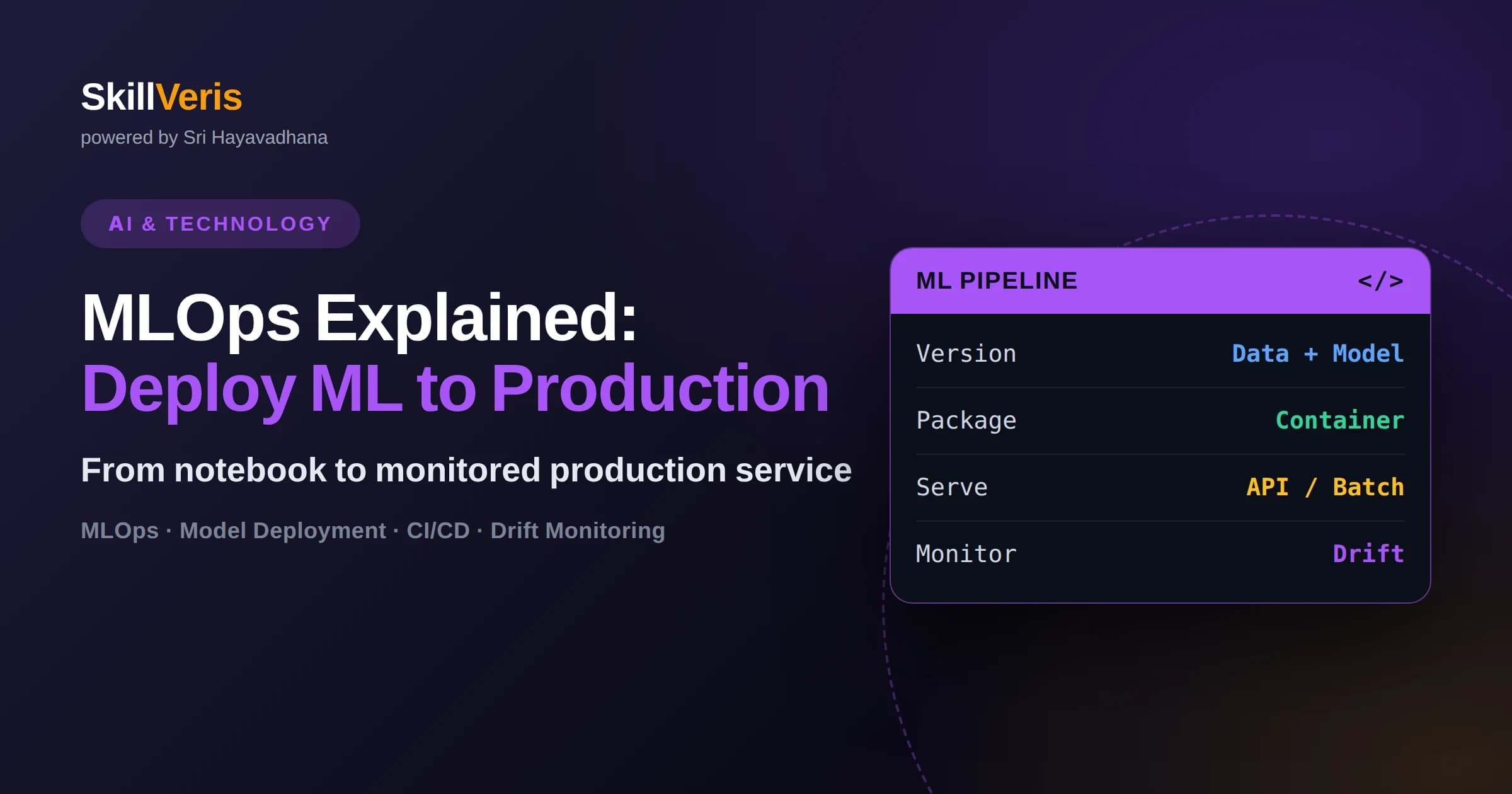
MLOps applies DevOps discipline — version control, automated testing, CI/CD — to the extra moving parts unique to machine learning: data, features, and trained models.
In this guide, you'll learn:
- A model that scores well in a notebook is not production-ready until it has a reproducible training pipeline, a versioned artifact, and a defined serving path.
- Real-time inference favors low-latency APIs behind a model server, while batch inference favors scheduled jobs that score large datasets at once.
- Production models degrade silently through data drift and concept drift, which is why monitoring input distributions and prediction quality is non-negotiable.
- A model registry gives every deployed model a traceable lineage back to the exact data, code, and hyperparameters that produced it.
1MLOps Explained: What It Actually Means to Deploy ML to Production
MLOps explained simply: it's the set of practices, tooling, and automation that takes a trained machine learning model out of a notebook and turns it into a reliable, monitored, continuously improving service running in production.
The term borrows heavily from DevOps, and for good reason — both disciplines are about closing the gap between 'it works on my machine' and 'it works reliably for real users, at scale, over time.' But machine learning adds a layer DevOps was never designed for: data. A traditional application's behavior is determined by its code. A machine learning system's behavior is determined by its code, its training data, and the statistical patterns learned from that data — three things that all need to be versioned, tested, and monitored independently.
This guide walks through what MLOps actually involves in practice: why casual deployment approaches fail, how the ML lifecycle differs from a standard software lifecycle, how to package and serve a model, how to catch silent degradation before it hurts users, and what a realistic, non-hype tooling landscape looks like in 2026.
2Why 'It Works on My Laptop' Isn't a Deployment Strategy
A model that produces great accuracy in a Jupyter notebook fails in production because a notebook has no reproducibility guarantees, no versioned dependencies, no defined input contract, and no plan for what happens when the world changes after training day.
Consider the common failure pattern: a data scientist trains a model locally, pickles it, and hands the file to an engineer to 'just deploy it.' The engineer discovers the notebook used a library version that's since changed behavior, that several preprocessing steps existed only as ad-hoc cells run in a specific undocumented order, and that the training data was pulled from a database snapshot nobody saved. Reproducing the exact model — let alone retraining it safely later — becomes close to impossible.
Production also introduces constraints a notebook never has to deal with: concurrent requests, latency budgets, uptime expectations, and a live stream of input data that will inevitably start looking different from the training set. None of that is solved by a bigger GPU or a cleverer algorithm — it's solved by process and infrastructure, which is exactly what MLOps provides.
- No dependency pinning means a re-run months later can silently produce a different model
- No data versioning means you can't reproduce or audit what the model actually learned from
- No serving contract means downstream consumers don't know what input shape or format to expect
- No monitoring means degradation is discovered by angry users, not by the team
3The ML Lifecycle: Data Versioning, Training Pipelines, and Model Registries
The ML lifecycle differs from a standard software lifecycle by adding three ML-specific stages before code ever reaches production: data versioning, an automated training pipeline, and a model registry that tracks every artifact produced.
Data versioning treats datasets the way Git treats source code — every training run references an exact, immutable snapshot of the data it used, so results can be reproduced and debugged later. Tools in this space (DVC, LakeFS, or dataset versioning built into a feature store) hash and track data alongside code commits, so a bug report months later can be traced back to precisely what the model saw during training.
A training pipeline turns the ad-hoc notebook steps — cleaning, feature engineering, splitting, training, evaluation — into an automated, parameterized, repeatable workflow, typically orchestrated with tools like Airflow, Kubeflow Pipelines, or a managed equivalent. The pipeline should be triggerable on demand or on a schedule, and it should fail loudly if an evaluation metric drops below a defined threshold rather than silently promoting a worse model.
The model registry is the connective tissue: every training run produces a versioned model artifact along with its metrics, its lineage (which data and code version produced it), and its current stage (staging, production, archived). MLflow's Model Registry and cloud-native equivalents like Vertex AI Model Registry or SageMaker Model Registry serve this role. Without a registry, 'which model is actually running in production right now' becomes a question nobody can answer confidently.
4Packaging and Serving a Model: Containers, APIs, and Inference Modes
Packaging and serving a model means wrapping the trained artifact in a consistent runtime environment — almost always a container — and exposing it through either a real-time API or a batch scoring job, depending on how the prediction will be consumed.
Containerizing a model with Docker solves the same dependency-drift problem that plagues local notebooks: the exact library versions, system packages, and runtime used at training time travel with the model into production. On top of the container, most teams add a dedicated model-serving layer — options range from a lightweight FastAPI/Flask wrapper for simple cases to purpose-built servers like TensorFlow Serving, TorchServe, or NVIDIA Triton Inference Server, which add batching, GPU scheduling, and multi-model hosting out of the box.
Real-time inference serves predictions synchronously through an API, typically with a latency budget measured in milliseconds — think fraud scoring on a checkout page or a recommendation shown as a user scrolls. Batch inference instead scores a large volume of records on a schedule, writing results to a table or file for downstream use — think overnight churn-risk scoring for an entire customer base. The two have very different infrastructure needs: real-time demands autoscaling, load balancing, and tight latency SLAs, while batch demands efficient large-scale compute and simpler cost-per-record optimization. Choosing the wrong mode for the use case is one of the most common and expensive deployment mistakes.
- Real-time inference: low-latency API, autoscaling, per-request cost, used for user-facing predictions
- Batch inference: scheduled job, high throughput, lower cost per prediction, used for periodic scoring
- Streaming inference: a middle ground scoring events as they arrive from a message queue, common in fraud and anomaly detection
5Monitoring for Model and Data Drift in Production
Monitoring for drift in production means continuously comparing the statistical properties of live input data and model predictions against the training baseline, because a model's accuracy degrades silently as the real world diverges from the data it learned on.
Data drift occurs when the distribution of input features shifts — a fraud model trained on pre-holiday spending patterns will see very different transaction profiles during a sales season. Concept drift is subtler and more dangerous: the relationship between inputs and the correct output itself changes, so even stable-looking input data now maps to a different correct answer. Both are typically detected using statistical distance metrics (population stability index, KL divergence, or simple summary-statistic comparisons) run on a schedule against a stored reference distribution.
Because ground-truth labels often arrive late or never (nobody tells you whether a churn prediction was 'correct' for months), teams also track proxy signals: prediction distribution shifts, feature null-rate spikes, latency and error rates, and business KPIs tied to the model's output. Tools like Evidently, WhyLabs, Arize, and the monitoring modules built into most cloud ML platforms exist specifically to automate this comparison and alert before a slow degradation becomes a visible incident.
6CI/CD for Machine Learning Pipelines
CI/CD for ML extends traditional continuous integration and delivery by adding data validation and model evaluation as required gates, so a pipeline can automatically retrain, test, and promote a model — or block it — without a human manually copying files around.
Continuous integration for ML runs automated checks whenever code, data, or a training configuration changes: unit tests for the preprocessing and feature logic, data validation checks (schema, ranges, null rates), and a fast smoke-training run to catch broken pipelines early. Continuous delivery then extends this to the model itself — retraining on fresh data, evaluating against a held-out set and against the currently deployed model, and only promoting the new version if it clears a defined bar (not just 'better,' but better by enough to justify the retraining and rollout cost).
The rollout step itself benefits from the same techniques used in general software delivery: shadow deployment (running the new model alongside the old one without serving its predictions, purely to compare), canary releases (routing a small percentage of traffic to the new model first), and blue-green deployment for instant rollback if a regression appears. The goal across all of this is the same one DevOps chased for regular software: make deployment boring, frequent, and reversible instead of rare, risky, and manual.
7A Realistic MLOps Tooling Landscape
A realistic MLOps toolchain covers five layers — experiment tracking, data/pipeline orchestration, model registry, serving infrastructure, and monitoring — and most teams assemble a combination rather than adopting a single all-in-one platform.
For experiment tracking and the model registry, MLflow remains a widely used open-source default, alongside Weights & Biases for richer experiment visualization. For orchestration, Apache Airflow and Kubeflow Pipelines are common choices, with Prefect and Dagster as newer alternatives favored for their developer ergonomics. For serving, teams choose between managed platform offerings (SageMaker, Vertex AI, Azure ML) that bundle most of the stack, or a self-managed combination of Docker, Kubernetes, and a dedicated model server like TorchServe or Triton for more control and portability. For monitoring, dedicated ML observability tools sit alongside general infrastructure monitoring (Prometheus/Grafana) since a healthy container tells you nothing about whether the model's predictions still make sense.
The honest takeaway for anyone starting out: no single tool 'is' MLOps, and chasing a perfect toolchain before shipping anything is a common trap. A small team can get real value from a simple, disciplined combination — versioned data, a registry, a container, a monitoring dashboard — long before they need a sprawling platform. If you want a structured, project-based way to build these skills end to end, SkillVeris runs a hands-on MLOps & Model Deployment course covering exactly this pipeline, from training through monitoring.
8Frequently Asked Questions
Q: What is MLOps in simple terms? A: MLOps is the practice of applying DevOps-style automation, versioning, and monitoring to the full machine learning lifecycle — data, training, deployment, and ongoing performance — so models run reliably in production instead of staying stuck in notebooks.
Q: How do you deploy a machine learning model to production? A: Package the trained model and its dependencies in a container, expose it through a real-time API or a batch scoring job depending on the use case, register the artifact in a model registry, and connect it to monitoring before routing live traffic to it.
Q: What is the difference between MLOps and DevOps? A: DevOps manages code and infrastructure; MLOps manages code, infrastructure, data, and trained models together, adding data versioning, model evaluation gates, and drift monitoring that traditional DevOps pipelines don't need.
Q: What is model drift and why does it matter? A: Model drift is the gradual mismatch between what a model learned during training and the patterns present in live production data; it matters because it degrades accuracy silently, without any error or crash to alert you.
Q: Do I need Kubernetes to do MLOps? A: No — Kubernetes helps at scale for managing containerized model servers, but small teams can practice solid MLOps with a simpler setup of a model registry, a container, a scheduled retraining pipeline, and a monitoring dashboard.
Q: What's the difference between batch and real-time inference? A: Real-time inference serves predictions synchronously through an API with strict latency requirements, while batch inference scores large volumes of data on a schedule and writes results for later use, trading immediacy for efficiency and lower cost.
Related Reading
Get The Print Version
Download a PDF of this article for offline reading.
About the Publisher
SkillVeris Team
AI Research Team
Our AI team covers the latest in machine learning, generative AI, and emerging tech — clearly and accurately.
View all postsRelated Posts
Never miss an update
Get the latest tutorials and guides delivered to your inbox.
No spam. Unsubscribe anytime.