MLOps Explained: From Model to Production
SkillVeris Team
Data Science Team
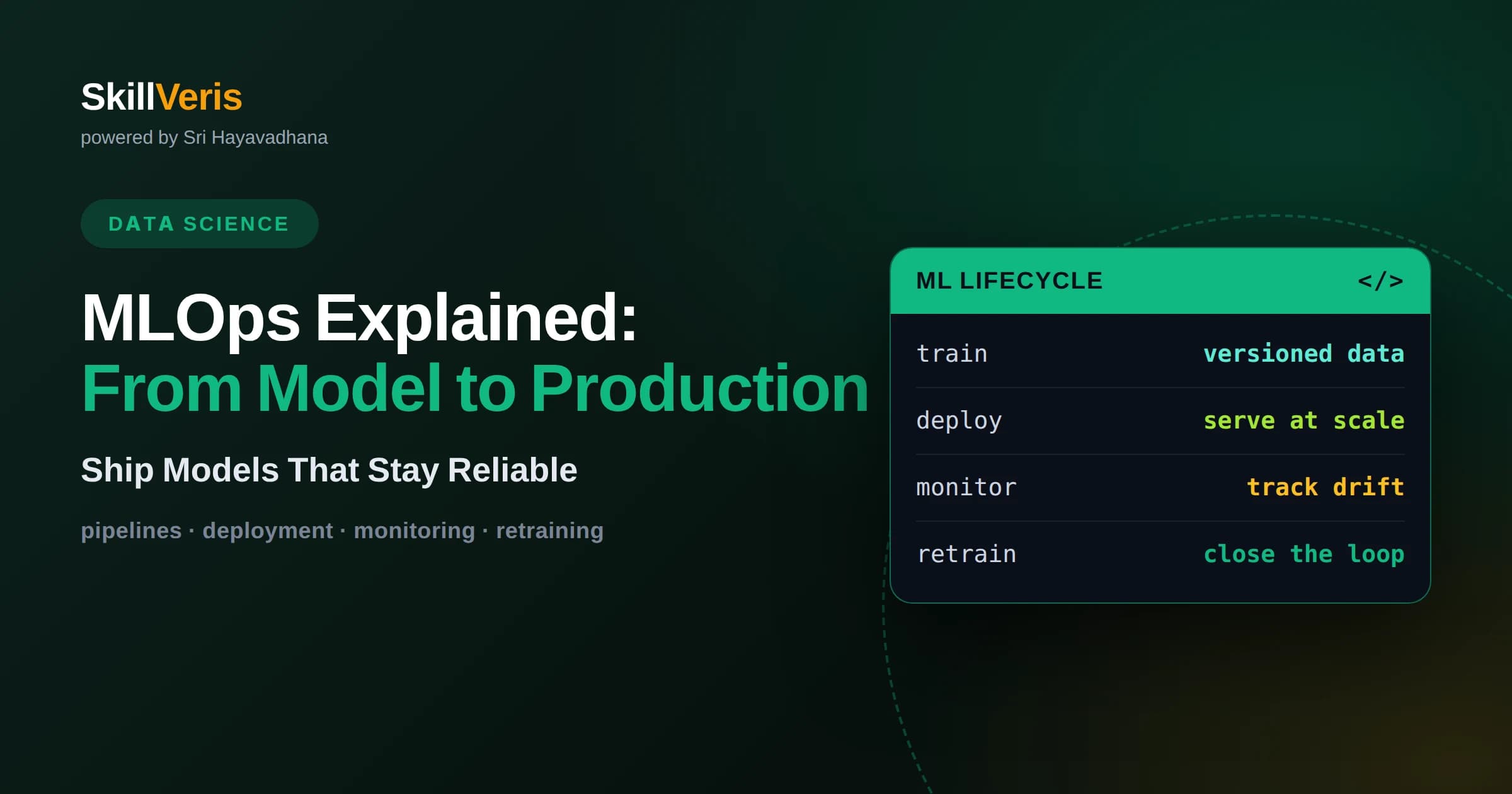
MLOps is the set of practices that takes a machine learning model from a notebook experiment to a monitored, reproducible service running in production, applying DevOps discipline to the unique demands of data and models.
In this guide, you'll learn:
- Unlike traditional software, ML systems can fail silently when the live data drifts away from the training data, so continuous monitoring of inputs and predictions is as important as the model's original accuracy.
- A production ML workflow needs versioning of code, data, and models together, automated pipelines for training and deployment, and a model registry that tracks which version is serving traffic and why.
- You can learn MLOps hands-on through SkillVeris's MLOps & Model Deployment course, which explains each stage of the lifecycle using the hobby analogy of your choice so the concepts stick.
1What Is MLOps, Really?
MLOps, short for Machine Learning Operations, is the discipline of reliably building, deploying, and maintaining machine learning models in production. If a data scientist trains a model that predicts customer churn or classifies images, MLOps is everything that happens between that promising notebook result and a service that answers real requests around the clock without breaking. It borrows heavily from DevOps but adds the extra dimensions that make ML different: data, experiments, and models that decay over time.
The core problem MLOps solves is that a model is never really finished. A trained model is a snapshot of patterns in the data it saw. The moment it goes live, the world keeps moving, new data arrives, user behaviour shifts, and the assumptions baked into the model slowly go stale. MLOps provides the automation, versioning, and monitoring needed to keep that model healthy, to retrain it when needed, and to roll back safely when something goes wrong.
Put simply, if machine learning is about creating a model, MLOps is about keeping that model useful, trustworthy, and reproducible for months and years after its first successful run. It turns a one-off experiment into a dependable part of a product.
2Why MLOps Matters
Many teams can train a decent model in an afternoon, yet struggle for months to get it into production and keep it there. The gap between a working prototype and a production system is where most machine learning projects stall or quietly die. Models that never ship deliver zero value, and models that ship but are never monitored can silently start making bad decisions that erode trust and cost money.
MLOps matters because ML systems have more moving parts than ordinary software. A regular application depends on code. An ML application depends on code, on the data used to train it, on the specific model artifact produced, and on the live data flowing through it. Any one of those can change independently and break the system. Without discipline, teams lose track of which data trained which model, cannot reproduce a result from three months ago, and cannot explain why yesterday's predictions were fine but today's are not.
By treating the whole pipeline as engineered infrastructure rather than a collection of manual steps, MLOps makes ML projects repeatable and auditable. That reliability is what lets organisations depend on models for real decisions instead of treating them as fragile science experiments.
3The Machine Learning Lifecycle
The ML lifecycle is the loop a model travels through from idea to retirement. It usually starts with a business problem and data collection, moves through data preparation and feature engineering, then into model training and evaluation, and finally into deployment, monitoring, and eventual retraining. Crucially it is a loop, not a straight line, because monitoring feeds insights back into new rounds of data collection and training.
Each stage produces artifacts that later stages depend on. Data preparation produces cleaned datasets and feature definitions. Training produces model files, metrics, and hyperparameters. Deployment produces a running service and configuration. MLOps ties these stages together so that a change early in the loop, such as a new data source, flows predictably through to a new deployed model rather than requiring someone to manually redo every step from memory.
Understanding the lifecycle as a whole is what separates MLOps from simply knowing how to train a model. The training step is often the smallest and easiest part. The surrounding stages of getting data reliably, serving predictions at scale, and watching for decay are where most real engineering effort goes.
4Training Versus Serving
Training and serving are two very different worlds, and confusing them is a common source of bugs. Training is a batch, resource-heavy process: you gather a large dataset, run it through an algorithm many times, and produce a model artifact. It can take minutes or days, it usually runs on powerful hardware, and it happens occasionally. Serving, or inference, is the opposite: it must answer a single request in milliseconds, run cheaply, and stay available continuously.
A classic failure is training-serving skew, where the data a model sees in production is transformed differently from the data it was trained on. If a feature was scaled one way during training and another way at serving time, the model receives inputs it never really learned from and its accuracy quietly collapses. Good MLOps practice shares feature transformation code between training and serving, or uses a feature store, so both paths compute inputs identically.
Thinking clearly about these two modes also shapes architecture choices. Some systems serve predictions in real time from a live endpoint, while others precompute predictions in a nightly batch and store them for fast lookup. The right choice depends on how fresh the predictions must be and how expensive inference is.
5CI/CD for Machine Learning Models
Continuous integration and continuous delivery, familiar from software engineering, extend naturally into MLOps but gain new stages. In traditional CI/CD, code is tested and automatically deployed when tests pass. For ML, the pipeline additionally validates data, trains or retrains the model, evaluates it against a threshold, and only promotes it if it beats the current production model on agreed metrics.
This automation matters because manual model deployment is slow and error-prone. When retraining requires a person to run a notebook, copy files around, and update a server by hand, mistakes creep in and releases become rare and scary. An automated pipeline turns retraining into a routine, repeatable event: new data triggers training, evaluation gates catch regressions, and a passing model is packaged and deployed the same way every time.
A mature ML pipeline also includes rollback. If a freshly deployed model starts behaving badly in production, the system should be able to revert to the previous known-good version quickly and automatically. Treating models as versioned, deployable artifacts, just like application builds, is what makes this possible.
6The Model Registry
A model registry is a central catalogue of trained models and their versions. Instead of models living as loose files on someone's laptop or in a random cloud bucket, the registry records each model along with its version number, the metrics it achieved, the data and code that produced it, and its current stage, such as staging, production, or archived. It becomes the single source of truth for what is deployed and why.
The registry answers questions that are otherwise painful to resolve. Which model is currently serving live traffic? What accuracy did it achieve? Who approved its promotion? If a problem appears, which previous version should we roll back to? Without a registry these answers live in chat messages and human memory, which fails exactly when you need them most, during an incident.
Registries also enable governance and auditability. In regulated settings you may need to prove which model made a particular decision months ago, and reproduce it. By linking each registered model back to its exact training run and data version, the registry makes that traceability practical rather than a heroic archaeology exercise.
7Monitoring and Drift Detection
Monitoring is arguably the part of MLOps that most distinguishes it from ordinary software operations. A normal service is monitored for uptime, latency, and errors, and ML services need all of that too. But an ML service can be perfectly healthy by those measures while making increasingly wrong predictions, because the model's accuracy is not visible in server logs. You have to watch the data and the predictions themselves.
The key phenomenon to watch for is drift. Data drift happens when the distribution of incoming features moves away from what the model was trained on, for example when a new customer segment starts using the product. Concept drift happens when the relationship between inputs and the correct answer itself changes, such as fraud patterns evolving to evade detection. Both degrade a model even though the code never changed.
Effective monitoring tracks input distributions, prediction distributions, and, wherever ground truth eventually arrives, real accuracy over time. When these signals cross alert thresholds, the system flags that the model may need retraining. Catching drift early is the difference between a model that gracefully adapts and one that silently rots until a stakeholder notices the damage.
8Reproducibility and Versioning
Reproducibility means being able to recreate a model result exactly, and it is harder in ML than in ordinary software because you must version three things at once: code, data, and the model artifact, along with the environment and random seeds. A result that cannot be reproduced cannot be trusted, debugged, or defended, so reproducibility sits at the foundation of serious MLOps.
Data versioning is the piece teams most often neglect. Code lives comfortably in version control, but datasets are large and change over time, and pointing at a moving dataset makes results impossible to reproduce. Tools that snapshot or hash datasets let you tie a specific model to the exact data it saw. Combined with recorded hyperparameters and pinned dependency versions, this lets anyone rebuild the same model from scratch.
The practical payoff is trust and speed. When every experiment is tracked and every artifact is versioned, comparing two models is a matter of reading recorded metrics rather than rerunning everything from memory, and reproducing a six-month-old result is routine rather than heroic.
9The MLOps Tooling Landscape
The MLOps ecosystem is broad, and it helps to think in categories rather than memorising product names. There are experiment trackers that record metrics and parameters across training runs, data and pipeline orchestration tools that schedule and connect the stages of a workflow, model registries that catalogue versions, serving frameworks that expose models as endpoints, and monitoring tools that watch data and predictions in production.
Containerisation and orchestration underpin much of this. Packaging a model and its dependencies into a container makes it portable and reproducible across environments, and orchestration platforms scale those containers to handle load. This is exactly why MLOps and container skills overlap so much, and why learning containers pays off directly when you deploy models. Many teams also rely on feature stores to keep training and serving features consistent.
No single tool covers everything, and healthy MLOps setups combine several. The goal is not to collect tools but to cover the capabilities: track experiments, version data and models, automate pipelines, serve reliably, and monitor continuously. Once you can name the capability a tool provides, evaluating any specific product becomes much easier.
10Common MLOps Pitfalls
The most common pitfall is treating deployment as the finish line. Teams celebrate shipping a model and then stop paying attention, only to discover months later that it has been quietly degrading. Deployment is the start of the model's operational life, not the end of the project, and budgeting for ongoing monitoring and retraining from the outset avoids this trap.
Another frequent mistake is manual, undocumented processes. When retraining depends on one person's notebook and tribal knowledge, the system becomes fragile and unmaintainable the moment that person is unavailable. Similarly, skipping data validation lets malformed or unexpected inputs flow straight into training or serving, producing garbage models or garbage predictions with no warning.
Finally, many teams over-engineer too early. Building an elaborate platform for a model that serves a handful of predictions a day wastes effort, while a critical model gets none of the monitoring it needs. Matching the level of MLOps investment to the model's importance and traffic keeps the effort proportionate and sustainable.
11How to Get Started with MLOps
You do not need to adopt every practice at once. A sensible starting point is to get versioning under control: put your code in version control, snapshot the data your models train on, and record the metrics and parameters of every experiment. Even this basic discipline eliminates a huge class of untraceable, unreproducible problems.
From there, automate the path from training to deployment one step at a time. Wrap your model in a simple serving interface, package it in a container so it runs the same everywhere, and add a basic monitoring check that alerts you when input data looks unusual or prediction patterns shift. Each increment makes the system more reliable without requiring a giant platform overhaul.
The mindset that ties it together is treating your ML system as a living product that needs operations, not a finished artifact. Start small, monitor from day one, and add automation where manual steps hurt most. That incremental approach builds real, durable MLOps capability.
12Learning MLOps on SkillVeris
SkillVeris offers a dedicated MLOps and Model Deployment course that walks through the entire lifecycle described here, from packaging a trained model to running it in production and monitoring it for drift. Rather than dumping abstract theory, the course builds each concept step by step so that pipelines, registries, and monitoring stop feeling like buzzwords and start feeling like tools you can actually reach for.
What makes the learning stick is SkillVeris's hobby personalisation. Every lesson can explain a concept through an analogy drawn from something you already enjoy, whether that is cricket, cooking, music, or gaming, so an idea like concept drift or training-serving skew connects to intuition you already have. The same rigorous content simply meets you where your interests are, which makes dense operational topics far easier to absorb.
Because the platform is free, you can work through the MLOps course alongside related material on containers, deep learning frameworks, and large language models, building a connected picture of how modern ML systems are actually run. Learning MLOps in context, next to the model-building skills it supports, is the fastest route from writing a model to confidently shipping one.
Related Reading
Get The Print Version
Download a PDF of this article for offline reading.
About the Publisher
SkillVeris Team
Data Science Team
Our data team shares real-world analytics, ML, and SQL insights grounded in industry practice.
View all postsRelated Posts
Never miss an update
Get the latest tutorials and guides delivered to your inbox.
No spam. Unsubscribe anytime.