LLM Quantization Explained: Smaller, Faster Models
SkillVeris Team
AI Research Team
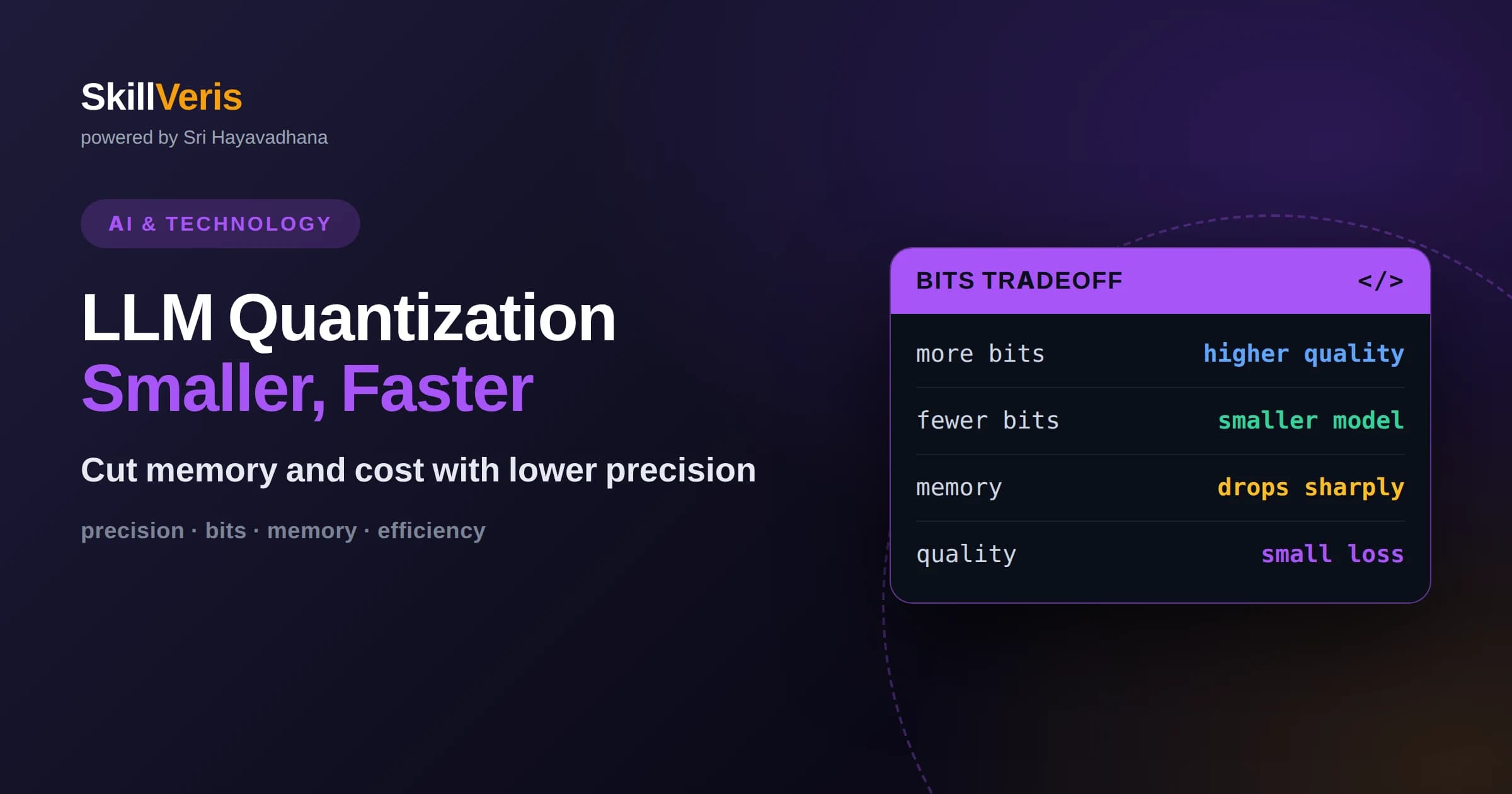
Quantization stores a model's numbers using fewer bits, dramatically reducing the memory it needs to run.
In this guide, you'll learn:
- A model that once required expensive hardware can often run on a laptop after quantization, with only modest quality loss.
- The trade-off is precision for efficiency: fewer bits mean a smaller, faster model that is slightly less accurate.
- Quantization is a major reason powerful open models are practical to run on everyday hardware.
1What Quantization Is
Quantization is the process of shrinking a language model by storing the numbers inside it using less precision. A model is made of billions of numerical values called weights, and normally each is stored in a format that uses many bits to capture fine detail. Quantization rounds these numbers to a coarser format that uses far fewer bits, which makes the whole model much smaller.
The immediate payoff is memory. A model stored with fewer bits per number takes up a fraction of the space, which means it needs far less memory to load and run. This is what lets a model that would have demanded expensive specialized hardware suddenly fit on a consumer machine. Quantization is, at its core, a compression technique tuned specifically for neural networks.
The reason this works without ruining the model is that language models are surprisingly tolerant of small errors in their weights. Rounding each number slightly introduces a little noise, but the model as a whole still behaves almost the same. This tolerance is the fortunate property that makes quantization practical rather than destructive.
2Understanding Numerical Precision
To grasp quantization, it helps to understand what precision means. A number stored with more bits can represent finer distinctions and a wider range of values. A number stored with fewer bits can only take on a limited set of values, so it must round to the nearest one it can express. More bits mean more faithful numbers; fewer bits mean coarser approximations.
Full-precision models typically store each weight in a format using many bits, giving them very fine-grained values. Quantization moves to formats with fewer bits, such as representing each weight in eight bits or even four. Cutting from sixteen bits down to four, for example, shrinks that part of the model to a quarter of its size, a dramatic saving.
This is the essential lever. The fewer bits you use per weight, the smaller and faster the model, but the coarser each number becomes. Choosing how far to push this is the central decision in quantization, balancing size against fidelity.
3Why Models Survive Being Compressed
It might seem that rounding billions of numbers would wreck a model, but in practice it does not. Neural networks distribute their knowledge across many weights, so no single value is critical. When each weight is nudged slightly by rounding, the errors are small and tend to average out rather than compound into failure.
This robustness has limits. Push the precision too low and the accumulated rounding errors begin to degrade the model's quality noticeably, causing it to make more mistakes or produce weaker output. The art of quantization is finding the point where the model is much smaller and faster but has not yet lost meaningful capability. Fortunately, that sweet spot is often quite favorable.
4The Core Trade-Off
Every quantization choice trades precision for efficiency. Using fewer bits gives you a smaller model that loads faster, uses less memory, and often runs quicker, but each reduction in precision risks a small drop in quality. The question is always how much quality you are willing to give up for how much saving.
In practice, moderate quantization often costs very little quality while saving a great deal of memory, which is why it is so widely used. More aggressive quantization saves even more but starts to show its effects. Knowing where your task sits on this spectrum, how much quality loss you can tolerate, guides how far you should compress a given model.
5How Quantization Is Applied
There are two broad moments at which quantization can happen. The most common is after training: you take a fully trained model and convert its weights to lower precision. This is simple and requires no retraining, and it works well for most cases. Many downloadable quantized models are made this way.
The other approach involves accounting for quantization during training itself, so the model learns to be robust to the coarser numbers it will eventually use. This can preserve more quality at very low precision but requires more effort. For most people using open models, the after-the-fact approach is what they encounter, since ready-made quantized versions are widely shared.
In either case, the result is a model file that is smaller and ready to run on less capable hardware. Understanding that quantization is usually a conversion step applied to an existing model demystifies where those compact model files come from.
6The Practical Impact on Running Models
Quantization is a major reason the open model movement is accessible to ordinary users. Without it, running a capable model would require costly, memory-heavy hardware out of reach for most individuals. With it, the same model in compressed form can run on a laptop or a modest desktop, opening these tools to a vastly wider audience.
The speed benefit matters too. Smaller numbers can often be processed faster, so a quantized model may respond more quickly as well as fit in less memory. For interactive uses where responsiveness counts, this is a real advantage. Quantization improves both of the resources that most constrain running models: memory and speed.
7Choosing a Quantization Level
When you download an open model, you often find several quantized versions at different precision levels. Choosing among them is a practical matter of matching your hardware and your quality needs. If you have generous memory, a higher-precision version preserves more quality. If memory is tight, a more compressed version lets the model fit at some cost to quality.
A sensible strategy is to start with a moderately quantized version, which usually offers an excellent balance, and only move to a more aggressive one if you must fit tighter constraints, or a less aggressive one if you have room and want maximum quality. Trying a couple of levels on your own task quickly reveals where the acceptable line sits for you.
8What Parts of a Model Get Compressed
Not every part of a model must be quantized to the same degree. Some components are more sensitive to precision loss than others, and thoughtful quantization schemes keep the sensitive parts at higher precision while compressing the rest more aggressively. This mixed approach captures most of the memory savings while protecting the parts of the model that matter most to quality.
This is why quantization is more nuanced than simply rounding everything uniformly. The better methods are selective, spending precision where it counts and saving it where it does not. Appreciating this helps explain why some quantized models hold up better than others even at similar overall sizes.
It also explains why two versions labeled with the same rough precision can differ in quality. The method used to decide what to compress, and how carefully it protects the sensitive parts, matters as much as the headline bit count. When you compare quantized models, it is worth looking beyond the size number to how well the version actually performs on real tasks, since the craftsmanship of the compression is not visible from the label alone.
9The Limits of Quantization
Quantization is powerful but not magic. There is a floor below which a model simply cannot retain its capabilities, no matter how clever the method. Compress too far and quality falls off sharply, so you cannot shrink a model indefinitely. The savings are real but bounded.
It is also worth remembering that quantization reduces size and can speed things up, but it does not make a weak model strong. A small model quantized lightly is still a small model. Quantization changes how efficiently a given model runs, not how capable that model fundamentally is. Keeping these two dimensions distinct prevents confusion when choosing what to run.
10Quantization in the Bigger Picture
Quantization sits alongside other techniques that make powerful models practical, and together they have democratized access to capable AI. It pairs naturally with the open model ecosystem, where compressed versions of strong base models are shared so that anyone can run them. Understanding quantization therefore unlocks much of what makes running your own models feasible.
As models continue to grow, techniques for running them efficiently only become more important. Quantization is one of the most effective and widely used of these, and a solid grasp of it prepares you to make smart choices about deploying models on real hardware within real constraints.
11How to Tell If Quantization Hurt
Because quantization trades a little quality for efficiency, you want a way to check whether that trade was worth it for your task. The honest method is to run the quantized model on examples you care about and compare its output to the full-precision version or to your own standard of a good answer. Numbers on a chart are helpful, but seeing the model handle your real prompts tells you what you actually need to know.
Sometimes the loss is invisible for your purpose, and the quantized model performs just as well while using a fraction of the memory. Other times, on harder or more precise tasks, the degradation shows up clearly. The only reliable way to know which case you are in is to test on work that resembles your own, since the effect of quantization is not uniform across all kinds of tasks.
This is why practitioners rarely trust a single quantized version blindly. They evaluate a couple of levels against their needs and pick the one that gives the best balance. The compression is only worthwhile if the model still does its job, and confirming that is a quick, worthwhile step.
12Why Quantization Powers Open AI
Quantization and the open model movement reinforce each other. Open weights let anyone compress and share a model, and quantization lets those shared models run on hardware ordinary people own. Together they have turned capable AI from something available only to large organizations into something a curious individual can run on a personal computer.
This democratizing effect is easy to overlook but profound. A technique that simply stores numbers with fewer bits has, in practice, widened access to powerful models enormously. When you download a compact version of a strong model and watch it run on your own machine, you are seeing quantization deliver on exactly that promise, which is why it has become such an essential part of the modern toolkit.
The broader lesson is that efficiency techniques are as important as raw capability in determining who can actually use a technology. A model that only runs in a data center reaches few people; the same model compressed to run on a laptop reaches many. As models keep growing, the methods that make them practical to run will only matter more, and quantization sits squarely at the center of that effort.
13See Quantization for Yourself
The trade-offs of quantization become vivid the moment you try them. Download two quantized versions of the same model at different precision levels, run them side by side, and compare their memory use, speed, and answer quality. The abstract idea of trading precision for efficiency turns into something you can measure directly.
On SkillVeris you can work through practical lessons that walk you through running quantized models, comparing levels, and choosing the right balance for your hardware. Experimenting hands-on is the fastest way to build an intuition for how far you can compress a model before it starts to matter.
Related Reading
Get The Print Version
Download a PDF of this article for offline reading.
About the Publisher
SkillVeris Team
AI Research Team
Our AI team covers the latest in machine learning, generative AI, and emerging tech — clearly and accurately.
View all postsRelated Posts
Never miss an update
Get the latest tutorials and guides delivered to your inbox.
No spam. Unsubscribe anytime.