How Transformers Work: The Architecture Behind Modern AI
SkillVeris Team
AI Research Team
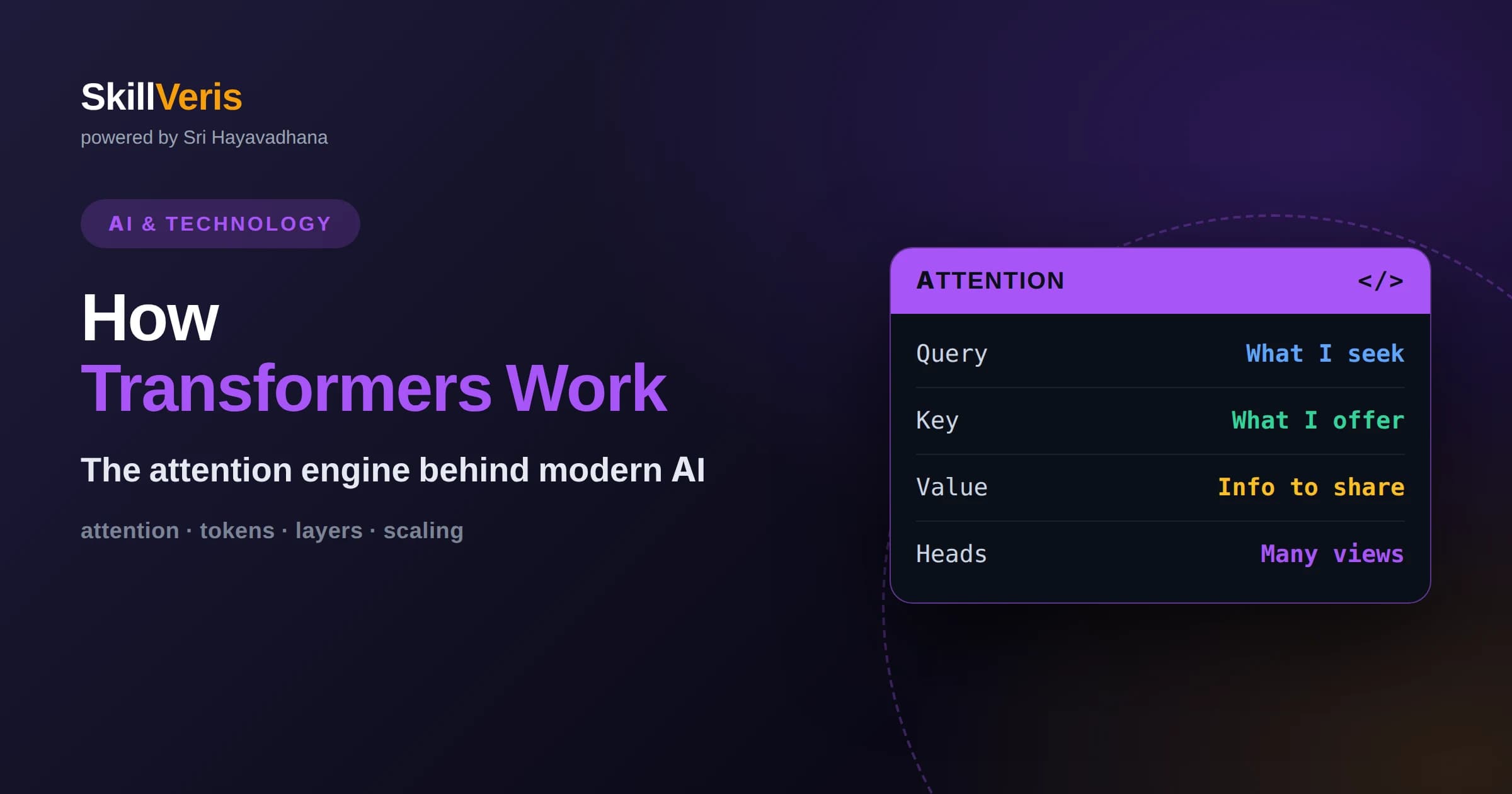
The transformer replaced sequential processing with attention, letting a model look at every token at once and learn how they relate.
In this guide, you'll learn:
- Self-attention lets each token gather relevant information from the whole sequence, which is how transformers capture long-range meaning.
- Stacking attention and feed-forward layers, plus positional information, is what gives transformers their depth and power.
- Nearly every modern language, vision, and multimodal model is built on the transformer blueprint introduced in 2017.
1How Do Transformers Work?
A transformer works by using a mechanism called attention to let every part of an input look at every other part and decide what is relevant, then combining that information across many stacked layers to build a rich understanding of the whole sequence. Instead of reading text strictly left to right, a transformer processes all tokens at once and learns, for each token, which other tokens should influence its meaning.
This design solved two problems at the same time. It let models capture relationships between words that are far apart in a sentence, and it let training happen in parallel across an entire sequence rather than one step at a time. That parallelism is a big reason transformers scaled so well and became the foundation for modern large language models, image generators, and multimodal systems.
The architecture was introduced in a 2017 research paper whose title, Attention Is All You Need, captured the core insight. Earlier approaches relied on recurrence, processing tokens in order and carrying a running summary. The transformer showed that attention alone, applied repeatedly, could do the job better. Understanding attention is therefore the key to understanding why modern AI works the way it does.
2What Came Before Transformers
Before transformers, the dominant approach to sequence data used recurrent neural networks. These models read one token at a time and maintained a hidden state that tried to summarize everything seen so far. The approach worked but had real limits. Because processing was sequential, training was slow, and information from early tokens tended to fade by the time the model reached later ones.
This fading made it hard to connect ideas separated by long distances, such as a pronoun and the noun it refers to many words earlier. Various fixes helped but never fully solved the problem. The transformer sidestepped it entirely by giving every token direct access to every other token, so distance in the sequence no longer weakened the connection between related words.
3From Tokens to Embeddings
A transformer cannot operate on raw text, so the first step is turning words into numbers. Text is split into tokens, and each token is mapped to a vector called an embedding, which is a list of numbers that represents that token in a high-dimensional space. Tokens with related meanings end up with similar vectors, which gives the model a numeric sense of meaning to work with.
These embeddings are learned during training rather than assigned by hand. As the model improves at prediction, it adjusts the embeddings so that useful relationships are reflected in the geometry of the space. Every layer of the transformer then refines these vectors, gradually transforming surface-level token representations into context-aware ones that capture how each word functions in its specific sentence.
4Positional Information: Keeping Order
Because a transformer looks at all tokens simultaneously, it has no built-in sense of order. Yet order clearly matters, since the dog bit the man means something different from the man bit the dog. To restore this, transformers add positional information to each token's embedding, encoding where the token sits in the sequence.
This positional signal lets attention distinguish between otherwise identical words in different places and lets the model learn patterns that depend on position, such as grammar. There are several ways to encode position, from fixed mathematical patterns to learned values, but the goal is always the same: give the parallel architecture a way to know which token came first, second, and so on.
5Self-Attention: The Core Idea
Self-attention is the heart of the transformer. For each token, the model creates three vectors, traditionally called the query, the key, and the value. The query represents what this token is looking for, the key represents what each token offers, and the value carries the actual information to be shared. By comparing a token's query against every token's key, the model scores how relevant each other token is.
Those relevance scores are turned into weights that sum to one, and the token then builds an updated representation by taking a weighted blend of all the value vectors. In effect, each token asks the whole sequence a question and assembles an answer from the parts that matter most. A word like it can pull meaning from the noun it refers to, no matter how far away that noun sits.
This is why attention is so powerful. It is a learned, content-based way of routing information. The model is not told which words relate; it discovers those relationships from data and applies them dynamically for every new input. Repeating this process across layers lets the model build increasingly sophisticated understanding.
6Multi-Head Attention: Many Perspectives
Rather than performing attention once, transformers do it several times in parallel with different learned projections. Each of these parallel computations is called a head, and together they form multi-head attention. Each head can focus on a different kind of relationship, such as grammatical agreement, subject and object links, or topical similarity.
Splitting attention into multiple heads lets the model attend to several patterns at the same time instead of forcing everything through a single lens. The outputs of all heads are combined and passed forward. This diversity of perspectives is a major source of the transformer's expressive power and helps it handle the many overlapping relationships present in real language.
Researchers who inspect trained models sometimes find heads that specialize in recognizable jobs, such as tracking which word a pronoun refers to or linking verbs to their subjects. Not every head has a tidy interpretation, but the fact that some do hints at how the model divides the labor of understanding. This specialization emerges from training rather than being programmed, which is part of what makes attention so elegant.
7Feed-Forward Layers and Nonlinearity
Attention gathers information from across the sequence, but on its own it mostly mixes existing values. To let the model transform that information in richer ways, each attention step is followed by a feed-forward network applied to every token independently. This small network expands the representation, applies a nonlinear function, and compresses it back, allowing the model to learn complex features.
Alternating attention and feed-forward layers gives the transformer a rhythm: gather context, then process it, gather again, process again. This two-part block is repeated many times, and the stacking of these blocks is what turns a shallow pattern matcher into a deep model capable of nuanced reasoning over language and other data.
8Residual Connections and Normalization
Deep networks are hard to train because signals can weaken or explode as they pass through many layers. Transformers use two techniques to stay stable. Residual connections add each layer's input back to its output, giving information a shortcut that helps gradients flow during training and preserves earlier representations.
Normalization keeps the numbers flowing through the network in a healthy range so that training remains steady. These may sound like plumbing details, but they are essential. Without residuals and normalization, stacking dozens or hundreds of layers would be impractical, and the deep transformers behind modern AI would not train reliably.
9Encoders, Decoders, and Variations
The original transformer had two halves. An encoder read the input and built a rich representation, and a decoder generated output while attending to that representation. This structure suits translation, where you read one language and produce another. Many later models keep only one half depending on the task.
Encoder-only models are strong at understanding tasks like classification and search because they read the entire input at once. Decoder-only models, which generate text by predicting the next token, power most chat assistants and code tools you interact with today. Recognizing which variant a model uses tells you a lot about what it is designed to do.
There are also encoder-decoder models that keep both halves, which remain a natural fit for tasks that map one sequence to another, such as translation or summarization. The choice among these variants is really a choice about the shape of the problem: pure understanding, pure generation, or transformation from one sequence into another. Knowing this taxonomy helps you read model descriptions and pick the right family for your task.
10Why Transformers Scale So Well
A key practical advantage of transformers is how gracefully they scale. Because attention processes all tokens in parallel, transformers make excellent use of modern hardware built for large parallel computations. Feeding them more data and more parameters tends to yield steadily better performance, a pattern that motivated the race toward ever larger models.
This scalability is central to the story of modern AI. The same architecture that translates a sentence can, when made much larger and trained on much more text, exhibit surprisingly broad abilities. Understanding that today's frontier models are, at their core, scaled-up transformers demystifies a lot of the hype around them.
11Transformers Beyond Text
Although transformers were invented for language, the architecture is remarkably general. Images can be split into patches and treated like tokens, audio can be turned into sequences, and even biological sequences can be modeled the same way. This flexibility is why transformers now sit behind image generators, speech systems, and multimodal models that handle several data types at once.
The lesson is that attention is a general tool for finding relationships in structured data, not a text-specific trick. Once you understand the transformer for language, you have a mental template that transfers to many other domains, which is a big part of why this single architecture reshaped the whole field.
12How Transformers Are Trained
A transformer is trained by showing it huge amounts of data and asking it to make predictions, then adjusting its many parameters based on how wrong each prediction was. For a language model, the task is usually predicting the next token. Over billions of examples, the attention weights, embeddings, and feed-forward parameters all settle into values that make good predictions, which requires the model to internalize grammar, facts, and reasoning patterns.
This training is computationally intensive because there are so many parameters and so much data. The parallel nature of attention is what makes it feasible, since modern hardware can process an entire sequence at once rather than crawling through it token by token. The efficiency of training is a big reason the transformer, rather than earlier architectures, became the platform for scaling up.
Once trained, the same forward pass that was used to learn is used to generate. The model applies its fixed parameters to new input, producing predictions that now reflect everything it absorbed. Understanding that training and inference share the same machinery, differing only in whether parameters are being updated, demystifies how these systems go from learning to doing.
13The Cost of Attention
Attention's power comes with a cost. Because every token can attend to every other token, the work grows quickly as sequences get longer, which is why very long inputs are more expensive to process. This is the practical reason context windows have limits and why handling very long documents efficiently is an active area of engineering.
Many refinements aim to make attention cheaper without losing its benefits, from smarter memory use to approximations that avoid comparing every pair of tokens. As a beginner you do not need these details, but knowing that sequence length drives cost explains a lot about how models are priced and why prompts have size limits.
14Turn Theory Into Practice
Reading about attention is a good start, but the ideas click when you see them work. Try tracing a short sentence through the steps: tokenize it, imagine the query and key comparisons, and picture which words each token would attend to. Small, concrete examples make the abstract mechanics feel intuitive.
On SkillVeris you can go further with guided lessons and hands-on exercises that let you inspect embeddings, visualize attention, and build up transformer concepts piece by piece. Learning the architecture by experimenting with it, rather than only reading about it, is the surest way to truly understand the engine behind modern AI.
Related Reading
Get The Print Version
Download a PDF of this article for offline reading.
About the Publisher
SkillVeris Team
AI Research Team
Our AI team covers the latest in machine learning, generative AI, and emerging tech — clearly and accurately.
View all postsRelated Posts
Never miss an update
Get the latest tutorials and guides delivered to your inbox.
No spam. Unsubscribe anytime.