How Transformers Work: Attention Explained Simply
SkillVeris Team
AI Research Team
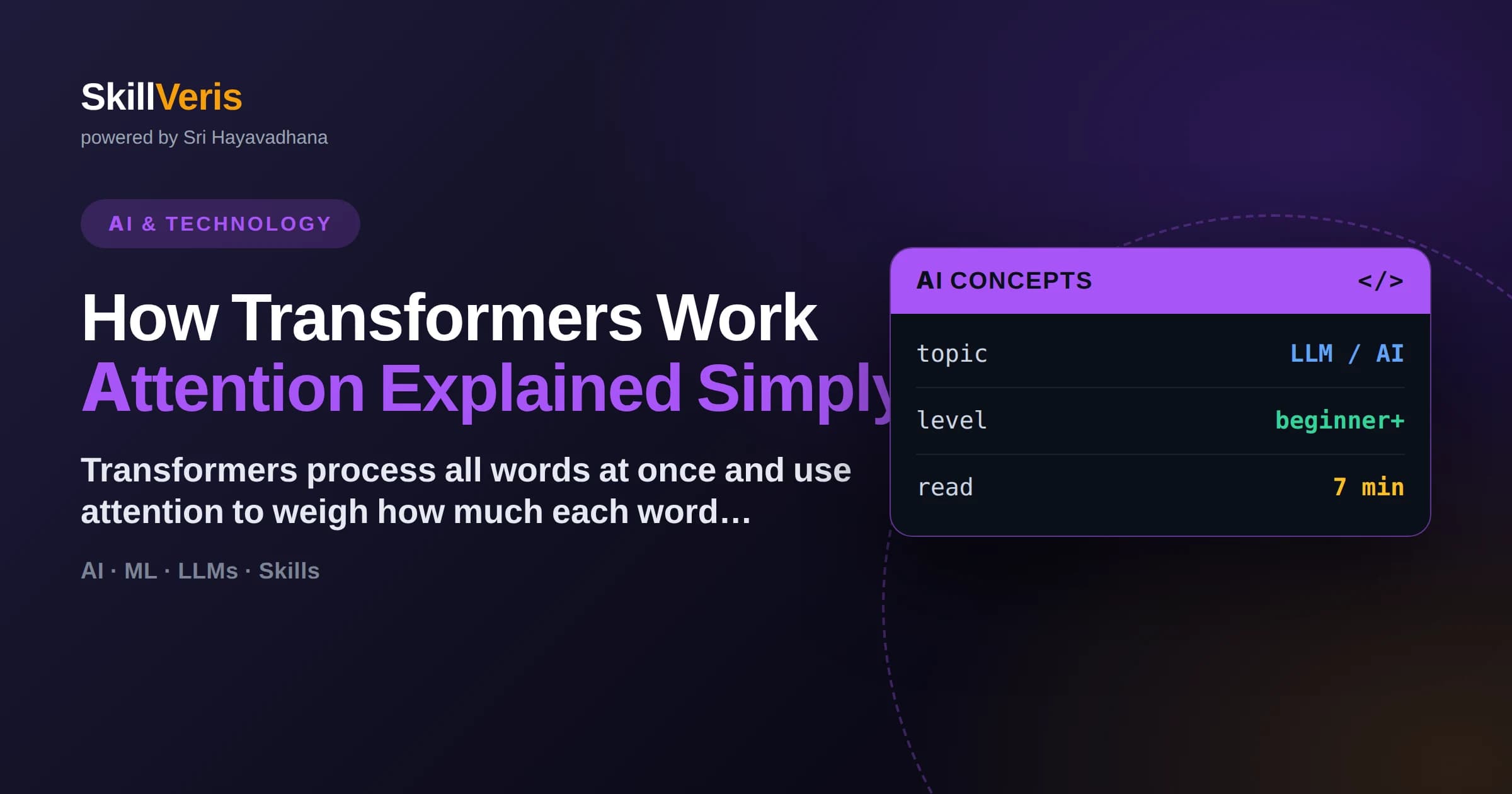
Transformers are the neural network architecture behind modern LLMs; they process all tokens in parallel and use attention to decide how much each token relates to every other.
In this guide, you'll learn:
- Attention lets the model weigh the whole context at once, so it can resolve meaning that depends on distant words — something older sequential models struggled with.
- Each token is turned into query, key, and value vectors; attention scores queries against keys to decide how much of each value to blend in.
- Processing tokens in parallel rather than one at a time is what makes transformers fast to train on modern hardware.
- Positional encodings tell the model word order, since attention alone has no built-in sense of sequence.
1How Transformers Work
A transformer is a neural network architecture that processes an entire sequence of tokens at once and uses a mechanism called attention to decide how much each token should focus on every other token. This lets it capture context and long-range relationships — like linking a pronoun to a noun ten words earlier — which is exactly what language understanding needs.
Introduced in 2017 and now the foundation of nearly every large language model, transformers replaced older sequential architectures because they are both more accurate at capturing context and far more efficient to train. This guide explains attention in plain terms.
2The Problem Transformers Solve
Before transformers, models read text one word at a time, carrying a summary of what came before. This made it hard to connect words far apart and slow to train, because each step depended on the previous one and could not be parallelised.
Transformers changed the game by letting every token look at every other token directly and simultaneously. There is no long chain of dependencies to walk — the model sees the whole sequence and decides what matters, all at once.
🔑Key Idea
The transformer's breakthrough is simple to state: instead of reading word by word, look at all the words at once and let each one attend to the others that matter.
3What Attention Actually Does
Attention is a mechanism that computes, for each token, a weighted blend of information from all the other tokens — the weights say how relevant each other token is. When processing the word 'it', attention can assign high weight to the noun it refers to, pulling in that meaning.
The result is a context-aware representation of every token. The same word gets a different internal representation depending on the sentence around it, which is how transformers capture that meaning depends on context.
4Query, Key, and Value
Attention is often explained with three vectors derived from each token: a query, a key, and a value. A helpful analogy is a search: the query is what a token is looking for, the keys are labels on all the other tokens, and the values are the information they carry.
- Query: what this token is looking for in the others.
- Key: what each token offers, used to match against queries.
- Value: the actual information a token contributes if attended to.
- Score: compare a query to every key to get relevance weights.
- Output: blend the values using those weights.
Putting It Together
For each token, the model scores its query against every key to get attention weights, then sums the values weighted by those scores. Tokens that are highly relevant contribute more; irrelevant ones contribute little. That weighted sum is the token's new, context-aware representation.
5Multi-Head Attention and Position
Transformers run attention several times in parallel, each an independent 'head'. Different heads can learn to focus on different kinds of relationships — one might track grammar, another might link related topics — and their outputs are combined for a richer picture.
Attention has no inherent sense of order, so transformers add positional encodings that tell the model where each token sits in the sequence. Without them, 'dog bites man' and 'man bites dog' would look identical to the attention mechanism.
- Multiple heads capture different types of relationships at once.
- Positional encodings inject word-order information.
- Layers stack, each refining the representation from the one below.
- The final representations feed the model's prediction of the next token.
6Why This Architecture Won
Transformers dominate because they are both effective and efficient. Parallel processing suits modern GPUs, so they train fast on huge datasets, and attention captures context better than the sequential models that came before.
- Parallelism: all tokens processed at once, ideal for GPU training.
- Long-range context: any token can attend directly to any other.
- Scalability: performance keeps improving as models and data grow.
- Versatility: the same architecture handles text, code, images, and more.
7Common Misconceptions to Avoid
Attention is often misunderstood in ways that make transformers seem more mysterious than they are.
- Thinking the model reads left to right — it attends to the whole sequence at once.
- Believing attention 'understands' like a human — it computes weighted blends of vectors.
- Ignoring positional encodings, then wondering how the model knows word order.
- Assuming one attention head does everything — many heads capture different patterns.
- Confusing the transformer architecture with any single model built on it.
⚠️Watch Out
Attention weights are not explanations. They show what the model blended, not why it is right. Do not treat high attention on a word as proof the model reasoned about it correctly.
8Key Takeaways
The core ideas of transformers fit into a few sentences once attention clicks.
- Transformers process all tokens in parallel and use attention to relate them.
- Attention builds a context-aware representation by blending relevant tokens.
- Query, key, and value vectors drive the attention computation.
- Multiple heads and positional encodings add richness and word order.
- Parallelism plus long-range context is why transformers power modern LLMs.
9Frequently Asked Questions
Q: What is attention in a transformer? A: Attention is a mechanism that lets each token weigh how relevant every other token is and blend their information accordingly. It produces a context-aware representation of each word, which is how transformers capture meaning that depends on surrounding text.
Q: Why are transformers faster to train than older models? A: Older sequential models processed text one step at a time, so steps could not run in parallel. Transformers process all tokens simultaneously, which maps well to GPU hardware and dramatically speeds up training on large datasets.
Q: What are query, key, and value? A: They are three vectors derived from each token. The query represents what a token seeks, keys represent what other tokens offer, and values carry the information to blend. Matching queries against keys produces the weights used to combine values.
Q: Do transformers understand language like humans? A: No. They compute statistical, context-aware representations by blending vectors through attention. The results can be remarkably capable, but the mechanism is mathematical pattern-matching, not human understanding or reasoning.
Related Reading
Get The Print Version
Download a PDF of this article for offline reading.
About the Publisher
SkillVeris Team
AI Research Team
Our AI team covers the latest in machine learning, generative AI, and emerging tech — clearly and accurately.
View all postsRelated Posts
Never miss an update
Get the latest tutorials and guides delivered to your inbox.
No spam. Unsubscribe anytime.