How to Evaluate LLMs: Benchmarks and Metrics
SkillVeris Team
AI Research Team
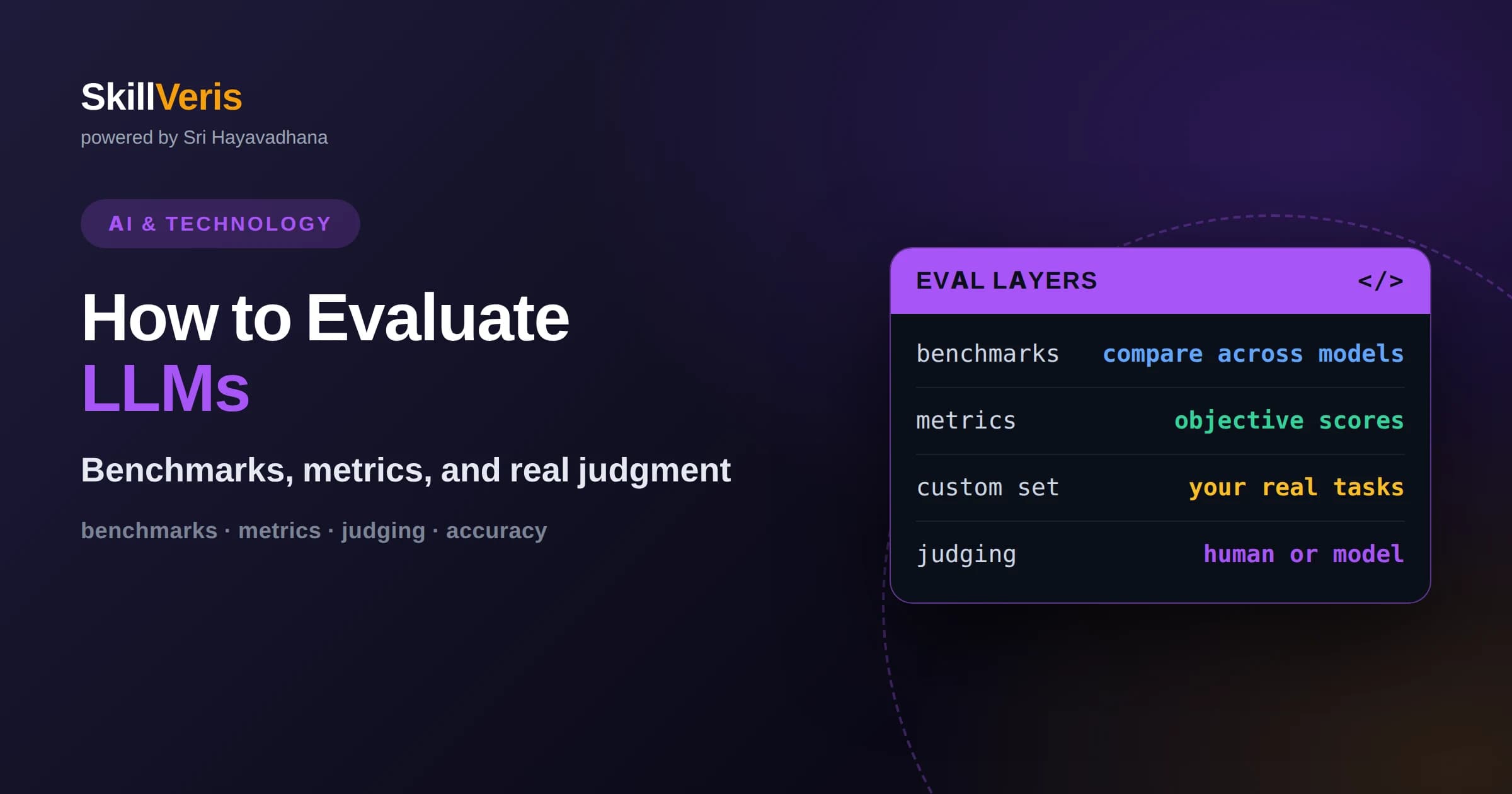
No single number captures how good a language model is; evaluation combines benchmarks, task metrics, and human judgment.
In this guide, you'll learn:
- Public benchmarks give comparable scores across models but can be gamed or leaked into training data, so treat them with caution.
- The evaluation that matters most is one built from your own real tasks, measuring the behavior your application actually needs.
- Using a strong model to judge another model's outputs has become a practical way to scale evaluation beyond manual review.
1Why Evaluating Models Is Genuinely Hard
Evaluating a language model means measuring how well it performs the tasks you care about, and there is no single score that captures this. A model that writes beautiful prose might reason poorly about numbers. One that excels at coding might give unsafe medical advice. Quality is many-dimensional, so honest evaluation looks at several dimensions rather than collapsing everything into one figure.
The difficulty deepens because many tasks have no single correct answer. Two summaries can both be excellent while using entirely different words. Grading open-ended output is far harder than checking whether a math answer is right. This is why evaluating language models blends automated measures, structured benchmarks, and human judgment, each covering what the others miss.
Understanding evaluation matters because it is how you choose a model, track whether changes help, and catch regressions before users do. Without measurement, you are flying blind, trusting impressions that may not hold up. With it, you can make decisions grounded in evidence.
2What Benchmarks Are and What They Measure
A benchmark is a standardized test made of many questions or tasks, run against a model to produce a comparable score. Benchmarks exist for many skills: answering knowledge questions, solving math problems, writing code, reasoning through multi-step problems, and more. Because everyone runs the same test, benchmark scores let you compare different models on a common yardstick.
Each benchmark targets a specific ability. A math benchmark reveals arithmetic and reasoning skill but says nothing about writing quality. A coding benchmark measures whether generated programs actually run correctly. To understand a model's overall profile you look across several benchmarks, since each is a spotlight on one area rather than a full portrait.
Benchmark results are usually reported as a percentage of tasks solved or a similar aggregate. These numbers are useful for a first impression and for tracking progress across model generations, but they should be the beginning of your assessment, not the end.
3The Limits of Public Benchmarks
Public benchmarks have a serious weakness: because they are widely known, their questions can leak into the data models are trained on. A model that has effectively seen the answers during training will score high without truly having the underlying skill. This is called contamination, and it inflates scores in misleading ways.
Benchmarks can also be optimized for directly. When a score becomes a target that labs compete on, models may be tuned to do well on that specific test rather than on the broader ability it was meant to represent. A famous principle warns that when a measure becomes a target, it stops being a good measure. High benchmark scores therefore deserve healthy skepticism.
Finally, a benchmark rarely matches your exact use case. A model that tops general reasoning tests might still stumble on the particular style of task your application demands. Public benchmarks are a starting filter, not a substitute for testing the model on the work you actually need done.
4Task-Specific Metrics
For tasks with a clear right answer, you can use direct metrics. Classification tasks use accuracy, which is simply the fraction of correct predictions, along with related measures that describe how the model trades off different kinds of mistakes. Extraction tasks can be checked against known correct fields. These metrics are objective and easy to compute.
Some tasks have automated scores designed for them. Translation and summarization have measures that compare a model's output to reference answers by looking at overlapping words or phrases. These give a quick, repeatable signal, though they are imperfect because good output can differ from the reference while still being correct. Treat such scores as rough guides rather than final verdicts.
The key is to match the metric to the task. Measuring a creative writing model with an exact-match score makes no sense, while measuring a data-extraction model that way is exactly right. Choosing the wrong metric produces numbers that look precise but mean little.
5Human Evaluation
For open-ended tasks, human judgment remains the gold standard. People can assess whether an answer is helpful, accurate, well-written, and appropriate in ways automated metrics cannot. A common approach is to have reviewers rate outputs on a scale, or to show them two responses and ask which is better, building up a picture of quality from many comparisons.
Human evaluation is powerful but slow and expensive, and it can be inconsistent if reviewers are not given clear guidelines. To make it reliable, teams write detailed rubrics describing what good and bad look like, and they often have multiple people rate the same items to check agreement. Done well, human evaluation catches the subtle quality issues that numbers alone miss.
6Using a Model to Judge a Model
Because human review is costly, a popular technique is to use a strong language model as an automated judge. You give the judge model an output, a description of what good looks like, and ask it to score or compare. This scales far beyond what humans can review manually and often correlates reasonably well with human ratings when the judging instructions are clear.
This approach has caveats. A judge model can carry its own biases, such as favoring longer answers or being swayed by confident tone. It also cannot exceed its own understanding, so it may misjudge tasks in areas where it is weak. Careful practitioners validate the judge against a sample of human ratings before trusting it, and they write precise, gradeable criteria so the judge has a firm standard to apply.
Used thoughtfully, model-based judging strikes a balance: cheaper and faster than pure human review, more nuanced than simple automated metrics. It has become a standard part of the evaluation toolkit, especially for iterating quickly during development.
7Building Your Own Evaluation Set
The most valuable evaluation you can create is one made from your own real tasks. Collect a representative set of the inputs your application will face, decide what a good response looks like for each, and use that set to measure any model or change. This custom evaluation reflects your actual needs far better than any public benchmark.
Start small if you must. Even a few dozen carefully chosen examples, covering common cases and tricky edge cases, can reveal a great deal. As you grow the set and see how models behave on it, you build confidence that your measurements track real user experience. This is the evaluation that should drive your decisions.
Keep this set stable over time so comparisons stay meaningful, and guard it from leaking into anything a model trains on. A private, consistent evaluation set is one of the most useful assets a team building on language models can own.
8Deciding What to Measure
Beyond raw quality, real applications care about other properties. Latency, how quickly the model responds, matters for interactive experiences. Cost per request affects whether a design is affordable at scale. Consistency, whether the model behaves reliably across similar inputs, affects trust. Safety, whether it avoids harmful or inappropriate output, can be non-negotiable.
A thorough evaluation weighs these alongside accuracy. The best model on a quality benchmark might be too slow or too expensive for your product, while a slightly less capable one fits perfectly. Deciding which properties matter, and how much, is part of turning evaluation into a genuine decision-making tool rather than an academic exercise.
9Common Evaluation Mistakes
A frequent error is trusting a single benchmark number and stopping there. Another is evaluating on data too small or too narrow to be representative, then being surprised when real usage looks different. Testing only on easy cases while ignoring the hard edge cases where models fail is a related trap that hides real weaknesses.
Teams also sometimes change several things at once, then cannot tell which change caused a shift in scores. Good evaluation practice changes one variable at a time and re-measures, so cause and effect stay clear. And whenever possible, keep a human spot-check in the loop, because automated scores can miss failures that a person would catch instantly.
10Putting an Evaluation Together
A mature evaluation combines layers. Public benchmarks give a quick sense of a model's general strengths. Task-specific metrics measure objective performance where answers are clear. A custom evaluation set built from your real tasks measures what you actually need. And human or model-based judging handles the open-ended quality that numbers cannot capture.
No single layer is enough on its own, but together they form a picture you can act on. The goal is not a perfect score but reliable insight: knowing which model to choose, whether a change helped, and where your system still falls short. That insight is what separates careful builders from those who simply hope.
11Balancing Capability and Safety
Evaluation is not only about how smart a model is; it is also about how safely it behaves. A model that gives brilliant answers but occasionally produces harmful, biased, or inappropriate output can be unusable in a real product. For this reason, safety evaluation runs alongside capability evaluation, checking whether the model refuses harmful requests, avoids toxic language, and handles sensitive topics responsibly.
Safety testing often uses deliberately challenging inputs designed to probe for failures, sometimes called red-teaming. By actively trying to make the model misbehave, you discover weaknesses before users do. A model that scores well on capability but fails these probes may need extra guardrails in your application, or may not be suitable at all for your context.
The right balance depends entirely on the stakes. A casual brainstorming tool can tolerate more variability than a system giving financial or medical guidance. Deciding how much weight to give safety versus raw capability is part of turning evaluation into a responsible engineering practice rather than a leaderboard chase.
12Tracking Performance Over Time
Evaluation is not a one-time event. Models get updated, your prompts change, and your data evolves, and any of these can shift performance in ways you did not intend. Running your evaluation set regularly turns it into a safety net that catches regressions, so a change meant to improve one thing does not quietly break another.
This practice, often borrowed from software testing, treats quality as something you monitor continuously rather than measure once and forget. Keeping a stable evaluation set and re-running it after every significant change gives you confidence that your system stays as good as, or better than, it was before. It is the discipline that keeps a working system working.
Over time, the results of these repeated evaluations become a valuable record. You can see how a model behaves across versions, notice slow drifts before they become problems, and justify decisions with evidence rather than intuition. A team that tracks its evaluations builds institutional knowledge about its own system that would otherwise be lost, which pays dividends every time a new change is proposed.
13Practice Evaluating Models
Evaluation is a skill you sharpen by doing. Build a small evaluation set for a task you understand, run a couple of models against it, and compare their outputs with both a metric and your own judgment. You will quickly see how much richer the picture becomes than any single benchmark score suggests.
On SkillVeris you can follow hands-on lessons that walk you through designing evaluation sets, choosing metrics, and setting up model-based judging responsibly. Learning to measure well is one of the most practical skills in applied AI, and practice is the fastest way to develop it.
Related Reading
Get The Print Version
Download a PDF of this article for offline reading.
About the Publisher
SkillVeris Team
AI Research Team
Our AI team covers the latest in machine learning, generative AI, and emerging tech — clearly and accurately.
View all postsRelated Posts
Never miss an update
Get the latest tutorials and guides delivered to your inbox.
No spam. Unsubscribe anytime.