How to Become an AI Engineer (Roadmap 2026)
SkillVeris Team
AI Research Team
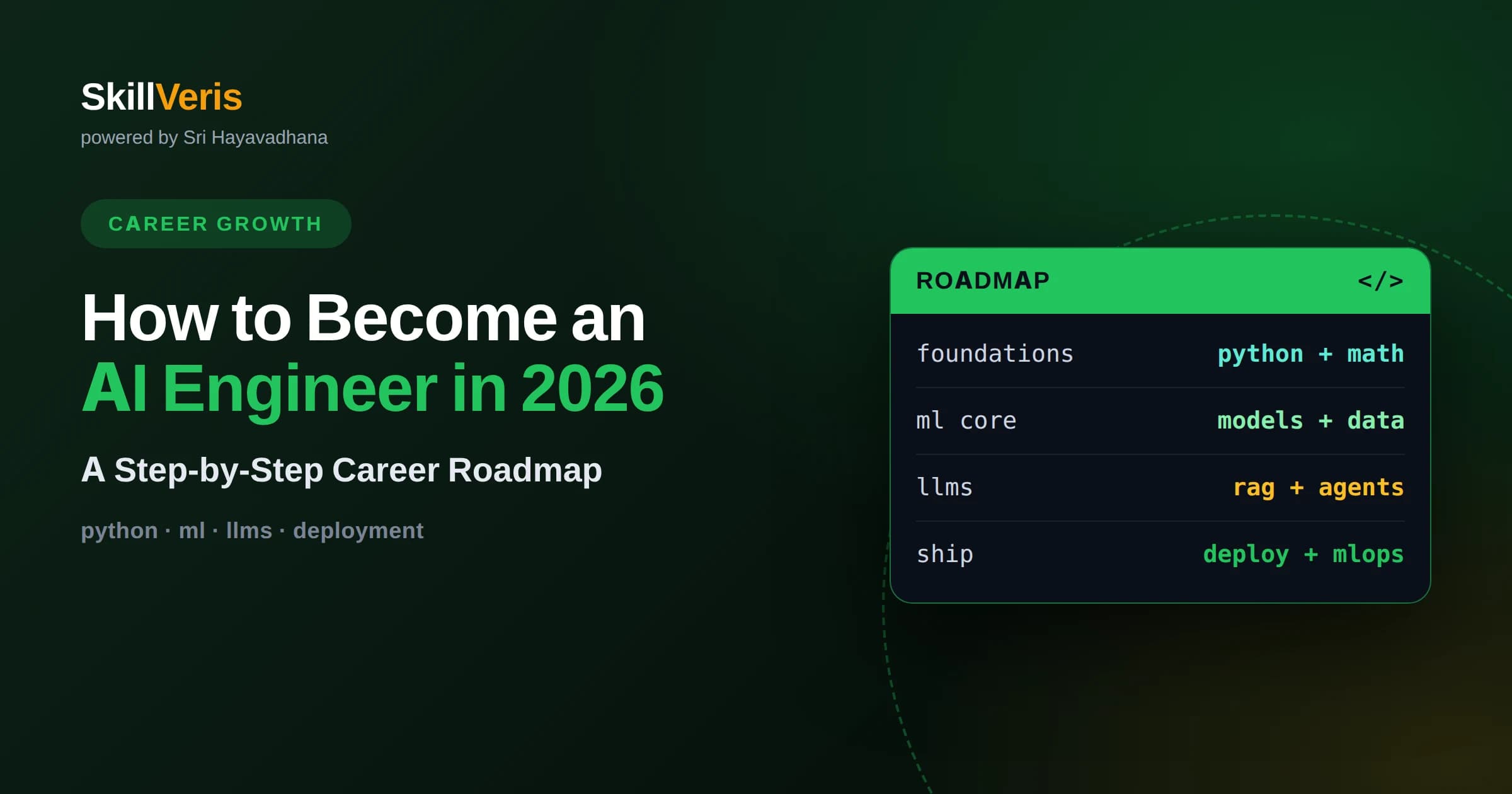
Becoming an AI engineer means layering four skill groups in order: programming and math foundations, core machine learning and deep learning, applied LLM systems like RAG and agents, and the MLOps needed to ship models reliably.
In this guide, you'll learn:
- You do not need a PhD to start; a working command of Python, linear algebra, probability, and a portfolio of deployed projects matters far more to most employers than credentials.
- A realistic path runs in phases rather than a fixed number of weeks — foundations, core ML, applied AI, and production engineering — with each phase gated by a project you can demonstrate.
- The fastest way to prove you are ready is a portfolio of end-to-end projects that solve a real problem, are deployed somewhere public, and are documented clearly enough for a stranger to follow.
1What an AI Engineer Actually Does
An AI engineer builds software systems that use machine learning and, increasingly, large language models to solve real problems. In practice that means taking a model — one you trained or one you called through an API — and wrapping it in reliable, testable, deployable code that other people can depend on. The job sits at the intersection of software engineering and applied machine learning, and in 2026 it leans heavily toward integrating and orchestrating models rather than inventing new ones from scratch.
This is different from a research scientist, who pushes the frontier of what models can do, and different from a pure data scientist, who focuses on analysis and insight. An AI engineer is judged on whether the system works in production: does it respond fast enough, does it stay within budget, does it fail gracefully, and does it actually improve the product. If you enjoy building things that ship and getting your hands dirty with both models and infrastructure, the role fits.
Understanding this shape early saves you from over-investing in the wrong skills. You do not need to derive backpropagation by hand to be effective, but you do need to reason about why a model behaves the way it does, how to evaluate it, and how to keep it running once real users arrive. The roadmap below is organized around that reality.
2The Honest Prerequisites
The single most important prerequisite is comfort writing code. If you can build a small program, read someone else's code without panic, and debug your way out of an error message, you have the foundation you need to begin. Python is the language of the field, so if you are choosing where to spend your first hours, spend them becoming genuinely fluent in Python rather than sampling many languages.
You also need patience and a tolerance for ambiguity. Machine learning systems rarely work the first time, and progress often looks like a series of small experiments rather than a straight line. The engineers who succeed treat every failed run as information rather than a verdict on their ability. That mindset is worth more than any single technical skill.
What you do not need is a graduate degree, a mathematics background from an elite university, or years of prior industry experience. Those things can help, but the field rewards demonstrated ability. A self-taught engineer with three strong deployed projects will often get further than a credentialed one who has never shipped anything. Start where you are.
3Phase One: Programming and Tooling
Your first phase is about becoming a competent Python programmer and learning the tools of the trade. Focus on the language fundamentals — data structures, functions, classes, error handling — and then the scientific stack that every AI engineer touches daily: NumPy for numerical arrays, Pandas for tabular data, and Matplotlib for quick visualization. These libraries are the vocabulary of applied machine learning, and fluency in them removes friction from everything that follows.
Alongside the language, learn the workflow that professionals use. Get comfortable with the command line, with Git and version control, with virtual environments, and with notebooks for exploration versus scripts for production. These are unglamorous skills, but they separate people who can only run tutorials from people who can build. Spend real time here; it pays back for the rest of your career.
On SkillVeris this is where the Python for AI and ML path lives, and it maps directly to this phase. The goal by the end is not to have watched lessons but to have written enough code that reaching for Pandas or writing a class feels automatic. A good exit test: can you take a messy CSV file, clean it, and produce a chart without looking up the syntax for every step?
4The Math You Really Need
Mathematics intimidates newcomers more than it should. You need a working grasp of three areas, and you can learn them alongside coding rather than as a prerequisite gate. Linear algebra explains how data is represented as vectors and matrices and why operations on them power neural networks. Probability and statistics explain uncertainty, distributions, and how to evaluate whether a result is real or noise. Calculus, specifically the idea of a gradient, explains how models learn by minimizing error.
The key word is working grasp. You are not trying to become a mathematician; you are trying to build intuition strong enough to reason about model behavior and read documentation without getting lost. Learning the math through code — implementing a small operation yourself and watching what it does — sticks far better than memorizing formulas. Every abstract concept has a concrete counterpart you can run.
Treat math as a companion to the whole journey rather than a wall to climb first. When a later lesson introduces gradient descent, that is the moment to deepen your calculus intuition, because now it means something. This just-in-time approach keeps motivation high and prevents the common trap of spending months on theory and never reaching the models you came for.
5Phase Two: Core Machine Learning
With foundations in place, the second phase is classical machine learning. Here you learn the core concepts that underpin everything: supervised versus unsupervised learning, training and test splits, overfitting and regularization, feature engineering, and the metrics used to judge a model. You will work with algorithms like linear and logistic regression, decision trees, and ensembles, mostly through the scikit-learn library, which makes experimentation fast.
This phase teaches you to think like a machine learning engineer. The algorithms matter less than the workflow around them: framing a problem, preparing data, choosing a metric that reflects what you actually care about, training a baseline, and iterating. A surprising amount of real AI work is this loop, and mastering it on simple models makes the complex ones far easier to handle later.
Resist the urge to skip straight to deep learning. The habits you build here — validating properly, avoiding data leakage, reading a confusion matrix — are exactly the habits that prevent embarrassing failures in production later. Engineers who skip this phase often build impressive-looking models that quietly do not work, because they never learned to be suspicious of their own results.
6Adding Deep Learning
Deep learning is where neural networks enter the picture, and it unlocks the modern capabilities that make AI exciting: image recognition, speech, and the language models that dominate current headlines. You will learn how networks are structured in layers, how they learn through backpropagation, and how to train them without them collapsing into useless states. The two dominant frameworks are PyTorch and TensorFlow with Keras, and both have dedicated learning paths on SkillVeris.
Start with one framework and go deep rather than sampling both. PyTorch has become the default in research and much of industry because its style feels natural to Python programmers, but TensorFlow and Keras remain widely used, especially in established production stacks. Whichever you choose, the transferable skill is understanding what a training loop does, how to feed data efficiently, and how to diagnose a model that will not learn.
The milestone for this phase is training a neural network end to end on a real dataset and understanding every step well enough to explain it. That might be an image classifier or a text sentiment model. What matters is that you built it, debugged it when it broke, and can articulate the choices you made. This is the project that starts to look like real AI work on a portfolio.
7Phase Three: LLMs and Transformers
In 2026, a huge share of AI engineering work centers on large language models, so this phase is essential rather than optional. You need to understand what transformers are, why the attention mechanism changed the field, and how models like the ones behind modern chat assistants are trained and used. You also need practical fluency: calling model APIs, controlling outputs with parameters, and above all writing effective prompts that get reliable results.
The Hugging Face Transformers ecosystem is the practical entry point, and there is a dedicated path for it. Through it you learn to load pretrained models, run inference, and fine-tune when needed. Fine-tuning is less common than beginners expect — most production systems use a capable model as-is and shape its behavior through prompting and context — but knowing how and when to fine-tune is part of the professional toolkit.
The mental shift in this phase is from training models to orchestrating them. Instead of building a network from scratch, you are often composing calls to powerful existing models and engineering the surrounding system to make them useful, safe, and cost-effective. This is where much of the day-to-day value of an AI engineer now lives, and where the next two topics become critical.
8RAG and Agentic Systems
Language models are powerful but limited: they do not know your private data and they can confidently state things that are wrong. Retrieval-augmented generation, or RAG, solves the first problem by connecting a model to a searchable store of your documents so it can ground its answers in real, current information. Learning RAG means understanding embeddings, vector databases, chunking strategies, and how to assemble retrieved context into a prompt. SkillVeris has a full path dedicated to it.
Agents take this further. An agentic system lets a model plan, use tools, call functions, and take multi-step actions toward a goal rather than answering a single question. Building reliable agents is one of the hardest and most in-demand skills in the field right now, because it combines prompt engineering, software design, and careful handling of failure. The AI Agents and Agentic Workflows path covers how to design these systems so they stay controllable.
Together, RAG and agents represent the applied heart of modern AI engineering. Many real products are essentially a well-built RAG pipeline or a carefully scoped agent wrapped in good software. If you can build these two things competently and explain their tradeoffs, you have a skill set that directly matches what a large number of teams are hiring for in 2026.
9Phase Four: MLOps and Deployment
A model that only runs in your notebook is a demo, not a product. The final core phase is MLOps: the discipline of deploying, monitoring, and maintaining machine learning systems in production. This covers packaging a model behind an API, containerizing it, managing versions and experiments, monitoring for performance drift, and building pipelines that retrain and redeploy without manual heroics. The MLOps and Model Deployment path on SkillVeris is built around exactly these skills.
This phase is what turns an ML hobbyist into an engineer companies trust with real systems. Production concerns — latency, cost, reliability, security, and reproducibility — are where many otherwise-capable candidates fall short, and where demonstrating competence sets you apart. Even a modest deployment, done properly with monitoring and clear documentation, signals maturity that pure model-building projects do not.
You do not need to become a full DevOps specialist, but you need enough fluency to deploy your own work and collaborate with infrastructure teams. The goal is to close the loop: take something you built in an earlier phase and put it somewhere a real user could reach it, then watch how it behaves. That experience is genuinely hard to fake, which is exactly why it is valuable on a resume.
10Building a Portfolio That Proves It
Throughout every phase, the thing that actually gets you hired is a portfolio of projects. Courses give you knowledge; projects give you evidence. Aim for a small number of end-to-end projects rather than a large pile of half-finished tutorials. Each strong project should solve a recognizable problem, use skills from multiple phases, be deployed somewhere public, and be documented well enough that a stranger could understand what you built and why.
The best portfolio projects mirror the work you want to do. If you want to build LLM applications, ship a RAG system over a real document set, or a small agent that automates a genuine task. If you lean toward classical ML, deploy a model that makes useful predictions with a clean interface. Depth beats breadth: one polished, deployed, well-explained project outweighs five notebooks that never left your laptop.
Document as you go. A clear README that explains the problem, your approach, the tradeoffs you made, and what you would improve tells a hiring manager far more than the code alone. Treat your portfolio as the real deliverable of your entire learning journey, and let each phase of study leave behind a concrete artifact you can point to.
11A Realistic, Phased Timeline
It is tempting to ask how many weeks this takes, but an honest answer is that it depends on your starting point, your available hours, and how deeply you engage. Rather than promising a fixed number, think in phases and gate each one with a project. You move to the next phase not when a calendar says so but when you can demonstrate the previous phase's core skill without hand-holding.
A reasonable sequence looks like this: solidify Python and math foundations until you can wrangle data comfortably; build classical ML fluency until you can frame and validate a problem properly; add deep learning until you can train a network end to end; then move into LLMs, RAG, and agents until you can ship an applied AI system; and finally learn enough MLOps to deploy and monitor your own work. Someone studying intensively will move faster than someone fitting it around a full-time job, and both paths are valid.
Avoid comparing your pace to anyone else's, and be wary of anyone promising a guaranteed timeline or salary. The field is real and the demand is real, but outcomes depend on your effort, your portfolio, and market conditions you do not control. Focus on the next project rather than the finish line, and the milestones will accumulate faster than you expect.
12How the SkillVeris Paths Map to the Journey
One advantage of following a structured platform is that the paths are already sequenced to match this roadmap. The AI Engineer path on SkillVeris stitches the phases together: Python for AI and ML for foundations, then core deep learning through the PyTorch and TensorFlow and Keras courses, then the applied layer through Large Language Models, Hugging Face Transformers, Retrieval-Augmented Generation, and AI Agents and Agentic Workflows, and finally MLOps and Model Deployment to close the production gap.
Because every SkillVeris course is personalized to a hobby you already enjoy, the abstract concepts arrive wrapped in analogies that make them stick — whether you think best through cricket, music, cooking, or chess. That personalization matters most in exactly the moments where learners usually quit: the dense math and the first confusing encounter with a new framework. Familiar mental models lower the barrier.
The platform is free, which means the only real cost is your time and consistency. Use the paths as scaffolding, but remember that the courses are the input and your portfolio is the output. Follow the sequence, build a project at the end of each phase, deploy your best work, and you will have both the knowledge and the evidence that becoming an AI engineer in 2026 actually requires.
13What to Do in Your First Week
The gap between wanting to become an AI engineer and becoming one is closed by starting, and starting small enough that you cannot fail. In your first week, install Python, set up a code editor and version control, and write a handful of small programs until the environment stops feeling foreign. Do not worry about neural networks yet; worry about building the habit of showing up and writing code every day.
Then pick your path and commit to the sequence rather than jumping between shiny topics. The learners who succeed are rarely the most talented; they are the ones who kept going through the boring foundational stretches and treated confusion as a normal part of learning rather than a sign they were not cut out for it. Consistency compounds in a way that intensity alone does not.
Finally, decide on your first portfolio project before you feel ready, and let it pull you through the material. Having a concrete thing you are building gives every lesson a purpose and turns passive study into active problem-solving. The roadmap is long, but it is walkable one phase at a time, and the person who starts today is a year ahead of the one still planning.
Related Reading
Get The Print Version
Download a PDF of this article for offline reading.
About the Publisher
SkillVeris Team
AI Research Team
Our AI team covers the latest in machine learning, generative AI, and emerging tech — clearly and accurately.
View all postsRelated Posts
Never miss an update
Get the latest tutorials and guides delivered to your inbox.
No spam. Unsubscribe anytime.