How LLM Temperature and Top-p Sampling Work
SkillVeris Team
AI Research Team
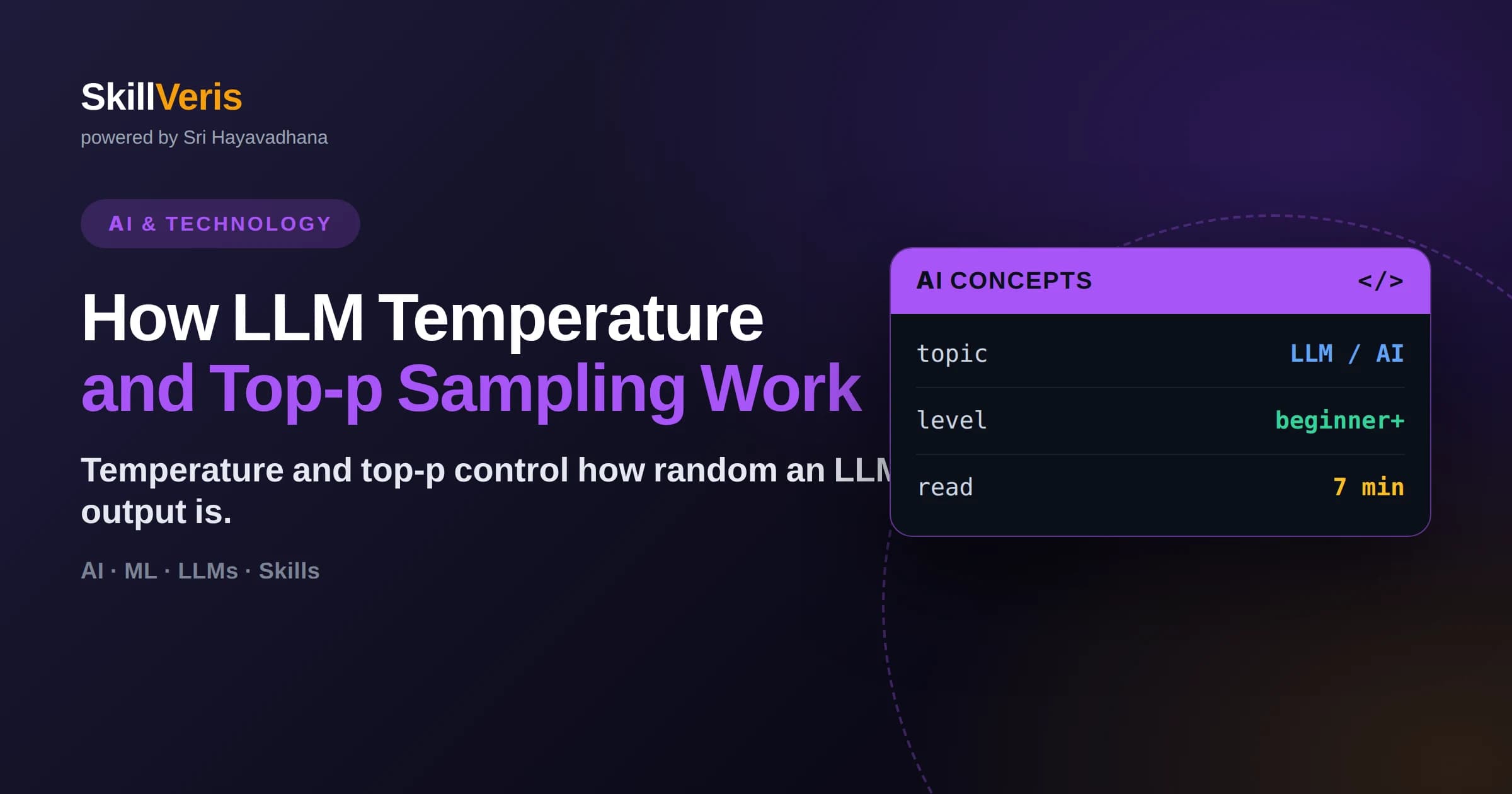
Temperature and top-p are sampling settings that control how random or deterministic an LLM's output is when it picks each next token.
In this guide, you'll learn:
- Temperature reshapes the probability distribution — low values sharpen it toward the likeliest tokens, high values flatten it to allow surprises.
- Top-p (nucleus sampling) limits candidates to the smallest set of tokens whose probabilities add up to p, cutting off the unlikely long tail.
- For factual, deterministic tasks use low temperature; for creative or brainstorming tasks raise it — but rarely change both aggressively at once.
- Setting temperature to 0 makes output as deterministic as possible, useful for testing, extraction, and reproducible pipelines.
1How Temperature and Top-p Work
Temperature and top-p are two knobs that control the randomness of an LLM's output. At each step, a model produces a probability for every possible next token; temperature reshapes those probabilities, and top-p narrows which tokens are even eligible to be chosen. Together they decide whether the model plays it safe or takes creative risks.
Neither setting changes what the model knows — they only change how it samples from what it already predicts. Understanding the difference lets you dial in reliable answers for factual work and varied output for creative work.
2First, How Sampling Works
An LLM generates text one token at a time. For each position it computes a score for every token in its vocabulary and converts those scores into probabilities. The question sampling answers is: given these probabilities, which token do we actually pick?
If you always picked the single highest-probability token, output would be deterministic but often bland and repetitive. Sampling introduces controlled randomness so the model can produce natural, varied language — and temperature and top-p are how you control that randomness.
3Temperature: Reshaping the Curve
Temperature scales the probability distribution before sampling. A low temperature makes the distribution peaky, so the most likely tokens dominate and output becomes focused and predictable. A high temperature flattens the distribution, giving less likely tokens a real chance and making output more diverse and surprising.
- Temperature near 0: nearly deterministic, always favours the top token — best for facts and extraction.
- Temperature around 0.7: a common balanced default for chat and general writing.
- Temperature above 1: adventurous and varied, useful for brainstorming but riskier.
- Very high temperature: output can become incoherent as unlikely tokens slip through.
💡Pro Tip
For anything you need to be reproducible — data extraction, classification, tests — set temperature to 0. You will get the most consistent output the model can give.
4Top-p: Trimming the Tail
Top-p, also called nucleus sampling, takes a different approach. Instead of reshaping probabilities, it builds the smallest set of top tokens whose combined probability reaches p, then samples only from that set. A top-p of 0.9 means 'consider the most likely tokens that together cover 90 percent of the probability, and ignore the rest'.
This adapts to context: when the model is confident, the nucleus is tiny; when many tokens are plausible, the nucleus widens. It is an effective way to cut off the unlikely long tail without hard-capping the number of candidates.
- top_p = 1.0: consider all tokens (no trimming).
- top_p = 0.9: a common setting that removes the improbable tail.
- top_p = 0.5: fairly restrictive, keeps only high-probability tokens.
- Lower top-p means safer, more focused output.
5Using Them Together
Temperature and top-p both reduce or increase randomness, so changing both at once makes their effects hard to reason about. A practical approach is to tune one and leave the other at a sensible default.
A Simple Strategy
Pick temperature as your primary control and leave top-p near 0.9, or vice versa. If you crank temperature high and top-p low, they fight each other; if you push both high, output can collapse into nonsense. Change one variable at a time and observe.
6Choosing Settings by Task
The right values depend on what you are asking the model to do. Match the randomness to the job.
- Factual Q&A, extraction, classification: temperature 0 to 0.3 for consistency.
- General chat and summaries: temperature around 0.5 to 0.7.
- Creative writing and brainstorming: temperature 0.8 to 1.0 for variety.
- Code generation: low temperature, since correctness beats creativity.
7Common Mistakes to Avoid
Sampling settings are simple, but a few misunderstandings cause real problems in production.
- Cranking temperature to fix wrong answers — randomness does not add knowledge.
- Changing temperature and top-p together and losing track of what caused a change.
- Using high temperature for factual tasks, inviting inconsistency and hallucination.
- Expecting temperature 0 to be perfectly reproducible across model versions — it rarely is guaranteed.
- Forgetting to set these at all and being surprised by run-to-run variation.
⚠️Watch Out
High temperature does not make a model more accurate or creative in a useful sense — it just makes it less predictable. If answers are wrong at low temperature, the fix is better prompts or context, not more randomness.
8Key Takeaways
Temperature and top-p are about control, not intelligence.
- Both settings control the randomness of token selection, not what the model knows.
- Temperature reshapes the probability curve; top-p trims the unlikely tail.
- Low values give focused, deterministic output; high values give variety.
- Tune one at a time and match the setting to the task.
- Use temperature 0 for anything that must be consistent or reproducible.
9Frequently Asked Questions
Q: Should I change temperature or top-p? A: Pick one as your main control and leave the other at a default. Temperature is the more intuitive knob for most people. Changing both aggressively at once makes the combined effect hard to predict, so adjust one variable at a time.
Q: Does temperature 0 give identical output every time? A: It makes output as deterministic as the model allows, which is highly consistent, but exact reproducibility is not always guaranteed across hardware or model versions. For most practical purposes, temperature 0 is your best bet for repeatable results.
Q: Will higher temperature make the model more creative? A: It makes output more varied and surprising, which can feel creative, but it also raises the chance of incoherence and errors. Real creativity comes from good prompting; temperature only widens the range of choices the model samples from.
Q: What are good default settings? A: A temperature around 0.7 with top-p near 0.9 is a reasonable general-purpose default for chat. Drop temperature toward 0 for factual or structured tasks, and raise it toward 1 for brainstorming.
Related Reading
Get The Print Version
Download a PDF of this article for offline reading.
About the Publisher
SkillVeris Team
AI Research Team
Our AI team covers the latest in machine learning, generative AI, and emerging tech — clearly and accurately.
View all postsRelated Posts

Never miss an update
Get the latest tutorials and guides delivered to your inbox.
No spam. Unsubscribe anytime.