How Large Language Models Work, Explained Simply
SkillVeris Team
AI Research Team
A large language model is fundamentally a very sophisticated next-token predictor trained on enormous amounts of text.
In this guide, you'll learn:
- Text is broken into tokens, and the model works with numeric representations of those tokens rather than raw words.
- The attention mechanism lets the model weigh which earlier tokens matter for predicting the next one, giving it a sense of context.
- Training adjusts billions of parameters so the model's predictions match real text, encoding grammar, facts, and style along the way.
- Inference is the model generating one token at a time, each new token feeding back in to produce the following one.
1What Is a Large Language Model, Really?
A large language model is, at its core, a system that predicts the next chunk of text given everything before it. That is the whole trick: trained on a staggering amount of writing, it learns the patterns of language so well that predicting the next word repeatedly produces essays, code, and conversation that feel intelligent.
It sounds too simple to explain something as impressive as a chatbot, and yet next-token prediction at massive scale really is the engine. The intelligence emerges from the scale of the data and the parameters, not from any hidden reasoning module bolted on top. This article walks through how that works using intuition and analogies, with no equations to wade through.
We will follow the path text takes through a model: how it becomes tokens, how attention gives the model context, how training shapes it, and how inference generates a reply one token at a time. By the end the models will feel far less mysterious.
2The Big Idea: Predicting the Next Word
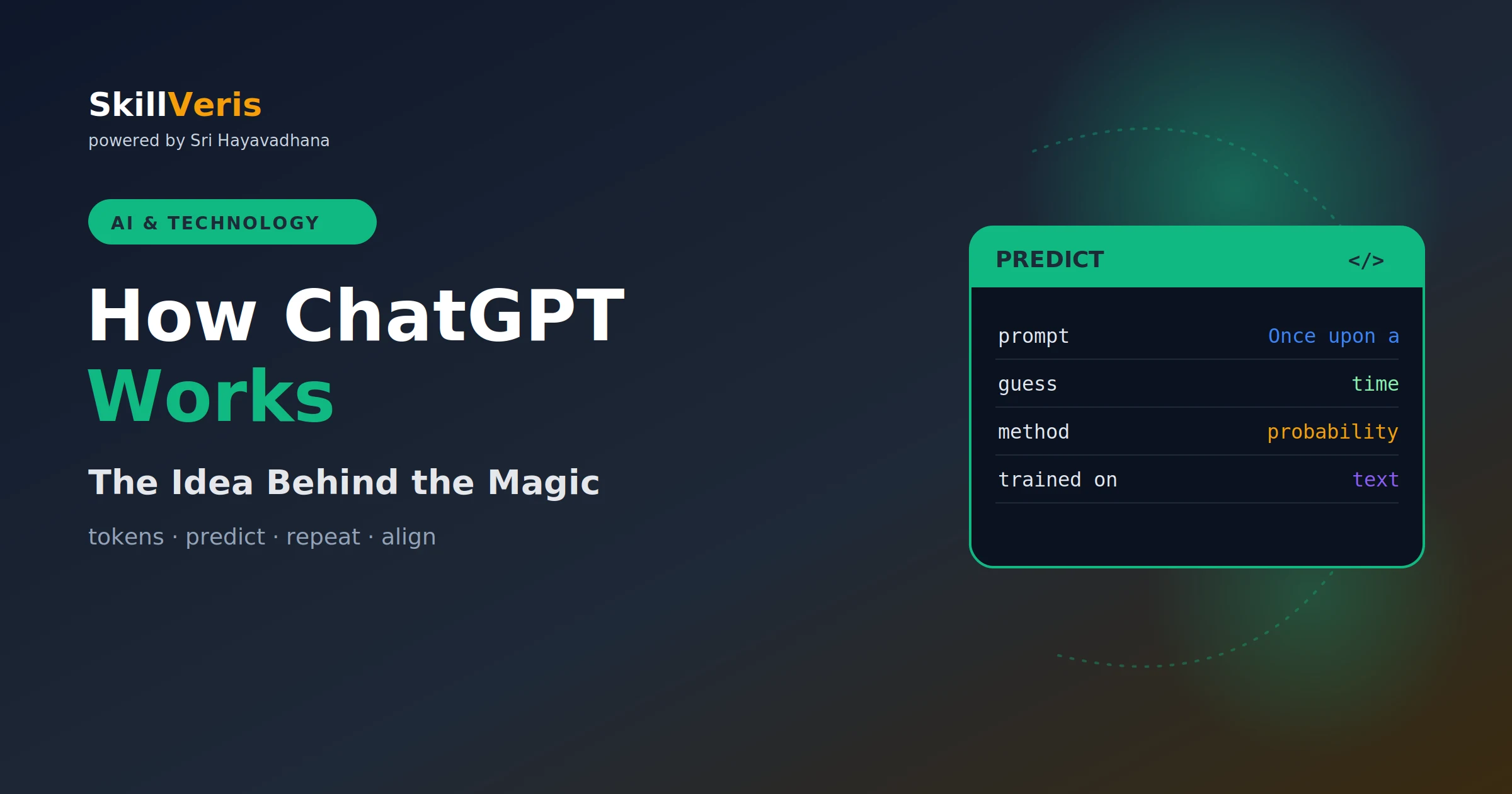
Imagine a phone keyboard that suggests the next word as you type. A large language model is that idea taken to an extreme, trained not on a few of your messages but on a large slice of the written internet, books, and code. Given the text so far, it estimates a probability for every possible next token and picks one.
Because it has seen so many patterns, its predictions are astonishingly good in context. Ask it to continue "The capital of France is" and it confidently predicts "Paris," not because it looked up a fact but because that continuation is overwhelmingly likely given its training. Holding this analogy in mind explains almost everything else about how the models behave.
3Tokens: How Models See Text
Models do not read words the way we do. They first split text into tokens, which are common chunks: whole short words, pieces of longer words, punctuation, and spaces. The word "unbelievable" might become "un," "believ," and "able." This tokenization lets a fixed vocabulary cover almost any text, including words the model has never seen.
Each token is then converted into a list of numbers called an embedding, which places it in a kind of meaning-space where related tokens sit near each other. The model never manipulates letters directly; it works entirely with these numeric representations, which is why token counts, not word counts, drive model limits and pricing.
4Attention: How Models Track Context
The breakthrough that made modern models possible is a mechanism called attention. As the model processes each token, attention lets it look back at all the previous tokens and decide how much each one should influence what comes next. In the sentence "The trophy did not fit in the case because it was too big," attention helps the model connect "it" to "trophy" rather than "case."
Think of attention as the model asking, for every word it is about to predict, which earlier words are relevant right now. This ability to weigh context dynamically is why these models stay coherent across long passages and can follow instructions given many sentences earlier. The architecture built around this mechanism is called the transformer.
🔑Why attention matters
Attention is what lets a model handle meaning that depends on context, like resolving what a pronoun refers to. It is the single idea that separated modern language models from their clumsier predecessors.
5Training: Where the Knowledge Comes From
A fresh model knows nothing; its billions of parameters start as random numbers. Training fixes this by showing it text with the next token hidden and nudging its parameters whenever it guesses wrong. Repeat this across trillions of tokens and the parameters slowly settle into values that encode grammar, facts, reasoning patterns, and style.
This first phase, called pretraining, is enormously expensive and produces a model that is knowledgeable but not necessarily helpful or safe. A second phase then refines it, often using human feedback to prefer answers people find useful and to discourage harmful ones. The result is a model that not only predicts text well but does so in a way aligned with how we want it to behave.
The Two Broad Phases
Almost every capable chat model goes through both of these before you ever use it.
Pretraining: learning general language and knowledge by predicting missing tokens across a massive corpus.
Alignment and fine-tuning: refining the model with curated examples and human feedback to make it helpful and safe.6Inference: Generating a Reply
When you send a prompt, the model runs in inference mode. It reads your tokens, predicts the most suitable next token, appends it, and then repeats the whole process with the slightly longer text. Word by word, or token by token, it builds a response, each new token conditioned on everything generated so far.
This one-at-a-time generation explains why longer answers take longer to produce and why the model sometimes paints itself into a corner: an early awkward token influences everything after it. A setting called temperature controls how boldly it picks among likely tokens, trading off predictable, focused output against varied, creative output.
7Why Models Hallucinate
Understanding the pipeline explains the models' most notorious flaw. Because a language model generates the most plausible next token rather than the verified true one, it will produce a fluent, confident answer even when it has no reliable information. It is optimizing for text that looks right, not for text that is right.
This is why a model can invent a convincing but fake citation or a nonexistent function. It is not lying in any human sense; it is completing a pattern. Knowing this reframes how you should use the tools: trust them for fluency and drafting, and verify them for facts, especially anything specific like names, numbers, and quotes.
⚠️Plausible, not verified
A model's confidence is not evidence. Because it predicts likely text rather than checking truth, always verify factual claims, code, and citations before relying on them.
8What This Design Cannot Do on Its Own
The same architecture that makes these models fluent also bounds them. On its own, a language model has no access to live information, no memory between conversations, and no way to run calculations it has not learned to imitate. Its knowledge is frozen at its training cutoff.
This is why real systems bolt extra tools onto the model. Retrieval feeds it current documents, code execution handles precise math, and memory systems store context across sessions. Recognizing that the base model is a powerful text predictor, not an all-knowing oracle, helps you understand why these additions exist and where each one fits.
9Frequently Asked Questions
How does a large language model actually work? It breaks text into tokens and repeatedly predicts the most likely next token using an attention-based transformer trained on huge amounts of text. Generating one token at a time produces coherent replies.
What is a token in a language model? A token is a small chunk of text, such as a word or word-piece, that the model reads and generates. Models process numeric representations of tokens rather than raw letters.
What is attention in simple terms? Attention is the mechanism that lets the model weigh which earlier words are most relevant when predicting the next one. It is how the model keeps track of context across a sentence or passage.
Why do language models make things up? Because they generate the most plausible next token rather than verified facts, they can produce confident but false statements called hallucinations. This is why you should verify important outputs.
Do you need advanced math to understand how LLMs work? No, the core ideas of tokens, attention, training, and inference can be grasped through intuition and analogies. Math is needed to build models, not to understand them conceptually.
Where can I learn how language models work for free? SkillVeris offers free courses and study notes on large language models and AI foundations that build on exactly these concepts with practical examples.
10The Whole Picture
Strip away the jargon and a large language model is a next-token predictor: it turns text into tokens, uses attention to weigh context, learns from massive training to set its parameters, and generates replies one token at a time during inference. That single pipeline accounts for both the striking capability and the confident mistakes you see every day.
If this clicked, you are ready to go deeper. Explore the free large language models and AI foundations courses and study notes on SkillVeris, where these ideas connect to prompting techniques, retrieval systems, and hands-on projects that turn intuition into real skill.
Related Reading
Get The Print Version
Download a PDF of this article for offline reading.
About the Publisher
SkillVeris Team
AI Research Team
Our AI team covers the latest in machine learning, generative AI, and emerging tech — clearly and accurately.
View all postsRelated Posts
Never miss an update
Get the latest tutorials and guides delivered to your inbox.
No spam. Unsubscribe anytime.