How Diffusion Models Generate Images
SkillVeris Team
AI Research Team
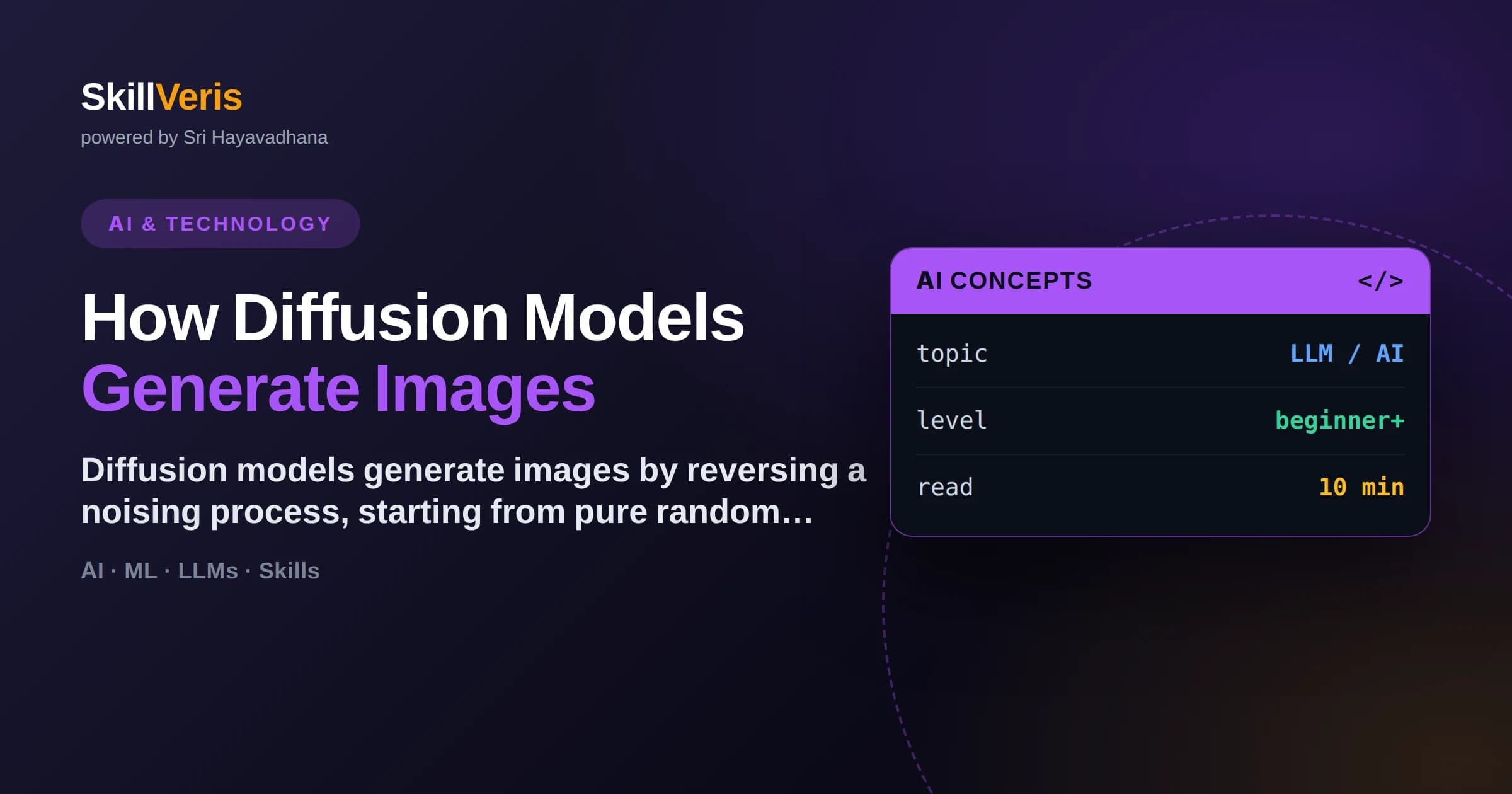
A diffusion model generates images by starting from random noise and repeatedly removing a little noise until a clear image emerges, guided by what it learned during training.
In this guide, you'll learn:
- Training teaches the model the reverse of a forward process that gradually adds Gaussian noise to real images until they become static.
- At each denoising step the network predicts the noise present, and that prediction is subtracted to move the image closer to something realistic.
- Text-to-image models add conditioning so a prompt steers the denoising toward matching content.
- Latent diffusion runs the whole process in a compressed latent space, making high-resolution generation far cheaper.
1How Diffusion Models Generate Images
A diffusion model generates an image by learning to reverse noise. It starts with a canvas of pure random noise and, over many small steps, predicts and removes the noise until a coherent image appears. Each step nudges the pixels toward something that looks like the images the model was trained on.
The magic is that the model never memorizes pictures. It learns the general skill of turning noise into structure, so it can produce endless new images that fit the patterns it absorbed during training.
2The Forward Noising Process
To understand generation, start with its opposite. During training, the model studies a forward process that takes a real image and slowly corrupts it by adding small amounts of Gaussian noise over many steps until nothing but static remains.
This forward process is fixed and requires no learning. Its only job is to create training examples: pairs of a noisy image and the exact noise that was added, at every noise level from barely touched to fully destroyed.
- Step 0: the original clean image.
- Middle steps: the image with increasing amounts of noise mixed in.
- Final step: essentially pure random noise with no visible structure.
- Each step records how much noise was added, which becomes the training target.
3Learning to Reverse the Noise
Generation is the forward process run backward. The model, usually a U-Net or transformer-based network, is trained to look at a noisy image and predict the noise inside it. Subtracting that predicted noise yields a slightly cleaner image.
Repeat this prediction-and-subtraction loop across many steps and the image sharpens from static into a detailed picture. Because the model learned to denoise at every noise level, it can start from complete randomness and still find its way to a realistic result.
🔑Core Loop
At each step the network answers one question: what noise is in this image right now? Remove that prediction, repeat, and structure gradually emerges from chaos.
4Turning Text Into Images
A plain diffusion model produces random images from its training distribution. To make it follow a prompt, you add conditioning. A text encoder converts your prompt into a set of embeddings, and those embeddings are fed into the denoiser at every step so the noise predictions bend toward matching content.
- A text encoder turns the prompt into embeddings the model can read.
- Cross-attention lets each denoising step attend to those text embeddings.
- The noise prediction shifts to favor images that fit the prompt.
- Over many steps, the output converges on a picture matching the words.
Why Prompts Are Approximate
The model steers toward the prompt but is not guaranteed to satisfy every detail, because it balances the text signal against what looks plausible. This is why rephrasing a prompt can noticeably change the result.
5Latent Diffusion for Efficiency
Running diffusion directly on full-resolution pixels is expensive because every step processes a large image. Latent diffusion solves this by first compressing images into a small latent representation with an autoencoder, running the entire noising and denoising process there, then decoding the final latent back into pixels.
Working in the compact latent space slashes the compute needed for each step, which is what makes high-resolution text-to-image generation practical on consumer hardware.
- encode: image -> compact latent representation
- diffuse: add and remove noise entirely in latent space
- decode: final latent -> full-resolution image
- result: far less compute per step than pixel-space diffusion
6Guidance and Control
Classifier-free guidance is the standard knob for controlling how closely output follows the prompt. During generation the model computes two predictions, one conditioned on the prompt and one unconditioned, then pushes the result away from the unconditioned version and toward the conditioned one.
A higher guidance scale makes the image adhere tightly to the prompt but can look oversaturated or rigid. A lower scale gives more variety and natural texture but may drift from what you asked for.
💡Pro Tip
Start with a moderate guidance scale and adjust from there. Crank it up when the model ignores your prompt, dial it down when images look harsh or overcooked.
7Sampling Steps and Schedulers
The number of denoising steps and the sampling algorithm, called a scheduler, control the speed-quality trade-off. More steps generally mean smoother, more detailed results but slower generation, while advanced schedulers can reach good quality in far fewer steps.
- Fewer steps: faster generation, sometimes rougher detail.
- More steps: slower, usually higher fidelity, with diminishing returns.
- Schedulers decide how much noise to remove at each step.
- Modern schedulers can produce strong images in a small number of steps.
Diminishing Returns
Beyond a certain point, adding steps barely improves quality while adding cost. It is worth benchmarking a few step counts for your scheduler to find the sweet spot rather than defaulting to the maximum.
8Best Practices for Better Results
Getting strong images out of a diffusion model is part prompt craft, part parameter tuning.
- Write specific prompts: name the subject, style, lighting, and composition.
- Tune guidance scale rather than accepting the default blindly.
- Use negative prompts to steer the model away from unwanted traits.
- Fix a seed when you want reproducible results across runs.
- Benchmark step counts to balance speed against quality for your scheduler.
9Common Mistakes to Avoid
A few misunderstandings trip up newcomers to image generation.
- Assuming the model retrieves stored images; it synthesizes new ones from learned patterns.
- Pushing guidance scale extremely high and getting harsh, oversaturated output.
- Expecting exact text or fine anatomy, which diffusion models often render imperfectly.
- Using vague prompts and blaming the model for generic results.
- Maxing out sampling steps when a smaller count would look nearly identical.
10Key Takeaways
The essentials of diffusion image generation come down to a handful of ideas.
- Diffusion models generate by reversing a noising process, step by step.
- Training teaches the model to predict and remove noise at every level.
- Text conditioning steers denoising toward images matching a prompt.
- Latent diffusion runs in compressed space to make high resolution affordable.
- Guidance scale and step count are the main knobs for control and quality.
11Frequently Asked Questions
Q: Do diffusion models copy images from their training data? A: No, they learn the general skill of turning noise into structure rather than storing specific pictures. Each output is newly synthesized, though the results reflect the styles and patterns present in the training set.
Q: Why do diffusion models struggle with text and hands? A: These require precise, consistent structure that is hard to reconstruct from noise, and small errors are very noticeable to humans. Models have improved at both, but they remain common failure points.
Q: What is the difference between pixel and latent diffusion? A: Pixel diffusion denoises the full-resolution image directly, which is accurate but expensive. Latent diffusion compresses the image first and denoises in a small latent space, dramatically cutting compute at high resolutions.
Q: What does the guidance scale do? A: It controls how strongly the model follows your prompt versus generating freely. Higher values stick closer to the prompt but can look harsh, while lower values give more variety and natural texture.
Related Reading
Get The Print Version
Download a PDF of this article for offline reading.
About the Publisher
SkillVeris Team
AI Research Team
Our AI team covers the latest in machine learning, generative AI, and emerging tech — clearly and accurately.
View all postsRelated Posts
Never miss an update
Get the latest tutorials and guides delivered to your inbox.
No spam. Unsubscribe anytime.