How AI Tokenization Works Explained Simply
SkillVeris Team
AI Research Team
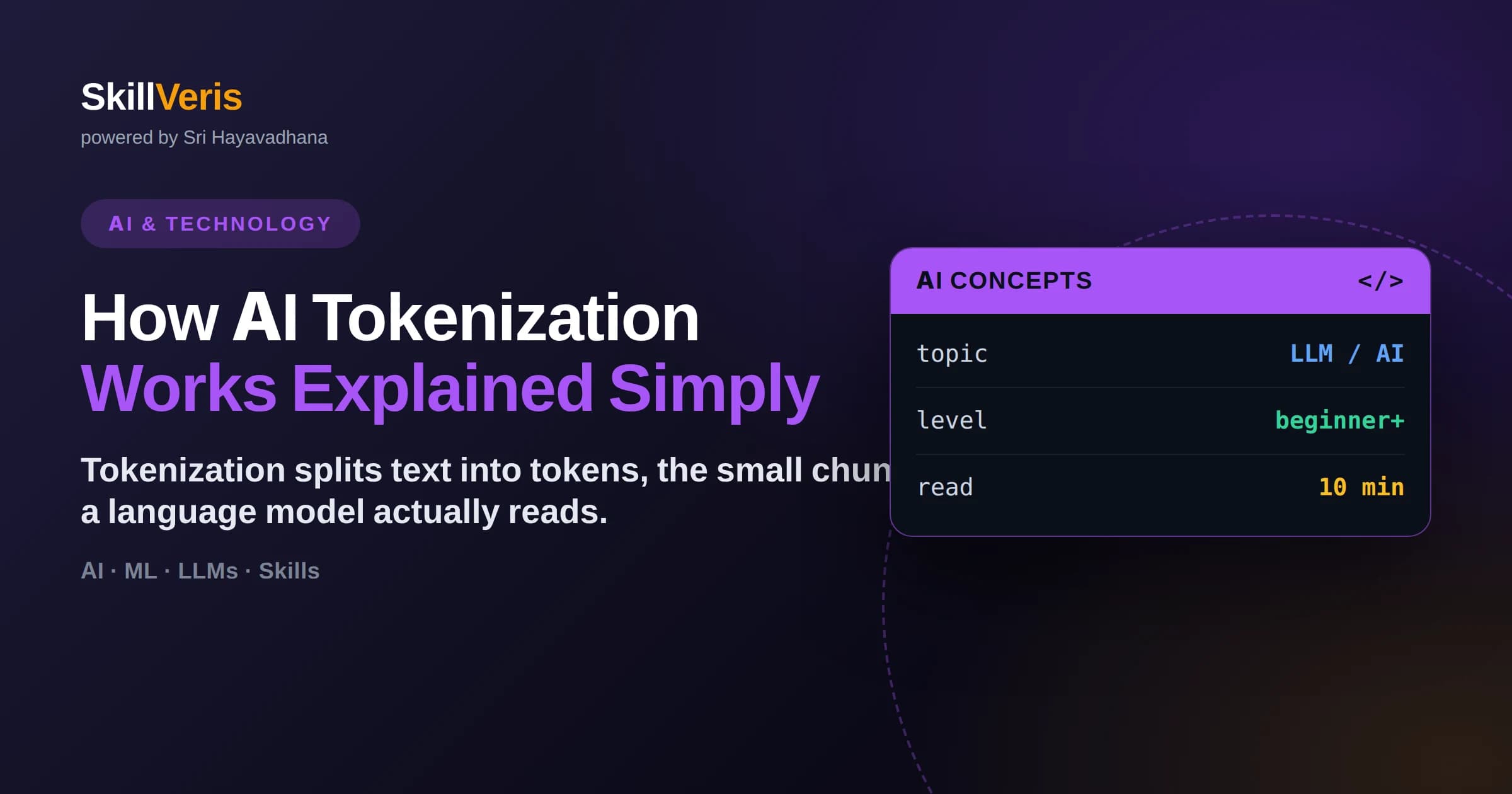
Tokenization is the process of breaking text into tokens, the small chunks a language model reads and generates instead of raw words or letters.
In this guide, you'll learn:
- A token is often part of a word, roughly three-quarters of an English word on average, and common words become single tokens.
- Models never see raw text; each token maps to a number, and the model works entirely with those numbers.
- Token counts drive context limits and pricing, so the same idea can cost different amounts depending on wording.
- Subword methods like Byte Pair Encoding let models handle any word, including ones never seen in training.
1What Is AI Tokenization?
Tokenization is how a language model breaks text into small pieces called tokens, which are the units it actually reads and generates. Before a model processes your sentence, a tokenizer splits it into these chunks, and each chunk is turned into a number the model can work with.
A token is usually part of a word rather than a whole word or a single letter. Common words like 'the' become one token, while a longer or rarer word like 'tokenization' may split into several. On average, one token is about three-quarters of an English word, which is why token counts and word counts never quite match.
2Why Models Use Tokens
Working at the word level would be impractical because human vocabulary is enormous and always growing, and a model can only handle a fixed vocabulary. Working at the single-character level would make sequences painfully long and strip away useful structure.
Subword tokens are the practical middle ground. They keep common words compact while still being able to represent any word by combining smaller pieces. This is how a model can process a brand name or typo it never saw in training: it just breaks the unfamiliar string into familiar subword tokens.
🔑The Balance
Tokens sit between whole words and single letters. That balance keeps sequences short enough to process while still covering any possible text.
3How Tokenization Works
The dominant approach is a family of subword algorithms, most famously Byte Pair Encoding. It learns a vocabulary from lots of text by repeatedly merging the most frequent pairs of characters into larger units.
- Start with individual characters as the base vocabulary.
- Count which adjacent pairs appear most often across the training text.
- Merge the most frequent pair into a new single token, and repeat many times.
- The result is a vocabulary where common sequences are single tokens and rare ones split into parts.
- At runtime, the tokenizer greedily maps your text to this learned vocabulary.
From Tokens to Numbers
Each token in the vocabulary has an ID, an integer index. When you send text, the tokenizer converts it into a list of these IDs, and the model does all its math on the numbers. When it generates, it predicts token IDs one at a time, and the tokenizer converts them back into readable text. The model never truly sees letters, only these numeric tokens.
4Why Tokenization Matters to You
Tokenization is not just an internal detail; it directly affects cost, limits, and behavior in ways that show up in your applications.
- Context limits: a model's window is measured in tokens, so token count decides what fits.
- Pricing: most APIs charge per token, so wordy prompts literally cost more.
- Languages: some non-English text tokenizes into more tokens per word, raising cost and using more context.
- Truncation: hitting the token limit trims content, sometimes mid-thought.
- Prompt design: trimming redundant words saves tokens without losing meaning.
💡Measure, Do Not Guess
Use your provider's tokenizer or token-counting endpoint to see exactly how many tokens a prompt uses. Word counts only give a rough estimate.
5Quirks Tokenization Explains
Several odd model behaviors make sense once you understand tokens. They are not random bugs but consequences of the model seeing tokens rather than letters.
- Miscounting letters: a model may struggle to count the r's in a word because it sees tokens, not individual characters.
- Rare-word handling: unusual names or jargon split into many tokens, which can reduce accuracy.
- Spacing sensitivity: a leading space can change how a word tokenizes, subtly affecting output.
- Number handling: digits may tokenize inconsistently, contributing to arithmetic slips.
- Non-English cost: languages with different scripts can use more tokens for the same meaning.
The Strawberry Problem
A well-known example is a model getting confused about how many times a letter appears in a word. Because the word arrives as one or a few tokens rather than a sequence of letters, the model has no direct view of the individual characters. It is reasoning about a token, not spelling, which is why character-level tasks can trip it up.
6Best Practices
You rarely configure tokenization yourself, but understanding it helps you write leaner, cheaper, more reliable prompts.
- Count tokens for long prompts so you stay within the context window and budget.
- Trim filler and repetition; concise prompts use fewer tokens without losing intent.
- Remember output counts too, and leave room in the window for the response.
- For character-level tasks like counting letters, consider giving the model explicit help or tools.
- Test prompts in other languages for token cost, since some scripts inflate counts.
7Common Mistakes to Avoid
Misunderstanding tokens leads to surprises in cost, truncation, and reliability.
- Estimating prompt size in words and being caught out when token counts run higher.
- Forgetting that generated output also consumes tokens and the window.
- Assuming the model reads letters, then being puzzled by spelling and counting errors.
- Ignoring that non-English or code-heavy text can tokenize into far more tokens.
- Padding prompts with redundant text that quietly inflates every request's cost.
8Key Takeaways
The core ideas about tokenization are simple to hold onto.
- Tokenization splits text into tokens, the chunks a model actually reads.
- A token is often part of a word, about three-quarters of an English word on average.
- Tokens map to numbers; models never see raw letters.
- Token counts drive context limits and pricing, so wording affects cost.
- Tokenization explains quirks like miscounting letters and rare-word trouble.
9Frequently Asked Questions
Q: What exactly is a token in AI? A: A token is a small chunk of text, often part of a word, that a language model treats as a single unit. Common words are one token, while longer or rarer words split into several. Each token maps to a number the model processes.
Q: How many tokens is a word? A: On average, one English word is roughly 1.3 tokens, or put differently, 1,000 tokens is about 750 words. It varies by word length, language, and content, so use a tokenizer for exact counts.
Q: Why do models struggle to count letters in a word? A: Because they see tokens, not individual characters. A word may arrive as a single token, so the model has no direct view of its letters and can miscount them, even though it handles the word's meaning fine.
Q: Does tokenization affect how much I pay for AI? A: Yes. Most APIs charge per token for both input and output, so the number of tokens in your prompt and the response determines cost. Concise prompts and awareness of how your text tokenizes can meaningfully reduce spending.
Related Reading
Get The Print Version
Download a PDF of this article for offline reading.
About the Publisher
SkillVeris Team
AI Research Team
Our AI team covers the latest in machine learning, generative AI, and emerging tech — clearly and accurately.
View all postsRelated Posts
Never miss an update
Get the latest tutorials and guides delivered to your inbox.
No spam. Unsubscribe anytime.