How AI Recommendation Systems Work
SkillVeris Team
AI Research Team
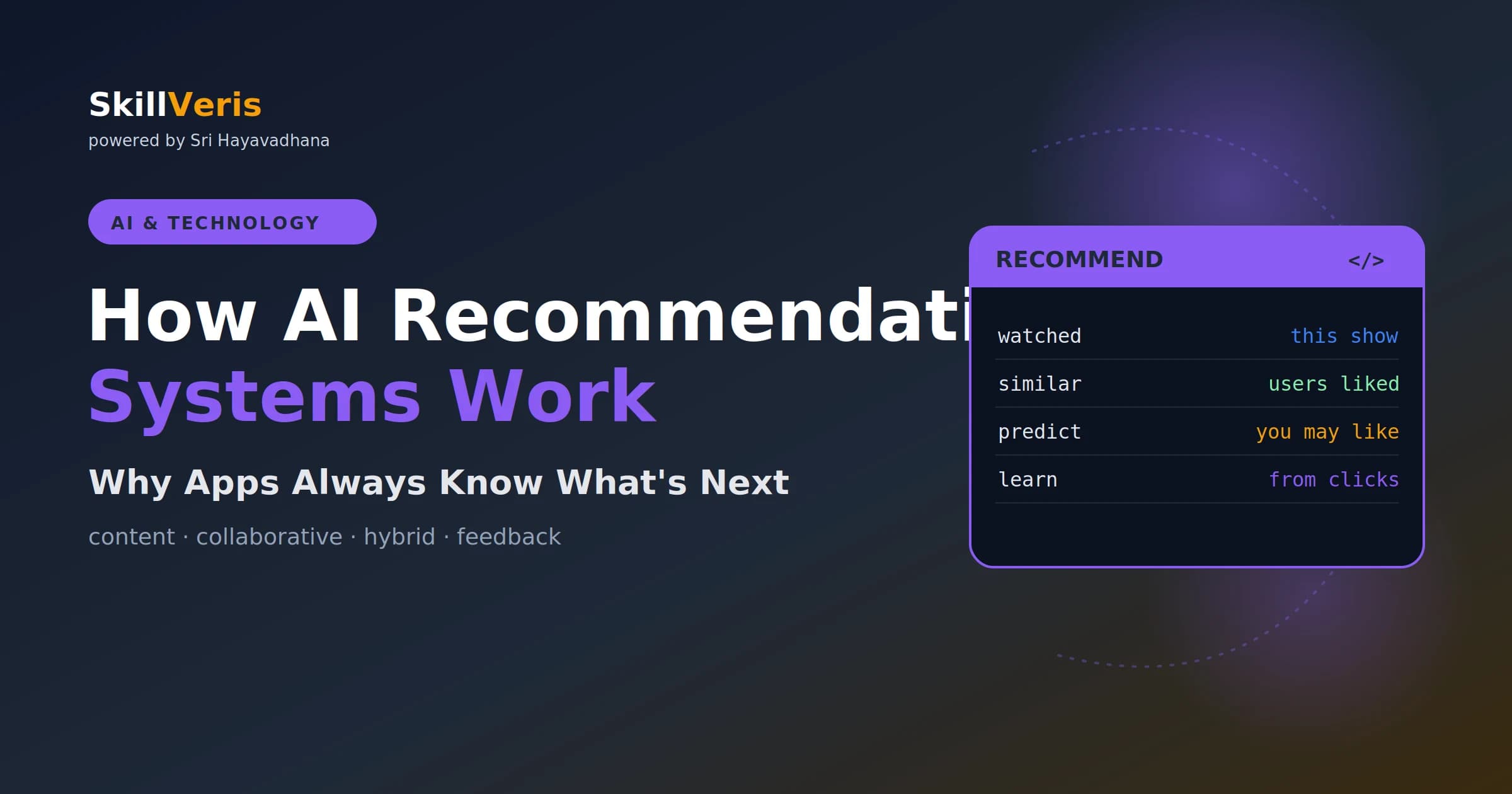
Recommendation systems suggest what you'll like using two core ideas: content-based filtering (match items similar to what you liked) and collaborative filtering (match you to sim
In this guide, you'll learn:
- Most real systems are hybrid and learn continuously from your clicks — powerful, but prone to filter bubbles.
- All concepts are explained with real-world examples and hands-on practice.
- All concepts are explained with real-world examples and hands-on practice.
- All concepts are explained with real-world examples and hands-on practice.
1About This Guide
Ever wonder how a streaming app lines up the next show you'll binge, or how a shop suggests exactly
the thing you needed? That's a recommendation system. This guide explains how they work, in plain
2What Recommendation Systems Are
A recommendation system predicts what you'll like and surfaces it — films, songs, products, posts,
people to follow. It's one of the most widely used and commercially valuable applications of AI, quietly
3Why They Matter
With endless options, recommendations cut through the noise — helping you discover things you'd enjoy
without endless searching. For businesses, good recommendations drive engagement and sales, which
4Content-Based Filtering
This approach looks at item features. If you liked several action films, it recommends more action films
— matching the characteristics of things you've enjoyed. It's intuitive and works even for new users, as
5Collaborative Filtering
This approach looks at similar people. If users with tastes like yours loved a particular song, it suggests
that song to you — even if it's unlike anything you've tried. It's the "people like you also enjoyed…" idea,
6Hybrid Systems
Most real-world systems combine both — hybrid recommendation. Mixing item features with patterns
across users gives more accurate, well-rounded suggestions than either method alone, and smooths
7The Feedback Loop
These systems learn continuously. Every click, watch, skip, like, and purchase is a signal that refines
your profile. The more you interact, the sharper the recommendations become — for better and,
- Strengths: save time, aid discovery, personalise experiences.
- Filter bubbles: they can narrow what you see to more of the same.
- Popularity bias: niche items can get buried under hits.
- Cold start: hard to recommend for brand-new users or items.
- Recommendation systems predict what you'll like and surface it.
Related Reading
Get The Print Version
Download a PDF of this article for offline reading.
About the Publisher
SkillVeris Team
AI Research Team
Our AI team covers the latest in machine learning, generative AI, and emerging tech — clearly and accurately.
View all postsRelated Posts



Never miss an update
Get the latest tutorials and guides delivered to your inbox.
No spam. Unsubscribe anytime.