Google Data Analytics Certificate: Is It Worth It in 2026
SkillVeris Team
Learning Team
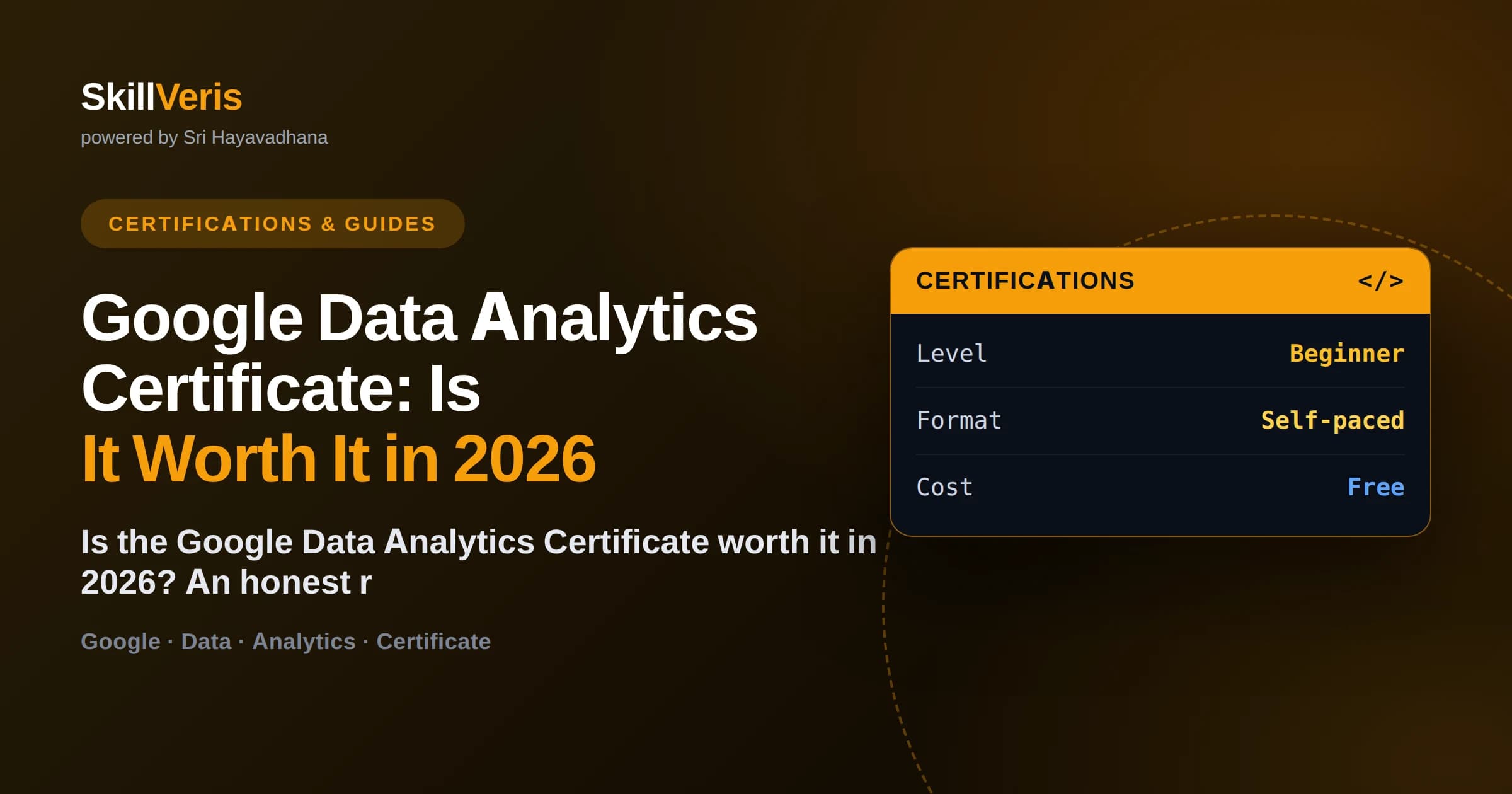
The Google Data Analytics Certificate is a solid, beginner-friendly foundation, but it is not a guaranteed job on its own in 2026.
In this guide, you'll learn:
- It covers the analytics process, spreadsheets, SQL, R, and Tableau, but goes broad rather than deep in each area.
- Its biggest weaknesses are shallow SQL, limited Python coverage, and pre-cleaned datasets that hide real-world messiness.
- The certificate's real value is structure, momentum, and a resume line, not the credential's name recognition among hiring managers.
- A strong portfolio of your own projects matters far more to employers than the certificate itself.
1Is the Google Data Analytics Certificate Worth It in 2026?
The Google Data Analytics Certificate is worth it in 2026 for one specific person: a complete beginner who wants a structured, affordable starting path and the discipline of a guided curriculum. It is not worth treating as a magic ticket to a job, because on its own it will not get you hired. Its real value is momentum and foundations; the hiring outcome comes from what you build after it, not from the certificate line itself.
The certificate has become extremely popular, which is both its strength and its weakness. It has introduced hundreds of thousands of people to analytics with a beginner-friendly, self-paced format. But that same popularity means it no longer stands out on a resume, so many people hold it that hiring managers see it as a baseline, not a differentiator.
This honest review breaks down what the certificate actually covers, where it genuinely helps, where it falls short, and the free alternatives that can teach you the same material, sometimes in more depth, without the subscription cost. The goal is to help you decide clearly rather than sell you on it.
2What the Certificate Actually Covers
The program is a multi-course series that walks a beginner through the full analytics lifecycle: asking the right questions, preparing and cleaning data, analyzing it, visualizing it, and sharing findings. It is designed to be completed in a few months of part-time study and assumes no prior experience, which is exactly why it works so well as an on-ramp.
Technically, it introduces spreadsheets for foundational analysis, SQL for querying databases, R for statistical analysis and programming, and Tableau for visualization and dashboards. It also spends meaningful time on the softer, process-oriented side, framing problems, thinking about stakeholders, and communicating results, which beginners often underestimate but employers value.
The final courses have you work through a capstone case study, producing a small end-to-end project you can talk about in interviews. This structured progression, from concept to a tangible deliverable, is one of the program's genuine strengths for people who struggle to self-direct their learning.
- The analytics process: ask, prepare, process, analyze, share, act.
- Spreadsheets for cleaning, formulas, pivot tables, and basic analysis.
- SQL fundamentals for querying and joining data.
- R for programming, statistics, and reproducible analysis.
- Tableau for building visualizations and dashboards.
- A capstone case study to produce one portfolio-ready project.
3Where It Genuinely Helps
For an absolute beginner, the certificate's biggest gift is structure. A curated, sequenced path removes the paralysis of not knowing what to learn next, and the built-in deadlines and progress tracking help you actually finish rather than abandon a pile of half-watched tutorials. If self-discipline is your bottleneck, that structure alone can justify the cost.
It also covers the process and communication side that purely technical courses often skip. Learning to frame a business question, think about stakeholders, and present findings clearly is a real advantage, because these are the skills that separate employable analysts from people who can only run queries. The certificate treats analytics as a job, not just a set of tools.
Finally, it is legitimately beginner-friendly and affordable relative to a degree or a bootcamp. The self-paced format fits around a full-time job, and for many people it is the thing that gets them off the fence and into learning at all. That momentum has real value, even if the credential itself does not open doors on its own.
🔑Its best use case
The certificate shines as a structured kickstart for disciplined beginners who then build their own projects. Treat it as chapter one of your learning, not the whole book, and it delivers real value.
4Where It Falls Short
The certificate's breadth is also its ceiling. By covering spreadsheets, SQL, R, and Tableau in a few months, it can only go so deep in each. The SQL in particular tends to be introductory, whereas real analyst roles often demand more advanced querying, joins, window functions, and performance awareness. You will need to go beyond the certificate to be genuinely job-ready in SQL.
It also teaches R rather than Python. Both are valid, but Python dominates many analytics and data science job postings, so learners aiming for those roles may need to pick up Python separately. And the datasets in the course are largely pre-cleaned and well-behaved, which hides the messy, ambiguous data that consumes most of a real analyst's time. That gap between tidy coursework and chaotic reality can be a shock.
The final honest point is market saturation. Because so many people now hold this exact certificate, it no longer differentiates you. Hiring managers increasingly see it as a baseline signal at best and focus instead on your portfolio, your ability to reason about data, and how you communicate. The certificate can get you learning; it will not get you hired by itself.
⚠️The certificate is not a portfolio
Completing the program proves you finished a course, not that you can solve novel problems. Employers hire on demonstrated ability. Without your own projects on messy, real data, the certificate line alone rarely moves the needle.
5Will It Actually Get You a Job?
By itself, usually not, and it is important to be clear-eyed about this. The certificate builds foundational skills and gives you one guided project, but the analysts who land roles pair that foundation with a portfolio of their own work, deeper skill in at least one query language, and the ability to communicate insights. The credential is a starting line, not a finish line.
The most successful path is to treat the certificate as phase one and then keep going: build three or four projects on real, messy datasets in a domain you care about, deepen your SQL well past the course level, and practice explaining your findings as if to a non-technical manager. That follow-through is what converts learning into interviews.
If you already have some analytics exposure, or strong self-discipline, you may not need the certificate's structure at all and can go straight to building skills and projects through free resources. If you are starting cold and want a guided path, it can be a reasonable, low-cost first step, as long as you know what comes after it.
6Strong Free Alternatives
Everything the certificate teaches, spreadsheets, SQL, statistics, and data visualization, is available for free through high-quality open courses and study notes, often with more depth in the areas that matter most for hiring. The trade-off is that free paths require you to sequence your own learning and stay disciplined, which is precisely the structure the paid certificate provides.
A strong free path looks like this: learn spreadsheets and data cleaning first, build solid SQL fundamentals and then push into intermediate querying, pick up basic statistics so your conclusions are sound, and learn a visualization tool to communicate results. Add Python if your target roles list it. Then, crucially, build your own portfolio projects on real datasets, this is the piece the certificate under-delivers and the piece employers weigh most.
The honest bottom line: the certificate buys you structure and a resume line; free resources buy you the same skills plus, if you self-direct well, more depth, for no cost. Either way, the deciding factor in your job search will be the projects you build and your ability to reason and communicate, not which learning source you chose.
- Free SQL courses that go deeper than introductory querying.
- Open spreadsheet and data-cleaning material with realistic, messy data.
- Free statistics foundations so your analysis holds up.
- Visualization and dashboarding tutorials for Tableau, Power BI, or similar.
- Guided project ideas to build a portfolio that actually gets read.
7Frequently Asked Questions
Is the Google Data Analytics Certificate worth it in 2026? For a disciplined beginner who wants structure and a low-cost on-ramp, yes, as a first step. It is not worth treating as a guaranteed path to a job; the hiring outcome depends on the portfolio and skills you build afterward.
Will the certificate get me a data analyst job on its own? Usually not. It builds foundations and one guided project, but employers hire on portfolios, deeper skills, and communication ability. Because so many people hold it, it now reads as a baseline rather than a differentiator.
How long does the certificate take to complete? Most learners finish in a few months of part-time, self-paced study, though it can be faster with focused effort. The timeline is flexible, which makes it fit around a full-time job.
Does the certificate teach Python? No, it teaches R for programming and statistics. Since Python dominates many analytics job listings, learners targeting those roles often need to pick up Python separately after or alongside the program.
Can I learn the same material for free? Yes. Everything the certificate covers, spreadsheets, SQL, statistics, and visualization, is available through free courses and study notes, often with more depth. The trade-off is that you must sequence and pace your own learning.
What matters more than the certificate to employers? Your portfolio of real projects, your depth in at least one query language, and your ability to reason about data and communicate findings clearly. These outweigh any single credential in hiring decisions.
8Your Next Steps
The Google Data Analytics Certificate in 2026 is a decent structured starting point for disciplined beginners, but it is neither a job guarantee nor a differentiator on its own. Its strengths are momentum, process, and communication; its limits are shallow SQL, no Python, tidy datasets, and market saturation. Whichever way you go, your projects and your ability to reason and communicate will decide your outcome.
If you would rather not pay for structure you can get for free, you can learn spreadsheets, SQL, statistics, and visualization, often in more depth, for free on SkillVeris, then build the real portfolio that employers actually read. Explore the free data analytics courses and study notes, pick your path, and put your energy into projects on messy, real data. That is what turns learning into a job.
Related Reading
Get The Print Version
Download a PDF of this article for offline reading.
About the Publisher
SkillVeris Team
Learning Team
Our learning specialists map the fastest paths to industry-recognised certifications.
View all postsRelated Posts
Never miss an update
Get the latest tutorials and guides delivered to your inbox.
No spam. Unsubscribe anytime.