Getting Started With scikit-learn
SkillVeris Team
Data Science Team
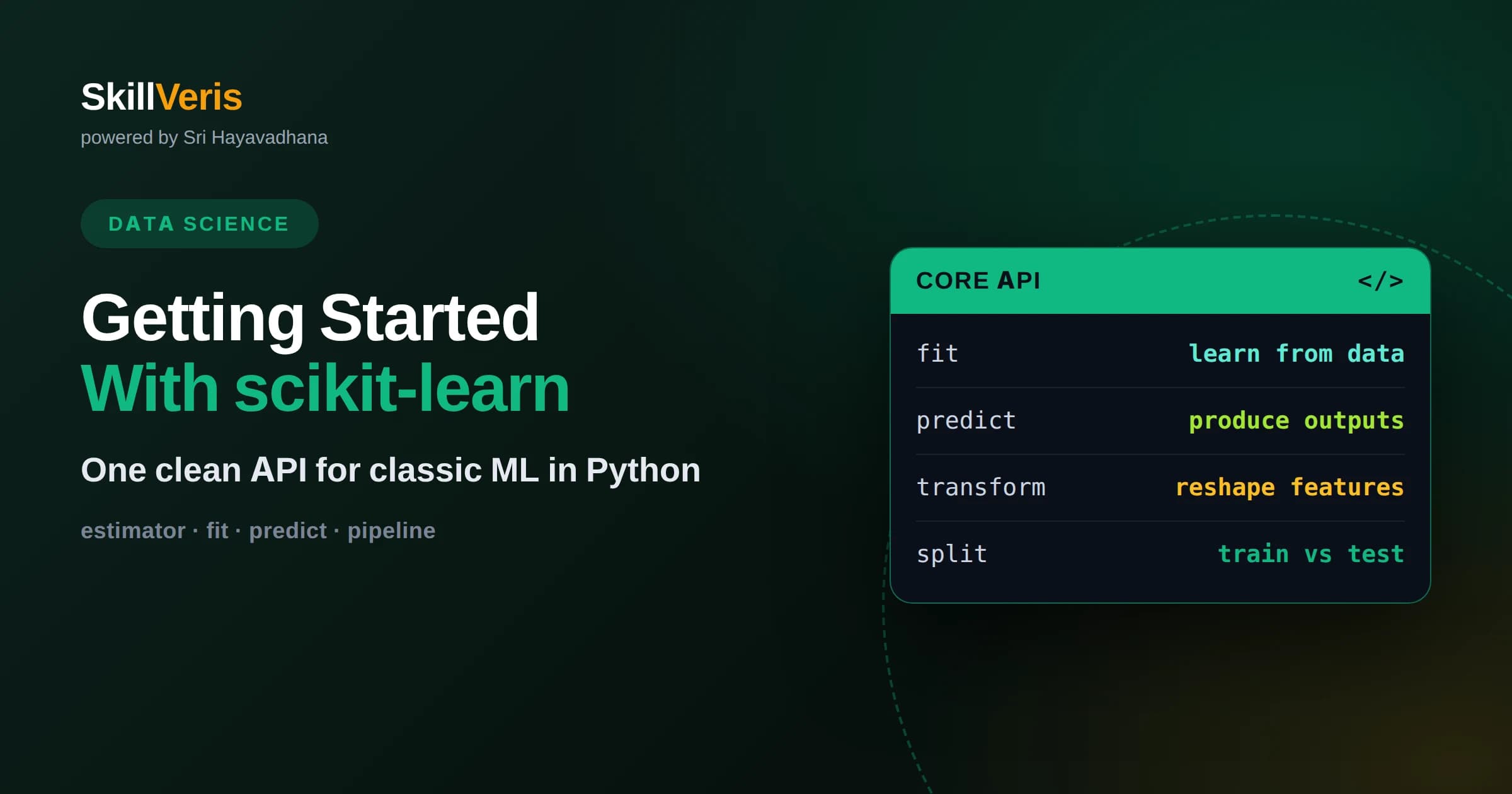
scikit-learn provides a single, consistent interface for dozens of machine learning algorithms in Python.
In this guide, you'll learn:
- The fit, predict, and transform pattern is the key idea that makes the whole library easy to learn.
- A proper workflow always splits data, trains only on the training set, and evaluates on unseen data.
- Pipelines bundle preprocessing and modeling so the same steps run reliably every time.
1What scikit-learn Is and Why It Dominates
scikit-learn is the most widely used Python library for classic machine learning, offering ready-made implementations of algorithms for classification, regression, clustering, and data preprocessing behind one consistent interface. If you want to train a model without writing the math yourself, scikit-learn is almost always where you start. It sits on top of NumPy and integrates smoothly with pandas.
Its popularity comes from design, not just features. Every model in the library follows the same small set of methods, so once you learn how to use one estimator you can use nearly all of them. That consistency lowers the cost of trying new algorithms to almost nothing, which is exactly what you want while learning and experimenting.
scikit-learn deliberately focuses on classic, well-understood methods rather than deep learning. That focus makes it the ideal tool for tabular data problems, which are the majority of real-world machine learning tasks, and a superb environment for learning the fundamentals that transfer everywhere. It is also exceptionally well documented, with clear examples for nearly every estimator, so you are rarely stuck for long when you want to try something new.
2The Estimator API: One Pattern to Rule Them All
The heart of scikit-learn is the estimator interface. Every algorithm is an object with a fit method that learns from data and, depending on its purpose, a predict method that produces outputs or a transform method that reshapes data. Learn this pattern once and the entire library opens up.
You create a model by instantiating its class, optionally passing settings called hyperparameters. You then call fit with your training features and, for supervised learning, the known answers. The model absorbs the patterns and stores what it learned inside the object, ready to be applied to new data.
Because every estimator shares this shape, swapping one algorithm for another is often a one-line change. This is what makes scikit-learn such a productive place to experiment: the plumbing stays the same while you compare very different models.
3Getting Data Into the Right Shape
scikit-learn expects your features as a two-dimensional structure, conventionally called X, where each row is a sample and each column is a feature. The targets you want to predict go in a one-dimensional structure conventionally called y. Getting your data into this shape is usually done with pandas or NumPy before modeling begins.
The library includes a few small built-in datasets that are perfect for practice because they load instantly and require no cleaning. Using one of these while you learn the API removes the distraction of data wrangling so you can focus on the modeling workflow itself.
Once you move to real data, most of your effort shifts to preparing X and y correctly. Ensuring the features are numeric, the shapes align, and there are no stray missing values is a prerequisite for everything that follows.
4Splitting Data to Measure Honestly
The single most important habit in machine learning is evaluating a model on data it has never seen. scikit-learn makes this easy with a function that randomly splits your data into a training set and a test set. You train on the first and measure performance on the second, which estimates how the model will behave on genuinely new inputs.
Without this split, you can fool yourself completely. A model that simply memorizes its training data will score perfectly on that same data and then fail on anything new. The test set is your defense against that illusion, giving you an honest read on generalization.
A common split holds out something like a quarter of the data for testing. Setting a fixed random seed makes the split reproducible, so your results are the same each time you run the code, which matters when you are comparing approaches.
5Training Your First Model
With X and y split into training and test sets, training a model is three lines: create the estimator, call fit on the training data, and call predict on the test features. That is genuinely all it takes to go from data to predictions, which is why scikit-learn is such an approachable entry point.
A good first choice is a simple, interpretable model such as logistic regression for classification or linear regression for continuous targets. Starting simple gives you a baseline to beat and keeps your attention on the workflow rather than on the intricacies of a complex algorithm.
The predictions you get back are just an array of the model's guesses for each test sample. On their own they mean little; the next step is comparing them to the true answers to see how well the model actually did.
6Evaluating Model Performance
scikit-learn provides metric functions that compare predictions to true values. For classification, accuracy reports the fraction of correct predictions, but it can mislead when classes are imbalanced. Precision, recall, and the F1 score give a fuller picture by accounting for the different kinds of mistakes a classifier can make.
For regression, metrics like mean absolute error and mean squared error summarize how far predictions fall from reality on average. Choosing the right metric depends on your problem, because a metric encodes what you consider a good result and what kind of error is most costly.
A confusion matrix is invaluable for classification because it shows exactly which classes get confused with which. Reading it often reveals that a model is strong on common cases but weak on rare ones, an insight a single accuracy number would hide.
7Preprocessing With Transformers
Preprocessing steps in scikit-learn are also estimators, but they use fit and transform instead of fit and predict. A scaler, for example, learns the mean and spread of each feature during fit and then applies that rescaling during transform. This uniform design means preprocessing feels just like modeling.
The crucial rule is to fit preprocessing on the training data only, then apply the learned transformation to both training and test sets. Fitting on all the data leaks information from the test set into training and inflates your scores, giving you a falsely optimistic view of performance.
Common transformers handle scaling numeric features, encoding categorical ones, and imputing missing values. Chaining several of them is how you turn raw data into model-ready features in a controlled, repeatable way.
8Bundling Steps With Pipelines
A pipeline chains preprocessing and modeling into a single object. When you call fit on a pipeline, it fits each transformer in turn and finally fits the model; when you call predict, it applies the same transformations before predicting. This guarantees the exact same steps run every time, in the correct order.
Pipelines are more than convenience. They eliminate a whole class of bugs where preprocessing is applied inconsistently between training and testing. Because the pipeline treats the entire flow as one estimator, it is also much harder to accidentally leak test data into your preprocessing.
Once your workflow lives in a pipeline, you can save it, load it later, and apply it to new data with a single call. That portability is what lets a model move from a notebook into a real application without rewriting the preprocessing logic.
9Getting Reliable Estimates With Cross-Validation
A single train-test split gives one estimate of performance, but that estimate depends on which rows happened to land in the test set. Cross-validation reduces this luck by splitting the data several ways, training and testing on each split, and averaging the results for a steadier estimate.
The most common form divides the data into equal folds, holds out each fold in turn for testing, and trains on the rest. scikit-learn automates this with a single function call, so getting a robust performance estimate costs almost no extra effort.
Cross-validation is especially important on smaller datasets, where a single split is noisy. It gives you more confidence that a difference between two models is real rather than an artifact of one particular random division.
10Tuning Hyperparameters
Every algorithm has hyperparameters, the settings you choose before training that shape how the model learns. Their best values depend on the data, so finding good ones is part of the job. scikit-learn provides search tools that try many combinations automatically and report which performed best under cross-validation.
Grid search exhaustively tries every combination in a defined range, while randomized search samples combinations at random, which is often faster when there are many options. Both wrap around your model and cross-validation, keeping the process organized and reproducible.
Resist the temptation to tune endlessly. Small gains from heavy tuning rarely matter as much as good features and clean data. Tune enough to get sensible settings, then invest your time where the bigger returns are.
11Common Beginner Mistakes to Avoid
The most frequent error is evaluating on training data and celebrating a score that means nothing. Always report performance on held-out data. Closely related is fitting preprocessing on the full dataset, which quietly leaks information and inflates results in the same way.
Another trap is ignoring class imbalance and trusting accuracy blindly. When one class dominates, a model that always predicts the majority can score high while being useless. Checking the class distribution and choosing appropriate metrics avoids this.
Finally, beginners often reach for complex models too early. A simple baseline is fast, interpretable, and often competitive. It tells you whether the problem is even learnable before you invest in something elaborate.
12Saving and Reusing Trained Models
A trained scikit-learn model, or an entire pipeline, is just a Python object holding what it learned. You can serialize it to disk and load it back later, which lets you train once and then make predictions in a separate program without retraining. This is the bridge from a notebook experiment to something an application can actually use.
Saving the whole pipeline rather than just the final model is the safe habit, because the pipeline carries its preprocessing with it. Loading it later gives you an object that transforms raw inputs and predicts in one step, exactly as it did during training, with no risk of applying preprocessing inconsistently.
Be mindful that a saved model is tied to the versions of the libraries used to create it. Recording those versions alongside the saved file saves you from confusing failures when you load an old model into a newer environment months later.
13Exploring the Wider Ecosystem
scikit-learn rarely works alone. It sits inside a Python data stack where NumPy provides fast numerical arrays, pandas handles labeled tables, and matplotlib or seaborn draw the charts you use to understand results. Fluency across these tools is what makes a scikit-learn workflow smooth end to end.
The library itself is broad. Beyond the models you meet first, it includes clustering for unsupervised problems, dimensionality reduction for compressing features, and dozens of utilities for validation and metrics. Because everything shares the same estimator interface, exploring these new corners feels familiar rather than daunting.
This consistency is the quiet superpower of the library. Once the core workflow is second nature, expanding your toolkit is mostly a matter of discovering which estimator solves a new problem, not learning a whole new way of working. That is what makes scikit-learn such a durable investment of your time.
14Start Building on SkillVeris
scikit-learn rewards hands-on practice because its consistent design means every model you train reinforces the same core workflow. Once fit, predict, and evaluate feel automatic, you can explore new algorithms with confidence, knowing the surrounding structure never changes. That fluency is the real goal of getting started.
SkillVeris guides you through building complete scikit-learn workflows on real datasets, from splitting data to tuning models, so the pattern becomes second nature. Working through these projects gives you the practical skill to take any tabular problem from raw data to a trustworthy trained model.
Related Reading
Get The Print Version
Download a PDF of this article for offline reading.
About the Publisher
SkillVeris Team
Data Science Team
Our data team shares real-world analytics, ML, and SQL insights grounded in industry practice.
View all postsRelated Posts
Never miss an update
Get the latest tutorials and guides delivered to your inbox.
No spam. Unsubscribe anytime.