Free Course on Artificial Intelligence: What to Expect
SkillVeris Team
AI Research Team
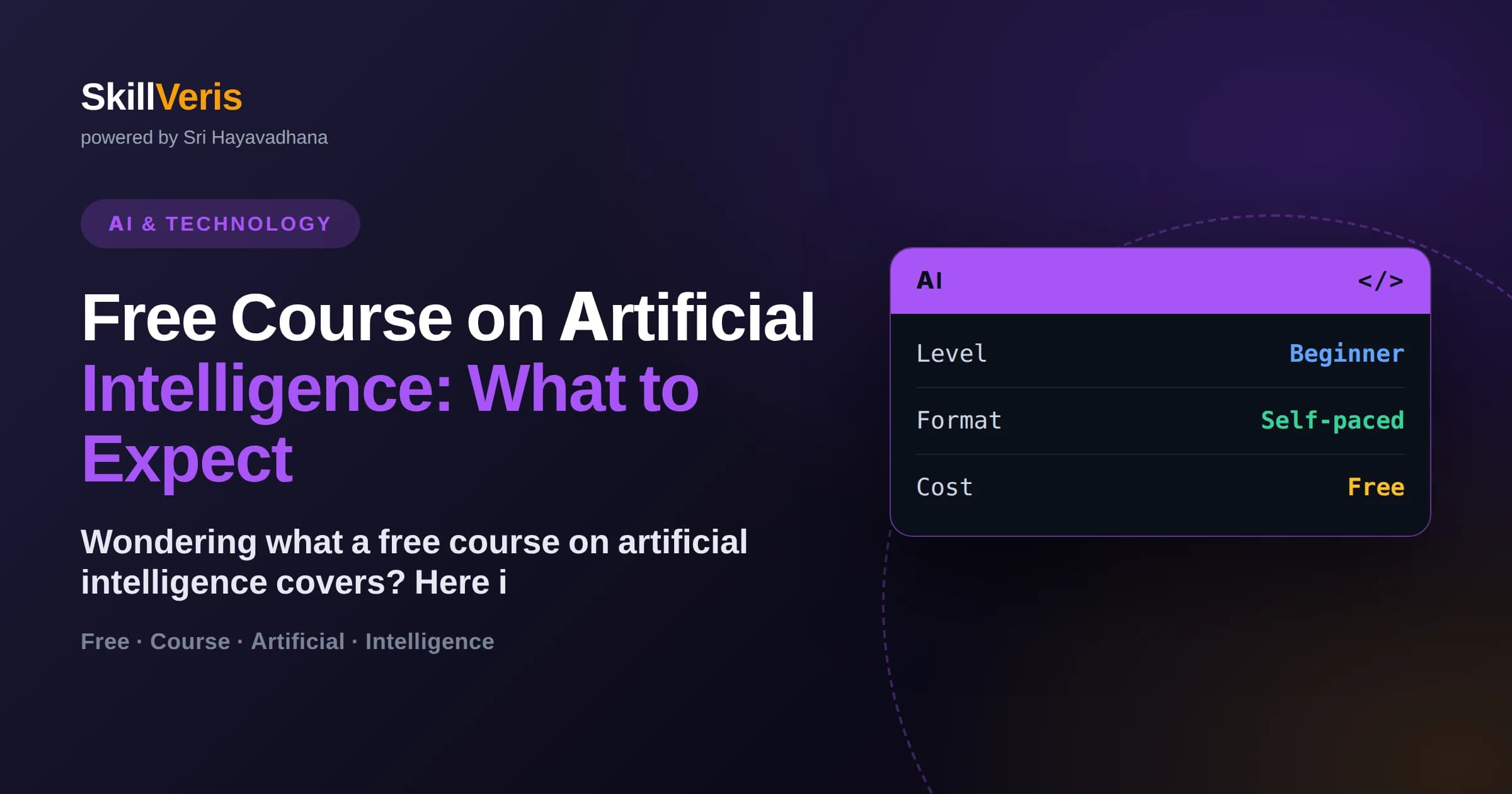
You will know the topics a well-built free AI course should cover, module by module.
In this guide, you'll learn:
- You can tell a rigorous free curriculum from a shallow one before you enrol.
- You will understand the balance of theory, coding, and projects to look for.
- You will set realistic expectations for time, difficulty, and outcomes.
- You can spot red flags like outdated content or exaggerated promises.
1What Does a Free AI Course Actually Cover?
A good free course on artificial intelligence walks you from core concepts through hands-on tools to real projects, usually over several structured modules. You should expect to learn what AI and machine learning are, how models learn from data, how to work with modern language models, and how to build a small project of your own.
The word 'free' should not mean 'thin'. The best free AI courses in 2026 match paid ones on substance — the difference is the price, not the depth. This article breaks down what to expect from a strong curriculum so you can recognise quality and avoid wasting time on shallow material.
Knowing the shape of a good course also helps you learn better, because you can see how each piece fits the whole rather than treating lessons as disconnected.
2The Typical Module Map
Most well-designed AI courses follow a recognisable arc. Understanding it helps you judge whether a course is complete or skipping something important.
Expect the curriculum to move from grounding concepts, to a little tooling, to the core of modern AI, and finally to building and evaluating. If a course jumps straight to advanced model-training without foundations, or stops at theory without a single project, it is unbalanced.
- Foundations: what AI, machine learning, and generative AI are, and how they relate.
- How learning works: data, training, prediction, and why data quality matters.
- Practical tooling: enough Python and notebook skills to run experiments.
- Modern models: language models, prompting, embeddings, and their limits.
- Applied patterns: retrieval, fine-tuning, and simple agents at a high level.
- Projects and evaluation: building something and checking whether it works.
- Ethics and safety: bias, misuse, and responsible use of AI.
3The Right Balance of Theory and Practice
A quality free course blends three ingredients: concepts to build intuition, guided coding to build skill, and projects to build confidence. Too much of any one is a warning sign.
All theory and no practice leaves you unable to build anything. All copy-paste coding with no concepts leaves you unable to adapt when something breaks. The sweet spot is understanding why you are doing something, then doing it, then applying it to a slightly different problem on your own. Look for courses with exercises after each concept, not just a wall of videos.
💡A quick quality test
Scan the course outline for the word 'project' or 'exercise'. If practice appears only at the very end or not at all, expect to finish knowing about AI but unable to build with it.
4What You Need Before Starting
A genuinely beginner-friendly free AI course assumes very little. You should be able to start with basic computer literacy and curiosity, learning any Python and math along the way.
Be cautious of courses labelled 'beginner' that quietly require calculus, statistics, or prior programming in the first module. That is a mismatch between the label and the content. A true beginner course teaches the small amount of Python and math it needs, when it needs it, rather than assuming you arrive with them.
5Time, Difficulty, and Realistic Outcomes
Set honest expectations. A solid introductory AI course typically represents twenty to forty hours of real work spread over several weeks, plus extra time for projects. You will find some parts easy and others genuinely hard — that struggle is where the learning happens, not a sign the course is bad.
As for outcomes: a good free introductory course makes you conversant in AI concepts and able to build a simple project. It does not make you a senior machine learning engineer, and any course that promises that in a few hours is overselling. Real expertise comes from many projects over many months.
6Red Flags to Watch For
Some free courses waste your time or teach outdated habits. Learn the warning signs before you commit weeks to one.
Watch for content that has not been updated for current tools, since AI moves fast and 2023-era material can teach obsolete workflows. Be wary of pure video with no exercises, of grand promises like 'become an AI expert overnight', and of courses that never let you build anything. Finally, distrust anything that skips ethics and limitations entirely, because responsible use is now a core part of competent AI work.
7How to Choose the Right One
Match the course to your goal. If you want to build AI-powered apps, prioritise courses heavy on models, prompting, and projects. If you want data-analysis skills, prioritise courses that connect AI to real datasets. If you are exploring, pick a broad foundations course and go deeper later.
Prefer courses that are part of a larger learning path, so you know what to study next and are not left stranded after the intro. Read the outline, check it is current, confirm it includes hands-on work, and make sure it teaches the 'why', not only the 'how'.
8How to Get the Most From a Free Course
Free courses have one weakness: no one makes you finish. Beat that by scheduling regular short sessions, taking notes in your own words, and doing every exercise instead of skipping to the next video.
Most importantly, build beyond the course. Take each new concept and apply it to a small problem you care about. The learners who benefit most from free AI courses are the ones who treat lessons as a launchpad for their own projects, not as the finish line.
9Frequently Asked Questions
What does a free AI course cover? A good one covers foundations, how models learn, practical tooling, modern language models, applied patterns, and hands-on projects. It should also touch on ethics and the limits of AI.
Are free AI courses as good as paid ones? Increasingly yes — the best free courses match paid ones on content, and the main difference is price rather than depth. What matters most is that the curriculum is current and includes practice.
How long does a free AI course take? An introductory course is usually twenty to forty hours of work spread over several weeks, plus extra time for projects. Consistency across weeks matters more than cramming.
Do I need prior coding experience? A true beginner course teaches the small amount of Python and math it needs along the way. Be cautious of 'beginner' courses that secretly assume programming or calculus in the first module.
What should a free AI course make me capable of? A solid introductory course leaves you conversant in AI concepts and able to build a simple project. It will not make you a senior engineer overnight, and honest courses say so.
Where can I take a free AI course? SkillVeris offers free, current AI courses structured with concepts, exercises, and projects, so you can follow a complete path from beginner foundations to real builds at no cost.
10Next Steps
You now know what a strong free AI course looks like: a clear module arc from foundations to projects, a healthy balance of theory and practice, honest expectations, and no shady promises. Use that checklist to pick well and to spot the courses worth skipping.
When you are ready, explore the free artificial intelligence courses on SkillVeris, which are built around exactly this structure and connect into broader learning paths. Choose one that matches your goal, commit to finishing it, and build a small project alongside it to make everything stick.
Related Reading
Get The Print Version
Download a PDF of this article for offline reading.
About the Publisher
SkillVeris Team
AI Research Team
Our AI team covers the latest in machine learning, generative AI, and emerging tech — clearly and accurately.
View all postsRelated Posts
Never miss an update
Get the latest tutorials and guides delivered to your inbox.
No spam. Unsubscribe anytime.