Free Artificial Intelligence Courses for Complete Beginners
SkillVeris Team
AI Research Team
You will follow a clear beginner path: concepts first, then tools, then real projects.
In this guide, you'll learn:
- You can tell the difference between AI, machine learning, and generative AI in plain language.
- You will know which foundational topics actually matter and which you can safely skip at first.
- You will pick up just enough Python and math to be dangerous, not overwhelmed.
- You can avoid the common beginner traps of tutorial-hopping and tool obsession.
1Can a Complete Beginner Learn AI for Free?
Yes — a complete beginner can learn artificial intelligence for free, and 2026 is the easiest time yet to start. Free courses, open tools, and generous cloud tiers mean the only real cost is your time and consistency. You do not need a degree, expensive software, or a powerful computer to begin.
The key is following a sensible order rather than collecting random tutorials. This guide lays out a concepts-first path: understand what AI is, learn the small amount of tooling you need, then build projects that make the ideas stick. Each step points to the kind of free material you can use.
Treat this as a route map, not a race. Beginners who progress steadily over a few months outperform those who binge for a weekend and burn out.
2First, Get the Vocabulary Straight
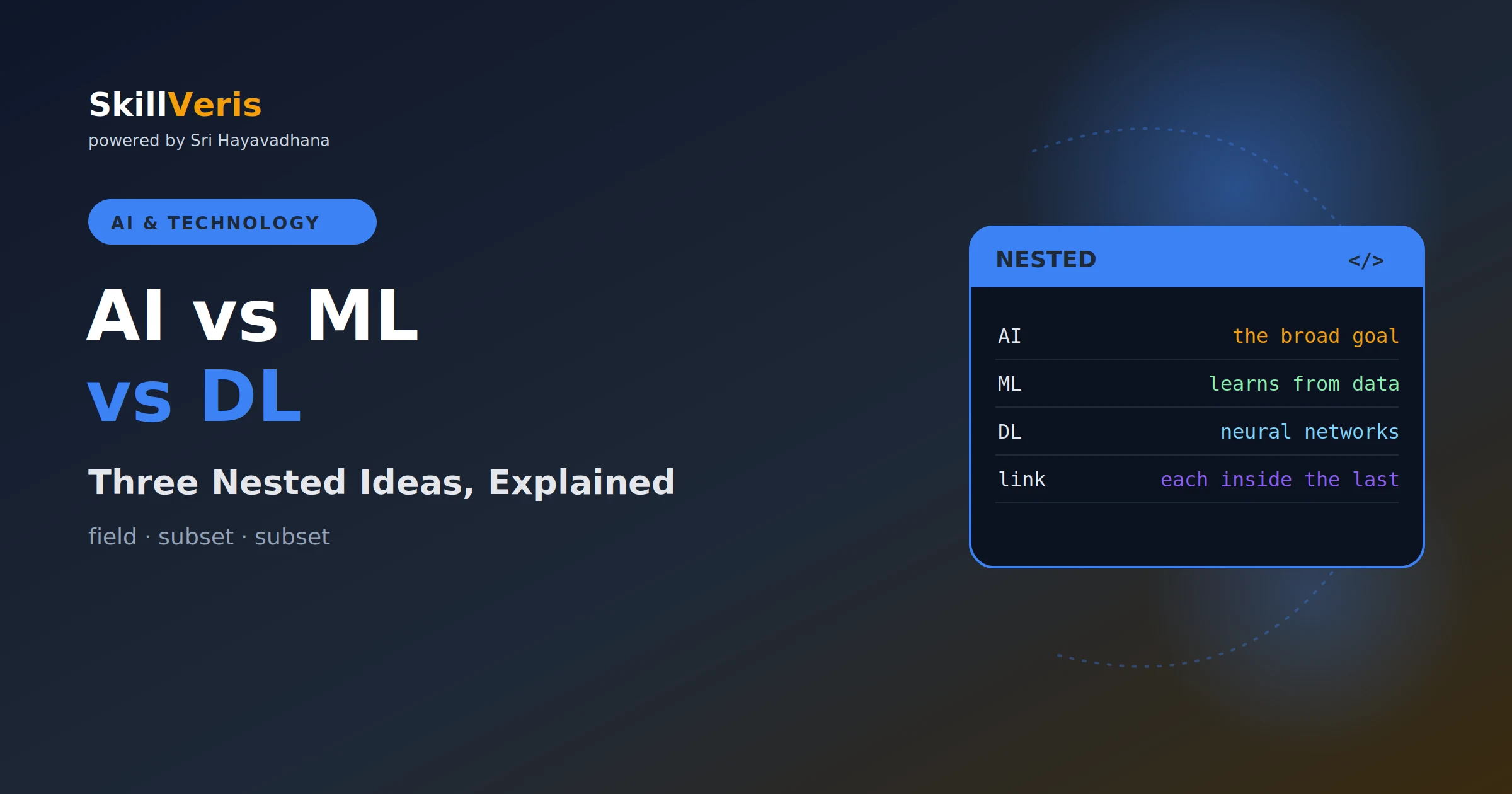
Before any course, anchor three terms. Artificial intelligence is the broad goal of making machines do things that seem to require human intelligence. Machine learning is the main technique for getting there — instead of hand-coding rules, you show a model examples and it learns patterns. Generative AI is a recent branch of machine learning that produces new content like text, images, and code.
So the relationship nests: generative AI is a kind of machine learning, and machine learning is a way of doing AI. When a chatbot answers you, that is generative AI, powered by machine learning, under the umbrella of AI. Getting this straight early stops a lot of confusion later.
💡Beginner mindset
You do not need to understand how a model works internally to start using and building with AI, any more than you need engine theory to drive. Understanding deepens as you build — do not wait for it before you start.
3Stage One: Concepts First
Spend your first few weeks on ideas, not code. A good free AI course for beginners starts with how machines learn from data, what training and prediction mean, and where AI genuinely helps versus where it is hyped.
Focus on intuition. Understand that a model finds patterns in past examples to make guesses about new ones; that more and cleaner data usually helps; and that models can be confidently wrong, which is why human review matters. These mental models will make every later tool click faster.
- How machine learning differs from traditional rule-based programming.
- The idea of training data, features, and predictions in everyday language.
- Why data quality and bias matter as much as the algorithm.
- What large language models are and, roughly, how they generate text.
- Where AI is genuinely useful today versus overhyped.
4Stage Two: Just Enough Tools
Once the concepts feel solid, pick up the minimum tooling. Python is the language of AI, and you need far less of it than you fear — variables, lists, loops, functions, and how to use a library. You can learn that core in a couple of weeks of free lessons.
The math scares beginners unnecessarily. To start, you need comfort with percentages, averages, and the idea of a graph; deeper linear algebra and calculus can wait until a project demands them. Learn to run code in a free notebook environment like Google Colab so you never fight with installation, and try a hosted AI model through its playground before touching any code at all.
5Stage Three: Build Real Projects
Projects are where learning becomes ability. After concepts and basic tools, build small, finishable things that force you to combine what you know.
Good first projects: a script that summarises articles using a free AI model, a simple classifier that sorts messages as spam or not, or a chatbot that answers questions about a document you give it. Each one teaches data handling, prompting or model use, and the humbling reality of debugging. Finishing a rough project beats half-watching ten polished tutorials.
6Common Beginner Traps to Avoid
The biggest trap is tutorial-hopping — endlessly starting new courses without finishing or building anything. It feels productive and teaches almost nothing. Commit to one path and one project at a time.
The second trap is tool obsession: believing you need the newest framework or a paid subscription before you can begin. You do not. The third is trying to master the math first; you will quit before you ever build. Learn concepts, learn just enough tooling, and build — in that order.
7How to Choose a Free Course
A good free AI course for complete beginners assumes no prior knowledge, teaches concepts before code, and includes hands-on exercises rather than only videos. It should update for 2026 tools, because AI moves fast and stale material teaches outdated habits.
Prefer courses that explain the 'why', let you practise in the browser, and connect to a broader path so you know what to learn next. Beware anything that promises to make you an 'AI expert in a weekend' — real understanding is gradual, and honest courses say so.
8A Realistic Timeline
With a few focused hours a week, a complete beginner can grasp core AI concepts in about a month, get comfortable with basic Python and a hosted model in the second month, and finish a first real project by month three. That is a genuinely useful foundation, not a fantasy.
Consistency beats intensity. Thirty focused minutes most days will take you further than an occasional marathon session, because AI concepts need repetition and small wins to lock in.
9Frequently Asked Questions
Are free artificial intelligence courses good enough for beginners? Yes — free courses now cover the same fundamentals as paid ones, and for a complete beginner the quality of the path matters more than the price. SkillVeris and other platforms offer full beginner tracks at no cost.
Do I need to know how to code before starting? No — you can start with pure concepts and playgrounds, then learn a small amount of Python as you go. Coding becomes necessary only when you start building your own projects.
How much math do I need to learn AI? Far less than most beginners fear at the start. Basic comfort with averages, percentages, and graphs is enough to begin; deeper math can wait until a project genuinely requires it.
How long does it take to learn AI as a beginner? With steady weekly effort, expect a solid foundation in about three months: concepts first, then tools, then a first project. Consistency matters more than total hours.
What is the difference between AI and machine learning? AI is the broad goal of intelligent machines, while machine learning is the main technique for achieving it by learning patterns from data. Generative AI is a recent branch of machine learning.
What should my first AI project be? Choose something small and finishable, like a text summariser or a simple message classifier using a free hosted model. Completing a rough project teaches more than watching many tutorials.
10Next Steps
You now have a beginner-friendly path: get the vocabulary straight, learn concepts, pick up just enough tooling, and build a real project. Follow that order, avoid tutorial-hopping, and give yourself a few consistent months rather than a frantic weekend.
You can do every stage for free on SkillVeris, where the AI courses and study notes are built for complete beginners and connect into clear learning paths. Pick your first project today, start the concepts track, and let each small win pull you to the next.
Related Reading
Get The Print Version
Download a PDF of this article for offline reading.
About the Publisher
SkillVeris Team
AI Research Team
Our AI team covers the latest in machine learning, generative AI, and emerging tech — clearly and accurately.
View all postsRelated Posts
Never miss an update
Get the latest tutorials and guides delivered to your inbox.
No spam. Unsubscribe anytime.