Feature Engineering: Turning Data Into Signal
SkillVeris Team
Data Science Team
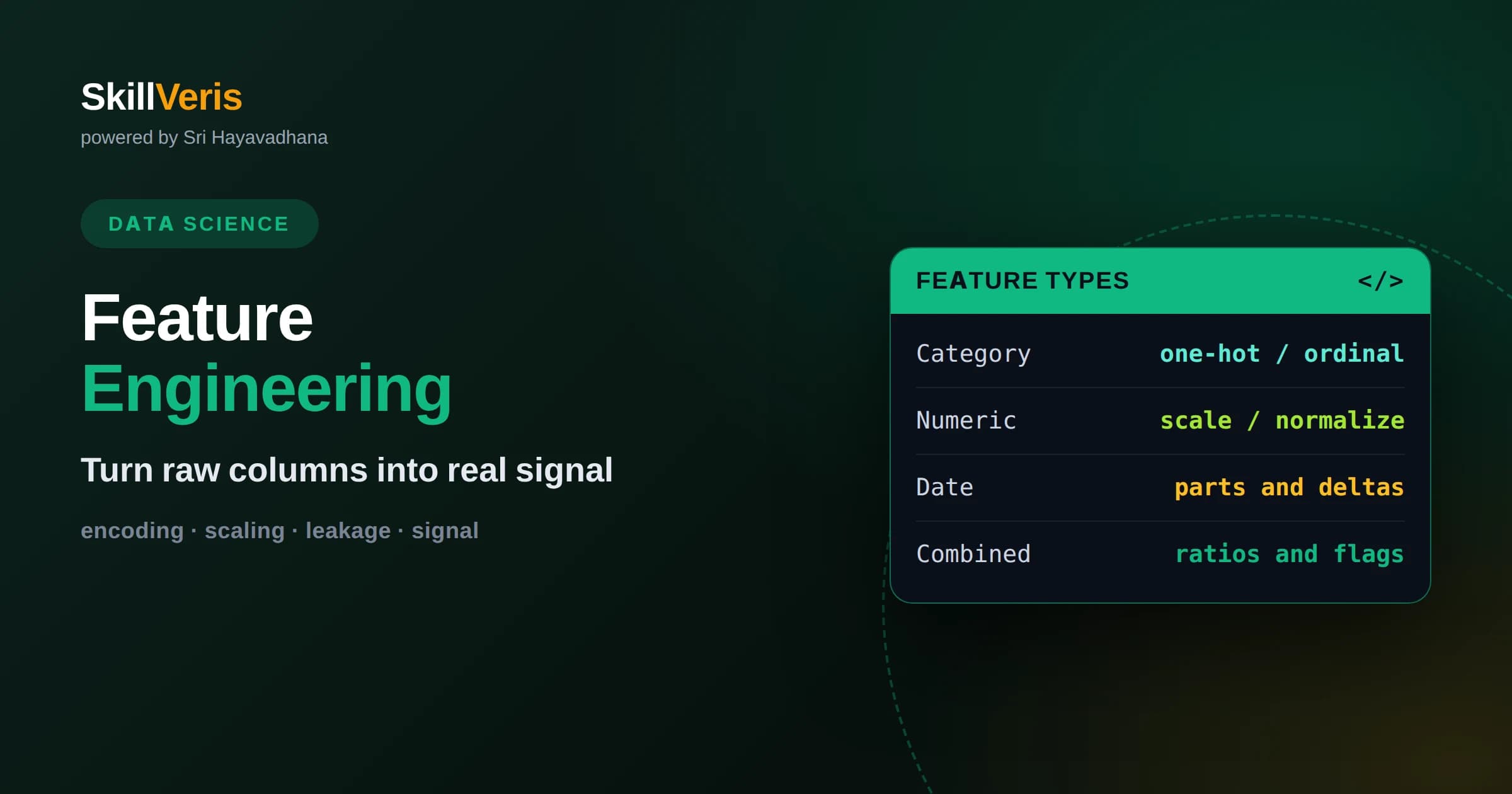
Feature engineering is the craft of reshaping raw data into inputs that expose the patterns a model needs to learn.
In this guide, you'll learn:
- Well-chosen features often improve results more than switching to a fancier algorithm.
- Core techniques include encoding categories, scaling numbers, handling dates, and combining columns into new signals.
- The biggest risk is leakage: accidentally feeding the model information it would not have at prediction time.
1What Feature Engineering Means
Feature engineering is the process of transforming raw data into features, the numeric inputs that a machine learning model actually consumes. In short, it is how you translate messy real-world columns into a form that makes the underlying pattern easy for an algorithm to detect. A feature is any measurable property you feed to the model, and engineering them well is often the single biggest lever on performance.
Models do not understand raw data the way people do. A date, a category label, or a block of text means nothing to a regression until you convert it into numbers that capture its useful structure. Feature engineering is that conversion, plus the creative work of deriving new quantities that make relationships clearer than the raw columns ever could.
A common saying in the field is that data beats algorithms and features beat both. The intuition is that a mediocre model with excellent features usually outperforms an excellent model fed raw, uninformative inputs. That is why experienced practitioners spend a large share of their time here.
2Why Features Beat Algorithms
It is easy to assume the algorithm does the heavy lifting, but algorithms can only find patterns that are present in the inputs. If the signal you care about is buried in a form the model cannot read, no amount of tuning will recover it. Feature engineering is how you surface that signal so the model has a fair chance.
Consider predicting whether someone will repay a loan. The raw data might include their account opening date and today's date. Neither is directly useful, but the difference between them, the length of their history, is highly informative. Creating that single derived feature can help more than swapping in a more complex model.
This is why practitioners invest so heavily in features. Algorithms are largely commoditized and available in every library, but the insight to construct the right feature for a specific problem is where domain knowledge and creativity pay off.
3Encoding Categorical Variables
Most models require numbers, so categories like color or country must be converted. The simplest approach is one-hot encoding, which creates a separate binary column for each category, marking one where that category is present and zero elsewhere. This works well when the number of categories is modest and none has an inherent order.
When categories have a natural order, such as small, medium, and large, ordinal encoding that maps them to increasing integers preserves that ranking. Using ordinal encoding on unordered categories is a mistake, though, because it invents an order that misleads the model into thinking one category is greater than another.
High-cardinality categories, those with hundreds or thousands of values, need special care. One-hot encoding them creates an explosion of columns. Alternatives include grouping rare categories together or using target-based encodings, which must be applied carefully to avoid leaking information from the target into the features.
4Scaling and Normalizing Numeric Features
Numeric features often live on wildly different scales. One column might range from zero to one while another ranges into the millions. Some algorithms, especially those based on distances or gradients, are sensitive to this and let the large-scale feature dominate simply because its numbers are bigger, not because it matters more.
Standardization rescales a feature to have a mean of zero and a standard deviation of one, putting everything on comparable footing. Normalization instead squeezes values into a fixed range such as zero to one. Which you choose depends on the algorithm and the data, but doing one of them is essential for distance-based and gradient-based methods.
Tree-based models are a notable exception; they split on thresholds and are indifferent to scale. Knowing which models care about scaling saves you unnecessary work and helps you avoid the mistake of assuming every pipeline needs the same preprocessing.
5Extracting Signal From Dates and Times
A raw timestamp is one of the richest sources of engineered features. On its own it is just a number, but you can decompose it into the day of the week, the month, whether it is a weekend, the hour of day, or the time elapsed since some reference event. Each of these can expose seasonal and cyclical patterns the raw value hides.
Cyclical features like hour of day or month need thoughtful encoding because the number wraps around. Hour twenty-three is close to hour zero, but as plain integers they look far apart. Transforming them with sine and cosine functions preserves that closeness so the model treats late night and early morning as neighbors.
Differences between dates are often the real signal. Time since last purchase, account age, and days until an event frequently predict behavior far better than the raw dates themselves. Whenever you see a timestamp, ask what interval or recurring pattern it might encode.
6Creating New Features by Combining Columns
Some of the most powerful features do not exist in the raw data at all; you construct them by combining columns. A ratio of two quantities, a sum, a difference, or a product can capture a relationship neither column expresses alone. Price per square meter, for instance, is often more predictive than price and area separately.
Domain knowledge guides this work. If you understand the process that generated the data, you can invent features that encode meaningful business logic, like whether a transaction amount exceeds a customer's typical spend. These informed combinations are where human insight adds value that automated methods struggle to match.
Interaction features, which multiply or combine two variables, let simple models capture effects that depend on the joint value of two inputs. They can dramatically help a linear model that would otherwise assume each feature acts independently.
7Turning Text Into Features
Text is unstructured, so it needs conversion before a model can use it. A classic starting point is the bag-of-words approach, which counts how often each word appears, turning a document into a vector of counts. A refinement called term frequency inverse document frequency down-weights common words and highlights distinctive ones.
Simpler engineered features from text can be surprisingly useful too: the length of a message, the count of capital letters, the presence of specific keywords, or the number of punctuation marks. These are quick to compute and often capture signal like urgency or spamminess.
Modern approaches use embeddings that represent text as dense numeric vectors capturing meaning. These are powerful but heavier, and for many tabular problems the simpler counts and hand-built features remain a strong, interpretable baseline worth trying first.
8Handling Missing Values as a Feature Problem
Missing data is a feature engineering decision, not just a cleanup chore. The simplest strategy fills gaps with a summary such as the mean or median for numbers, or the most frequent value for categories. This keeps rows usable but can distort the distribution if many values are missing.
Often the fact that a value is missing carries information. Adding a binary flag that marks whether the original value was present lets the model learn from the missingness itself. This is valuable when data is missing for a reason, such as customers who skip optional fields behaving differently.
Whatever you choose, apply the same rule consistently to training and future data. Computing a fill value from the training set and reusing it later prevents subtle inconsistencies that would otherwise make your model behave differently in production than in testing.
9Avoiding Data Leakage
Data leakage is the most dangerous trap in feature engineering. It happens when a feature contains information that would not be available at prediction time, or that indirectly encodes the answer. A model trained on leaked features looks brilliant in testing and fails completely in the real world, because the shortcut it learned no longer exists.
A classic example is including a field that is only filled in after the outcome you are predicting. If you predict whether a claim is fraudulent and include the investigator's notes, you have leaked the answer. The model will appear nearly perfect and then collapse on genuinely new cases.
Preventing leakage requires thinking carefully about timing. Ask of every feature whether its value would truly be known at the moment of prediction. Fitting all preprocessing on the training data alone, never on the full dataset, is a practical safeguard that stops information from bleeding across the split.
10Selecting the Features That Matter
More features are not always better. Irrelevant or redundant features add noise, slow training, and can even hurt accuracy by giving the model spurious patterns to latch onto. Feature selection trims the set down to the inputs that genuinely help, which improves both performance and interpretability.
Simple methods include removing features with almost no variation, dropping one of any pair that is highly correlated, and ranking features by their measured importance from a trained model. Each approach gives a different lens on which columns are pulling their weight.
Selection is iterative and tied to evaluation. You try a set of features, measure performance honestly, and adjust. The aim is a lean set that captures the signal without the clutter, which usually generalizes better to new data than a bloated one.
11Making Feature Engineering Reproducible
As your transformations grow, applying them by hand becomes error prone. Tools like the pipeline abstraction in scikit-learn let you chain preprocessing steps together so the exact same transformations run on training data, test data, and future inputs. This consistency is what separates a demo from something that survives in production.
Reproducible pipelines also make experimentation safer. When every transformation is defined in one place, you can change a step, rerun the whole flow, and trust that nothing was applied inconsistently. That reliability compounds over the life of a project.
Version your feature logic alongside your code. Features drift as data changes, and being able to trace exactly how a feature was computed is invaluable when a model's behavior shifts unexpectedly months later.
12Why Domain Knowledge Is Your Edge
The best features rarely come from a formula; they come from understanding the process that generated the data. Someone who knows how a business actually works can invent a feature that captures a meaningful relationship no generic transformation would ever find. This is why feature engineering is where subject-matter experts add the most value.
Consider fraud detection. A data scientist without banking knowledge might scale and encode the raw columns competently. Someone who understands fraud will additionally build features like the time since the last transaction, the distance from the usual spending location, or whether the amount is a suspicious round number. Those informed features often carry the real signal.
The practical lesson is to talk to the people who understand the domain before you engineer anything. Ask what patterns they look for, what warning signs they trust, and what relationships they believe matter. Translating that human expertise into features is one of the highest-leverage things you can do, and it is a skill that compounds across every project you touch.
13Iterate, Measure, and Validate
Feature engineering is never a single pass. You build a set of features, train a model, study where it fails, and let those failures suggest new features. Each cycle sharpens your inputs, and this loop typically improves results more than any amount of algorithm tuning in isolation.
Always measure the effect of a new feature on held-out data rather than trusting that it should help. A feature that seems obviously useful can add noise, and one that seems trivial can carry surprising signal. Honest evaluation is the only reliable judge, and it keeps you from cluttering the model with features that merely feel important.
Keep a record of which features you tried and what happened. This log prevents you from repeating dead ends and helps you explain your final feature set to teammates. Over time it also becomes a personal library of ideas you can reuse whenever a similar problem appears.
14Sharpen Your Feature Skills on SkillVeris
Feature engineering is learned by doing, not by reading. The techniques here are simple to state but take practice to apply well, because the right feature always depends on the specific dataset and question in front of you. The way to build that judgment is to engineer features for many different problems and see what actually moves your results.
SkillVeris offers hands-on lessons that let you build, test, and compare features inside real projects, connecting the ideas here to the modeling and evaluation steps that come next. Working through them turns feature engineering from an abstract concept into a reliable instinct you can bring to any dataset.
Related Reading
Get The Print Version
Download a PDF of this article for offline reading.
About the Publisher
SkillVeris Team
Data Science Team
Our data team shares real-world analytics, ML, and SQL insights grounded in industry practice.
View all postsRelated Posts



Never miss an update
Get the latest tutorials and guides delivered to your inbox.
No spam. Unsubscribe anytime.