Diffusion Models: How AI Generates Images
SkillVeris Team
AI Research Team
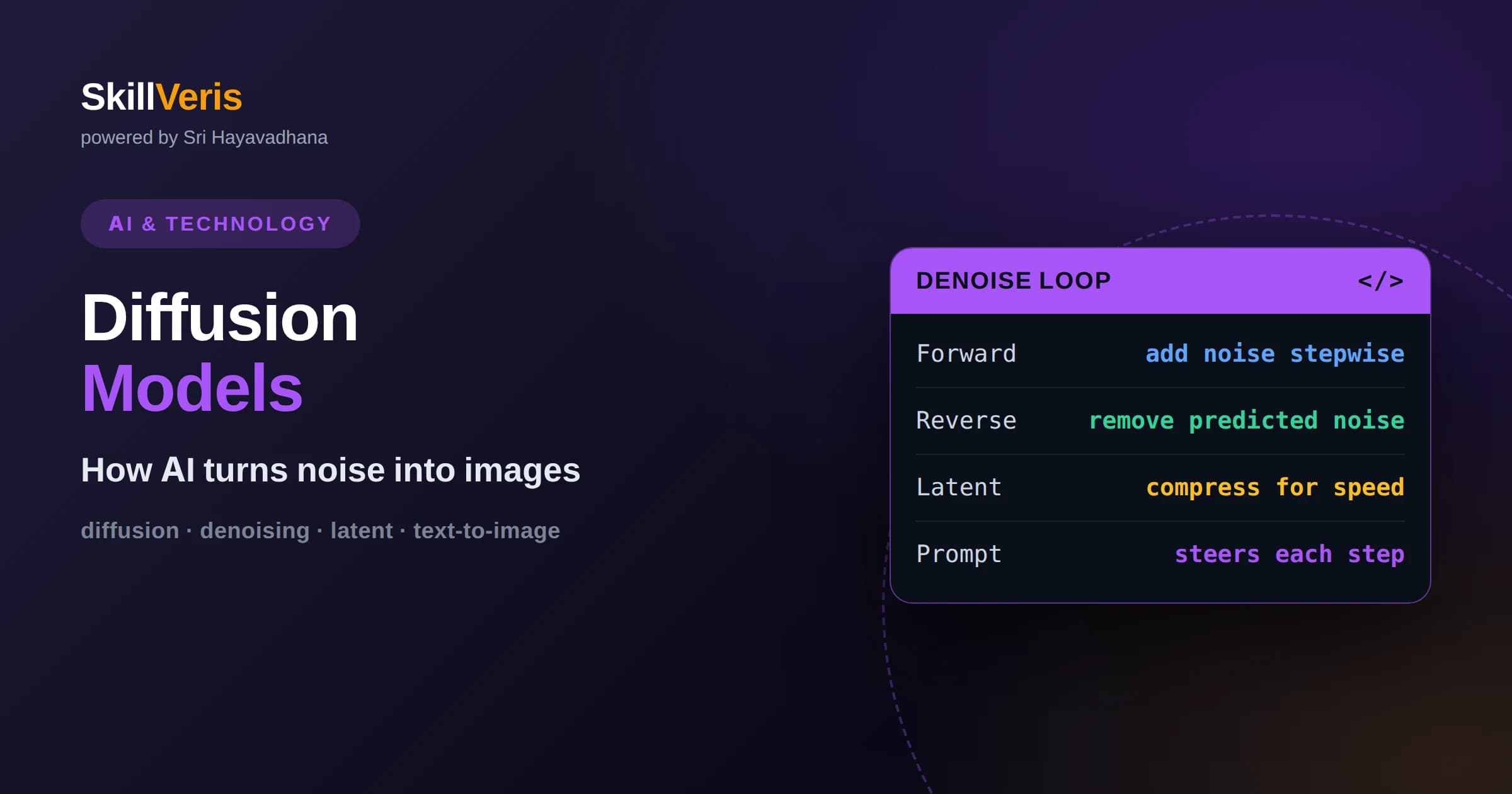
Diffusion models learn to reverse a process that gradually turns images into noise, so they can start from noise and denoise their way to a picture.
In this guide, you'll learn:
- A neural network is trained to predict the noise added at each step, and repeatedly subtracting it transforms static into a coherent image.
- Text-to-image generation works by conditioning the denoising on a text prompt so the output matches your description.
- Modern systems run diffusion in a compressed latent space for speed, which is why high-quality image generation now fits on ordinary hardware.
1What Diffusion Models Are
A diffusion model is a type of AI that generates images by learning to reverse a gradual noising process. During training it takes real images, adds noise to them step by step until they become pure random static, and learns to undo each step. To create a new image, it starts from random noise and applies that learned reversal repeatedly until a coherent picture emerges.
The elegance of the idea is that generating a full image at once is extremely hard, but removing a little noise from a slightly noisy image is comparatively easy. Diffusion breaks an impossible-seeming task into hundreds of small, manageable steps, each one a modest denoising the model can learn reliably.
This approach has become the dominant method for high-quality image generation because it produces diverse, detailed, and controllable results. Once you understand the forward noising and reverse denoising, the rest of the field, including text prompts and editing, becomes variations on this central mechanism.
It helps to hold onto a simple mental picture: imagine slowly sprinkling static over a photo until it disappears, then learning to peel that static back off one thin layer at a time. Everything else in this article, from latent compression to text guidance, is a refinement that makes this peeling faster, cheaper, or more controllable, but the peeling itself is the heart of it.
2The Forward Process: Adding Noise
The forward process is where a clean image is progressively corrupted with random noise over many small steps. Early steps barely change the picture, while later steps overwhelm it until nothing recognizable remains, only static. This process is fixed and defined by a schedule; no learning happens here.
The purpose of the forward process is to create training examples. At each step the model sees a partially noised image and knows exactly how much noise was added, because the process itself added it. This gives a limitless supply of paired examples of noisy input and the noise that should be removed.
Because the noising follows known mathematics, the model can jump directly to any noise level for training rather than stepping through all of them. This makes training efficient and gives the model experience denoising images at every stage, from barely touched to almost pure static.
3The Reverse Process: Removing Noise
Generation happens in the reverse process, where the model starts from random noise and gradually removes it to reveal an image. At each step it predicts what the noise is, subtracts a portion of it, and repeats. After many steps the accumulated denoising turns meaningless static into a structured, detailed picture.
The reason this produces novel images rather than copies is that the starting noise is random and the denoising is probabilistic. Different random starts lead the model down different paths, so it generates fresh images consistent with what it learned rather than reproducing training examples exactly.
Each reverse step nudges the noise a little closer to the manifold of realistic images the model learned. Early steps establish broad structure and composition, while later steps refine fine details and textures, which is why partially denoised images look like blurry sketches that sharpen over time.
4What the Neural Network Learns
At the heart of a diffusion model is a neural network trained to predict the noise present in an image at a given step. Its training objective is simple: given a noisy image and the step number, output the noise that was added. Once it can do this accurately, it can be used in reverse to denoise anything.
The network architecture is designed to see both the big picture and fine detail simultaneously, combining broad context with local texture so it can reconstruct coherent scenes. This is essential because good denoising requires understanding what the overall image should be while also fixing individual regions.
Training rewards the network for accurate noise prediction across many images and many noise levels. Because the objective is so well-defined and provides endless training pairs, diffusion models train stably compared to some earlier generative approaches, which partly explains their rapid rise.
5Latent Diffusion: Making It Fast
Running diffusion directly on full-resolution images is expensive because every pixel must be processed at every step. Latent diffusion solves this by first compressing images into a smaller latent representation using an autoencoder, running the entire noising and denoising process in that compact space, and then decoding the result back into a full image.
This compression captures the meaningful content of an image while discarding redundant pixel detail, so the diffusion process works on a much smaller amount of data. The speedup is dramatic, which is precisely why high-quality image generation moved from research clusters to consumer hardware.
The autoencoder is trained separately to compress and reconstruct images faithfully, and its quality sets an upper bound on the final output. Latent diffusion is the architectural trick behind most popular open image generators, and understanding it explains why they are both fast and capable.
6How Text Prompts Steer Generation
Text-to-image generation works by conditioning the denoising process on your prompt so the output matches your words. The prompt is encoded into a numeric representation by a text encoder, and this representation is fed into the denoising network at every step, guiding it toward images consistent with the description.
Because the network sees the text at each step, the prompt influences the picture from broad composition down to fine detail. Asking for a red bicycle on a beach at sunset nudges every denoising step toward that scene, so the emerging image steadily aligns with the requested content, colors, and mood.
The link between words and images comes from training on huge collections of image and caption pairs, which teach the model how language corresponds to visual content. The richness of that training data determines how well the model understands prompts and how faithfully it renders them.
7Guidance and Controlling Output
A technique called guidance controls how strongly the model follows your prompt versus generating freely. Turning guidance up makes the image adhere more tightly to the text, while turning it down allows more variety and often more natural-looking results. Finding the right balance is part of getting good outputs.
Too much guidance can produce oversaturated or unnatural images that obey the prompt at the expense of realism, while too little can wander off topic. This tradeoff is one of the main knobs you adjust when tuning generation, alongside the number of denoising steps and the random seed.
Beyond text, additional conditioning methods let you steer generation with reference images, sketches, poses, or depth maps, giving fine control over structure and layout. These extensions all plug into the same denoising process, layering extra guidance on top of the text prompt.
8Sampling Steps and Speed
The number of denoising steps trades quality against speed. More steps generally yield smoother, more refined images but take longer, while fewer steps are faster but can look rougher. Much recent research focuses on getting high quality in as few steps as possible.
Different samplers, the algorithms that decide how to move from one noise level to the next, reach good results in different numbers of steps. Some are designed to produce solid images in only a handful of steps, dramatically speeding up generation without a large quality loss.
For interactive use, fast sampling matters because it lets you iterate on prompts quickly, seeing results in seconds rather than minutes. Understanding the step count as a dial you can turn helps you balance responsiveness against final polish for your particular use.
9Editing, Inpainting, and Variations
Diffusion models do more than generate from scratch; they also edit existing images. Inpainting fills a masked region with new content that blends into the surroundings, letting you remove objects or replace parts of a picture while keeping the rest intact. The model denoises only the masked area, conditioned on what surrounds it.
Image-to-image transformation starts the reverse process from a noised version of an existing picture rather than pure noise, so the output keeps the overall structure while adopting a new style or details from the prompt. This is how you turn a sketch into a finished illustration or restyle a photo.
These capabilities all reuse the same denoising machinery with different starting points and conditioning. Recognizing that editing, variation, and generation are one mechanism applied differently makes the whole toolkit far easier to understand and use creatively.
10Limitations and Responsible Use
Diffusion models have real weaknesses. They can struggle with precise details like hands, text within images, and exact counts, and they can reflect biases present in their training data, generating stereotyped or skewed depictions. Knowing these limits helps you use the tools thoughtfully and check outputs.
There are also important ethical considerations. Generated images can be used to mislead, training data may include copyrighted or personal content, and realistic synthetic imagery raises questions about consent and authenticity. Responsible use means being transparent that images are AI-generated and avoiding harmful applications.
As the technology matures, techniques for watermarking and provenance aim to help distinguish generated from real imagery. Treating these tools as powerful but fallible, and being honest about their output, keeps their use constructive rather than deceptive.
11Why Diffusion Matters Beyond Images
The diffusion idea, learning to reverse a gradual corruption process, extends well beyond pictures. Researchers apply the same principle to audio, video, three-dimensional shapes, and even molecular design, because the underlying recipe of small, learnable denoising steps is remarkably general.
This generality is why understanding diffusion is worth the effort even if you only care about one application. The mental model transfers, so grasping how image generation works gives you a head start on the next wave of generative tools built on the same foundation.
Diffusion also illustrates a broader lesson in AI: breaking a hard problem into many easy steps often beats trying to solve it in one leap. That principle recurs across the field and is worth carrying with you into other problems.
12Getting Started With Generation
You do not need to understand every equation to start creating with diffusion models. Many are available through hosted services and open tools that expose a simple interface: type a prompt, adjust a few settings, and receive an image. Starting here lets you build intuition through experimentation before diving into internals.
Begin by writing descriptive prompts that name the subject, style, lighting, and composition you want, then iterate. Small wording changes can shift results significantly, so treat prompting as a craft you refine rather than a single command. Keeping a record of prompts that worked helps you learn what language the model responds to.
As you gain comfort, experiment with the dials that shape output: guidance strength, the number of sampling steps, and the random seed that lets you reproduce or vary a result. Understanding these controls turns generation from a slot machine into a tool you can direct toward a specific creative goal.
13Explore and Build on SkillVeris
The best way to internalize diffusion is to experiment: generate images, vary prompts, adjust guidance and steps, and watch how each change affects the result. Seeing a partially denoised image sharpen into a picture makes the abstract process concrete in a way reading cannot.
As you go deeper, try the editing tools, explore how conditioning steers structure, and notice where the model struggles so you learn its real boundaries. Hands-on tinkering builds the intuition that turns you from a user into someone who understands the machinery.
On SkillVeris you can follow guided lessons that connect these concepts to real code and real experiments, taking you from the intuition of noising and denoising to building with generative image tools yourself. Learn by making, and the theory will stick.
Related Reading
Get The Print Version
Download a PDF of this article for offline reading.
About the Publisher
SkillVeris Team
AI Research Team
Our AI team covers the latest in machine learning, generative AI, and emerging tech — clearly and accurately.
View all postsRelated Posts
Never miss an update
Get the latest tutorials and guides delivered to your inbox.
No spam. Unsubscribe anytime.