Decision Trees and Random Forests Explained
SkillVeris Team
Data Science Team
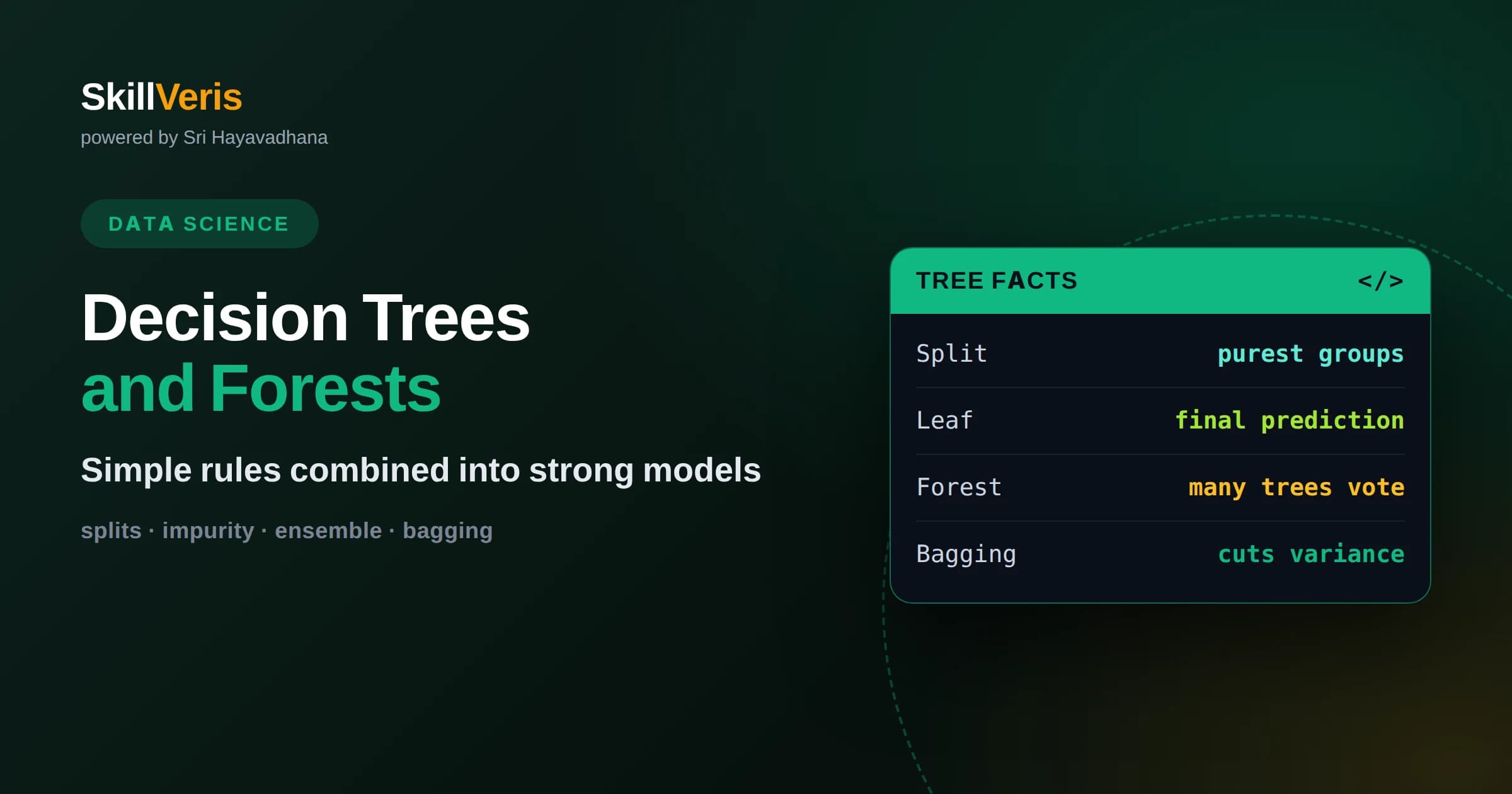
A decision tree predicts by asking a series of yes-or-no questions that split the data into ever purer groups.
In this guide, you'll learn:
- Single trees are easy to read but prone to overfitting when grown too deep.
- A random forest combines many varied trees and averages them for far more reliable predictions.
- Both models handle mixed data types and nonlinear patterns without heavy preprocessing.
1What a Decision Tree Is
A decision tree is a model that makes predictions by asking a sequence of simple yes-or-no questions about the features, following the answers down branches until it reaches a final decision. It works exactly like a flowchart, and that resemblance is why decision trees are among the most intuitive models in all of machine learning.
Each internal question splits the data into two groups based on one feature, such as whether an age is above a threshold or a category matches a value. Following these splits, any input lands in a leaf at the bottom of the tree, and the leaf holds the prediction, either a class label or a number.
Because you can literally read the tree as a set of rules, it is transparent in a way many models are not. You can trace exactly why any prediction was made, which makes decision trees valuable when explanations matter as much as accuracy. In settings like lending or healthcare, where a decision must be justified to a regulator or a patient, that traceability is not a luxury but a requirement.
2How a Tree Decides Where to Split
A tree is built by repeatedly choosing the split that best separates the data. At each step the algorithm considers many possible questions and picks the one that makes the resulting groups as pure as possible, meaning each group is dominated by a single class or has similar target values.
Purity is measured with a criterion. For classification, common measures are Gini impurity and entropy, both of which are low when a group is homogeneous. For regression, the tree usually minimizes the variance of the target within each group. The best split is the one that reduces impurity the most.
This process is greedy: the tree makes the locally best split at each step without planning ahead. That keeps training fast and usually works well, even though it does not guarantee the globally optimal tree. The result is a structure that carves the feature space into rectangular regions.
3Growing and Stopping the Tree
Left unchecked, a tree keeps splitting until every leaf is perfectly pure, often ending with a leaf for nearly every data point. Such a tree memorizes the training data, including its noise, and generalizes poorly. Controlling growth is therefore essential to a useful tree.
You limit growth with stopping rules such as a maximum depth, a minimum number of samples required to split, or a minimum number of samples in a leaf. These constraints keep the tree from carving the data too finely and force it to capture broad patterns rather than individual quirks.
An alternative is to grow a large tree and then prune it back, removing branches that add little predictive value. Both approaches target the same goal: a tree complex enough to capture real structure but simple enough to generalize to new data.
4The Strengths of Decision Trees
Decision trees have several practical virtues. They handle numeric and categorical features together with minimal preprocessing, they are unaffected by the scale of features because they split on thresholds, and they naturally capture nonlinear relationships and interactions between features without you having to engineer them.
They also cope gracefully with missing values and outliers compared to many other models, and they produce a clear picture of which features drive the predictions. This combination of flexibility and transparency makes them a popular choice, especially as a first model on messy tabular data.
Perhaps most importantly, trees require little tuning to get a reasonable result. You can grow one, read it, and understand your problem better, which is valuable even when you eventually deploy something more sophisticated.
5The Core Weakness: Overfitting
The main flaw of a single decision tree is instability. Because it splits greedily and can grow arbitrarily complex, a tree easily overfits, learning the training data so precisely that it stumbles on anything new. Deep, unconstrained trees are especially prone to this.
Trees are also high variance, meaning small changes in the training data can produce a very different tree. Swap a few rows and the top split might change, cascading into an entirely different structure. This sensitivity makes a single tree's predictions less trustworthy than its clean appearance suggests.
These weaknesses are exactly what ensemble methods were designed to fix. Rather than trying to perfect one tree, the insight is to combine many imperfect trees so their individual errors cancel out, which leads directly to the random forest.
6What a Random Forest Is
A random forest is an ensemble of many decision trees whose predictions are combined, by majority vote for classification or by averaging for regression, to produce a single, more reliable answer. The core idea is that a crowd of diverse, imperfect trees together makes better decisions than any one tree alone.
The magic is in the diversity. If every tree were identical, combining them would gain nothing. A random forest deliberately makes its trees different from one another so their mistakes are uncorrelated, and averaging uncorrelated mistakes cancels much of the error while preserving the shared signal.
This simple ensemble idea produces one of the most reliable off-the-shelf models available. Random forests often perform well with little tuning, which is why they are a common go-to for tabular prediction problems across many industries.
7How Random Forests Create Diversity
Random forests inject randomness in two ways. First, each tree is trained on a different random sample of the data, drawn with replacement so some rows repeat and others are left out. This technique, called bootstrap sampling, gives every tree a slightly different view of the problem.
Second, at each split, a tree considers only a random subset of the features rather than all of them. This prevents a few strong features from dominating every tree and forces the ensemble to explore different patterns, further decorrelating the trees so their errors are more independent.
Together these two sources of randomness create the diversity that makes the ensemble work. Each tree is individually weaker than a fully optimized single tree, but their combination is stronger and far more stable, a striking example of the whole exceeding the sum of its parts.
8Why Combining Trees Reduces Error
The technique of training models on bootstrap samples and averaging them is called bagging, short for bootstrap aggregating. Its power comes from variance reduction. Individual trees are high variance, but averaging many of them smooths out the noise, much as averaging many noisy measurements gives a steadier estimate.
Crucially, averaging reduces variance without much increasing bias, because each tree still captures the real pattern. The forest keeps the signal the trees agree on while canceling the noise they disagree on. That is why a random forest is usually far more accurate than any single tree it contains.
This variance-reduction principle is general and appears throughout machine learning. Understanding it through random forests gives you intuition that transfers to other ensemble methods and to why combining models so often beats perfecting one.
9Reading Feature Importance
Random forests give up the perfect readability of a single tree, since you cannot easily follow hundreds of trees at once. In exchange they offer feature importance scores, which rank how much each feature contributed to the model's predictions across all the trees.
These scores are computed from how much each feature reduced impurity when it was used to split, aggregated over the whole forest. They give a useful, if approximate, sense of which inputs matter most, guiding feature selection and helping you explain the model at a high level.
Treat importance scores as a helpful summary rather than gospel. They can be biased toward features with many possible split points, and correlated features can share or steal importance from one another. Still, they are a practical window into an otherwise opaque model.
10Choosing Between a Tree and a Forest
The choice comes down to what you value. A single decision tree is the right pick when interpretability is paramount and you need to show the exact rules behind a decision, or when you want a quick, readable model to understand your data.
A random forest is the right pick when accuracy and robustness matter more than reading individual rules. It almost always predicts better than a single tree and needs less careful tuning to avoid overfitting, at the cost of being harder to interpret and heavier to compute.
In practice many workflows use both: a single tree to explore and explain, and a forest to deploy for its stronger, steadier predictions. Knowing the trade-off lets you match the tool to the goal rather than defaulting to one.
11Where to Go Beyond Random Forests
Random forests are one family of tree ensembles, and another, gradient boosting, often pushes accuracy even higher. Instead of averaging independent trees, boosting builds trees in sequence, each one correcting the errors of the ones before it, which can be extremely powerful on tabular data.
Boosting trades some of the forest's simplicity and resistance to overfitting for greater accuracy when tuned well. It requires more care with its settings, but modern boosting libraries have made it a favorite in competitions and production alike.
Understanding decision trees and random forests first is the right order, because boosting builds directly on the same idea of combining trees. The concepts of splits, impurity, and ensembling carry straight over, so this foundation prepares you for the more advanced methods.
12Using Trees and Forests for Regression
Trees and forests are not limited to classification; they predict continuous numbers just as readily. A regression tree splits the data to make the target values within each leaf as similar as possible, and its prediction for a leaf is simply the average of the targets that landed there.
This gives regression trees a distinctive behavior: their predictions are piecewise constant, jumping between flat levels rather than following a smooth curve. A single tree can therefore look blocky, but a random forest averaging many such trees smooths the output considerably and captures nonlinear trends without any manual feature engineering.
Because tree-based regression makes no assumption of a linear relationship, it handles curves, thresholds, and interactions naturally. That flexibility makes forests a strong default for messy tabular regression problems where the shape of the relationship is unknown, complementing the linear models you would reach for when interpretability is the priority.
13Tuning and Using Random Forests Well
Random forests are forgiving, but a few settings still matter. The number of trees is the simplest: more trees generally give steadier predictions up to a point of diminishing returns, after which you are just spending computation for little gain. A few hundred trees is often plenty.
The other important knobs control each tree's complexity, such as maximum depth and the minimum samples per leaf, along with how many features are considered at each split. Constraining the trees a little can improve generalization, while the feature subset size directly controls how diverse the forest is.
A practical benefit of the bootstrap sampling is that each tree leaves out some data, and those left-out rows can be used to estimate performance for free, an approach called out-of-bag evaluation. It gives you a quick sanity check on the forest without setting aside a separate validation split, which is convenient on smaller datasets.
14Grow Your Skills on SkillVeris
Trees and forests become concrete once you train them, visualize a single tree's rules, and watch a forest outperform it on the same data. Experimenting with depth limits and forest size teaches you the overfitting and variance ideas far more vividly than any description can.
SkillVeris offers hands-on lessons that guide you through building, tuning, and comparing tree-based models on real datasets, then connect them to the ensemble and boosting methods that follow. Working through them gives you a practical command of some of the most useful and widely deployed models in data science.
Related Reading
Get The Print Version
Download a PDF of this article for offline reading.
About the Publisher
SkillVeris Team
Data Science Team
Our data team shares real-world analytics, ML, and SQL insights grounded in industry practice.
View all postsRelated Posts


Never miss an update
Get the latest tutorials and guides delivered to your inbox.
No spam. Unsubscribe anytime.