Data Cleaning: The Most Important Skill in Data Science
SkillVeris Team
Data Science Team
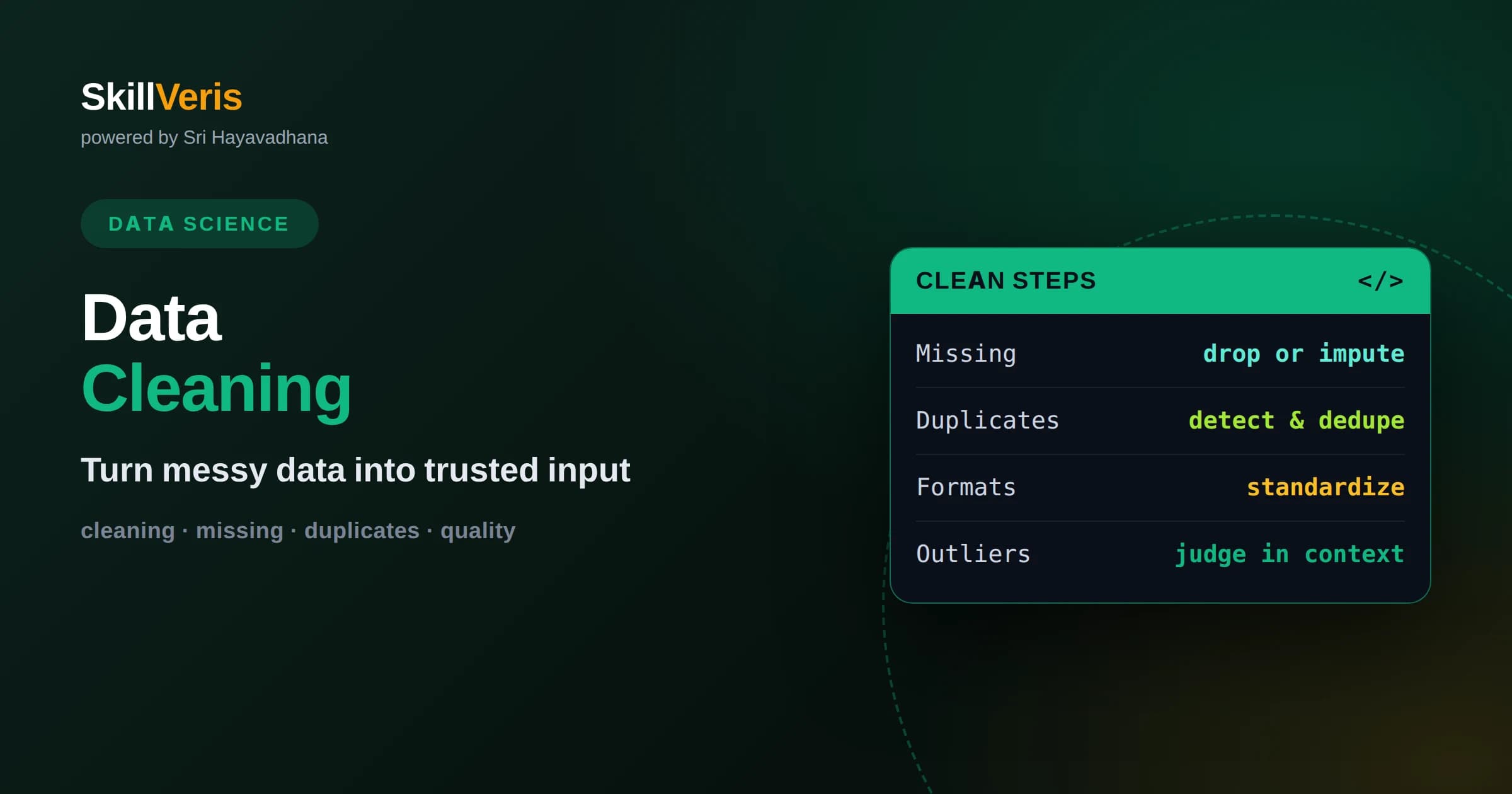
Data cleaning is where analysts spend most of their time, because reliable conclusions depend entirely on trustworthy input data.
In this guide, you'll learn:
- The core tasks are handling missing values, removing duplicates, fixing inconsistent formats, and dealing with outliers deliberately rather than blindly.
- Every cleaning decision is a judgment call that affects results, so documenting what you did and why is as important as the cleaning itself.
- Building repeatable, tested cleaning pipelines beats one-off manual fixes, making your analysis reproducible and your future self grateful.
1Why Data Cleaning Matters Most
Data cleaning is the process of detecting and correcting errors, inconsistencies, and gaps in raw data so it becomes reliable input for analysis. It is widely considered the most important skill in data science because the quality of every conclusion depends entirely on the quality of the data behind it. No model or chart can rescue an analysis built on flawed data.
The blunt reality is captured by the phrase garbage in, garbage out. A sophisticated algorithm fed messy data produces confident, precise, and completely wrong answers. Clean data, by contrast, lets even simple methods yield trustworthy insight. This is why experienced practitioners treat cleaning as the foundation rather than a chore to rush through.
Surveys of working data scientists consistently find that the majority of their time goes to finding, cleaning, and organizing data rather than to modeling. Whether or not any single number is exact, the pattern is clear: cleaning is the bulk of real data work, and getting good at it is one of the highest-leverage things a practitioner can do.
2Start by Understanding the Data
Effective cleaning begins with understanding, not editing. Before changing anything, explore the dataset to learn what each column means, what values are valid, how the data was collected, and where it might have gone wrong. Rushing to fix problems you do not yet understand often creates new ones.
Profile the data systematically. Look at the range and distribution of each column, count missing and unique values, and eye a sample of actual rows. This exploration reveals the problems you need to solve, such as impossible values, unexpected categories, or columns stored in the wrong type, before you commit to any transformation.
Context is essential. A value that looks like an error might be legitimate, and a plausible-looking value might be wrong. Talking to whoever produced the data, or reading its documentation, often explains anomalies that would otherwise be a mystery. Cleaning guided by understanding is far safer than cleaning by reflex.
3Handling Missing Values
Missing data is one of the most common problems, and how you handle it shapes your results. The first step is understanding why values are missing, because data missing at random is very different from data missing for a systematic reason, such as a sensor that fails only under certain conditions. The reason should guide the remedy.
There are three broad options. You can drop rows or columns with missing values, which is simple but loses information and can bias results if the missingness is not random. You can impute, filling gaps with a statistic like the mean or median, a predicted value, or a forward fill for time series. Or you can flag missingness explicitly so a downstream model can account for it.
There is no universally correct choice; each involves trade-offs. Dropping is safe when missing values are few and random, imputation preserves data but introduces assumptions, and flagging keeps information about the gap itself. The professional move is to choose consciously based on the situation and to record which approach you used and why.
It also pays to check how much is missing before deciding. A column that is almost entirely empty may be worth removing outright, while one with only a handful of gaps might be safely imputed. Quantifying the extent of missingness per column turns a vague worry into a concrete, defensible decision about how to proceed.
4Detecting and Removing Duplicates
Duplicate records inflate counts, skew averages, and can badly distort analysis. Duplicates arise from many sources, including data being merged from multiple systems, repeated form submissions, or logging errors. Detecting them is a routine but essential cleaning step that prevents double-counting.
Not all duplicates are exact. Two records may represent the same real-world entity while differing in formatting, spelling, or a single field, which makes them harder to catch than identical rows. Deciding which columns define a true duplicate is a judgment call, and sometimes you must standardize fields first before duplicates become visible.
When removing duplicates, think about which copy to keep. You might keep the first occurrence, the most recent, or the most complete record. Being deliberate about this choice, rather than blindly dropping duplicates, ensures you retain the best version of each record and do not accidentally discard the wrong one.
5Fixing Inconsistent Formats
Real data is riddled with inconsistent formatting that makes the same thing appear as many different values. Dates in mixed formats, text with inconsistent capitalization, extra whitespace, and category labels spelled several ways all fragment data that should be unified. Standardizing these formats is a large part of cleaning.
Common fixes include trimming whitespace, converting text to a consistent case, parsing dates and numbers into proper types, and mapping variant spellings of a category onto a single canonical value. Each of these turns superficially different entries into the identical values they were meant to be, which is essential before grouping, counting, or joining.
Consistency is what makes data computable. A grouping operation treats two spellings of the same category as separate groups, and a join fails to match records that differ only by formatting. Investing in standardization early prevents a cascade of subtle errors in every analysis that follows.
6Correcting Data Types
Data often loads with the wrong types, especially when read from text files where everything arrives as strings. Numbers stored as text cannot be summed, dates stored as text cannot be compared chronologically, and categories stored as generic objects use more memory and miss out on useful behavior. Fixing types is a foundational cleaning step.
Type conversion sometimes surfaces hidden data problems. A column that will not convert to numbers may contain stray text, currency symbols, or thousands separators that need cleaning first. In this way, converting types acts as a validation check, forcing errors into the open where you can address them.
Getting types right pays dividends throughout the analysis. Correct numeric, datetime, and categorical types enable the right operations, improve performance, and prevent whole classes of bugs. It is a small, unglamorous step that quietly makes everything downstream work as expected.
7Handling Outliers Thoughtfully
Outliers are values that lie far outside the typical range, and they demand careful thought rather than automatic removal. Some outliers are genuine errors, like a data entry mistake that adds an extra digit, while others are real and important, such as a rare but legitimate large transaction. Treating both the same way risks discarding valuable signal.
Detecting outliers can use simple rules based on ranges or statistical measures of spread, or visual methods that make extreme points obvious. Detection, however, is only the first step. The crucial decision is what an outlier means in context, which determines whether you correct it, remove it, cap it, or keep it as is.
The guiding principle is to never remove data just because it is inconvenient. An outlier that reflects reality may be the most interesting part of the dataset. Deciding how to treat extreme values based on understanding, and documenting that decision, keeps your analysis honest and defensible.
8Validation and Business Rules
Beyond formatting, data should obey logical and business rules, and checking these constraints catches errors that look superficially fine. An age should not be negative, an end date should not precede a start date, and a percentage should fall within a sensible range. Encoding such rules as validation checks surfaces impossible records.
Cross-field consistency is especially valuable. Individual values may each look plausible while their combination is impossible, such as a shipping date before an order date. Validating relationships between columns, not just values within them, uncovers a deeper layer of errors that single-column checks miss.
Building these checks into your process turns cleaning from a one-time scrub into ongoing quality assurance. When you run the same validations every time new data arrives, you catch problems automatically rather than discovering them after they have corrupted an analysis.
9Build Reproducible Pipelines
Cleaning data by hand in a spreadsheet or with untracked one-off edits is a trap. Manual fixes cannot be repeated, cannot be reviewed, and vanish the moment you receive updated data. Professional cleaning is done in code, as a sequence of transformations that can be rerun on new data from scratch.
A scripted pipeline brings reproducibility, transparency, and reliability. Anyone can see exactly what was done, run it again on refreshed data, and trust that the same rules were applied consistently. When you find a new problem, you fix it once in the pipeline and every future run benefits, rather than repeating manual corrections forever.
Treat cleaning code with the same care as any other code. Keep it organized, add checks that fail loudly when data violates expectations, and version it alongside your analysis. This discipline transforms cleaning from fragile handwork into a dependable foundation you can build on with confidence.
10Document Every Decision
Every cleaning step is a decision that shapes your conclusions, so documentation is not optional. Recording what you changed, why you changed it, and what assumptions you made lets others, and your future self, understand and trust the analysis. Undocumented cleaning turns a dataset into a black box whose numbers cannot be questioned or reproduced.
Good documentation also protects against silent bias. When you decide to drop certain rows or impute certain values, writing down the rationale forces you to justify it and lets reviewers judge whether the choice was sound. Cleaning shapes results, and transparency about how is a core part of doing honest analysis.
Keeping the raw data untouched and applying cleaning in a separate, documented layer preserves the ability to revisit choices later. If a decision turns out to be wrong, you can change it and rerun, rather than being stuck with irreversible edits. Reversibility and documentation together make cleaning trustworthy.
11Cleaning Is Iterative
Data cleaning is rarely a single linear pass. As you analyze, you discover new problems that send you back to clean further, and each cycle deepens your understanding of the data. Expecting this iteration, rather than treating cleaning as a box to check once, leads to more thorough and reliable results.
This loop between cleaning and analysis is healthy. Early exploration reveals surface issues, initial analysis exposes deeper ones, and refined cleaning improves the analysis in turn. Accepting that the two feed each other keeps you from prematurely trusting results built on data you have not yet fully understood.
Knowing when to stop is a skill of its own. Perfect data does not exist, and endless cleaning has diminishing returns. The goal is data clean enough to support reliable conclusions for the question at hand, which is a practical judgment rather than an unreachable ideal.
12Master the Craft
Because cleaning consumes so much of real data work, getting good at it dramatically raises your productivity and the trustworthiness of everything you produce. It is not glamorous, but it is the skill that separates analyses people can rely on from ones that quietly mislead. Investing in it is investing in every project you will ever do.
The way to improve is to clean real, messy datasets, not tidy textbook examples. Genuine data throws problems no tutorial anticipates, and wrestling with them builds the judgment that cleaning demands. Each dataset you clean expands your repertoire of problems recognized and techniques mastered.
On SkillVeris you can practice data cleaning on realistic messy datasets through guided exercises that walk you from raw chaos to analysis-ready data, with feedback at each decision. Take a dataset from your own work or a public source, profile it, and build a small reproducible cleaning pipeline today. That hands-on practice is how this most important skill becomes second nature.
Related Reading
Get The Print Version
Download a PDF of this article for offline reading.
About the Publisher
SkillVeris Team
Data Science Team
Our data team shares real-world analytics, ML, and SQL insights grounded in industry practice.
View all postsRelated Posts



Never miss an update
Get the latest tutorials and guides delivered to your inbox.
No spam. Unsubscribe anytime.