Data Analyst vs Data Scientist vs Data Engineer
SkillVeris Team
Data Science Team
You will clearly distinguish the three roles by what they build and who consumes their work.
In this guide, you'll learn:
- You will see the day-to-day tools and skills each role uses, from SQL and dashboards to Python and data pipelines.
- You will understand realistic 2026 salary ranges and why they differ between the roles.
- You will learn why data analyst is the most accessible entry point for most beginners.
- You will map a practical path that lets you move between roles as your skills grow.
1Three Roles, One Data Pipeline
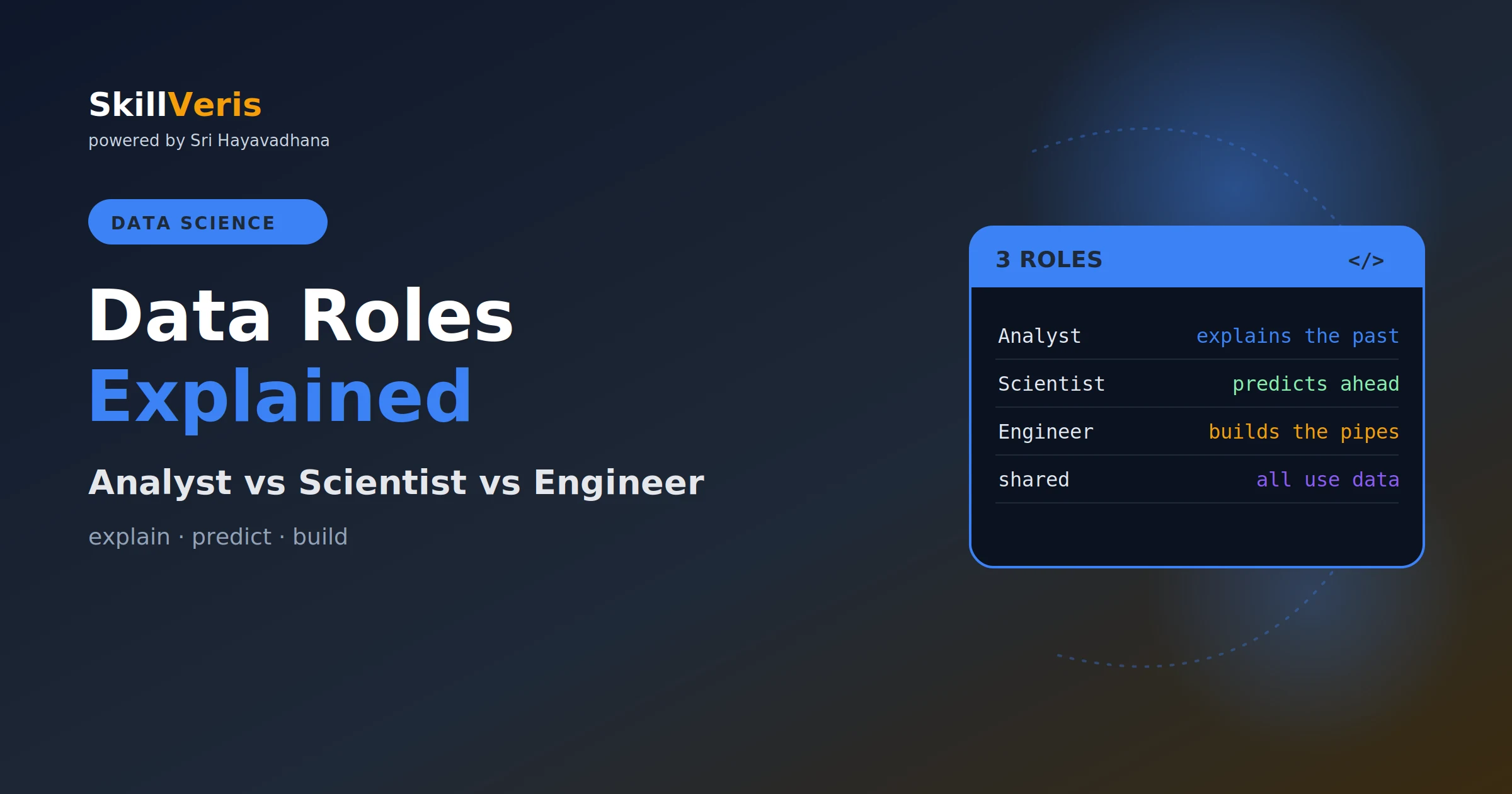
A data engineer builds and maintains the systems that move and store data, a data analyst turns that data into insights and reports for business decisions, and a data scientist builds predictive models and runs experiments to answer harder, forward-looking questions. They sit at different stages of the same pipeline and hand work to each other.
The three titles get used loosely and overlap in small companies, where one person may wear all three hats. But the distinctions are real and worth understanding before you choose which to target, because the skills, tools, and entry difficulty differ significantly.
This guide breaks down what each role actually does day to day, what it pays, and which one makes the most sense to aim for first.
2The Data Engineer: Building the Plumbing
Data engineers build the infrastructure that everyone else depends on. They design pipelines that pull data from source systems, clean and transform it, and load it into warehouses where analysts and scientists can use it. When a dashboard is up to date and a dataset is reliable, a data engineer made that happen behind the scenes.
Their core skills are strong programming (usually Python or Scala), advanced SQL, and tools like Apache Spark, Airflow, dbt, and cloud warehouses such as Snowflake or BigQuery. It is the most software-engineering-heavy of the three roles, and consequently the hardest to enter directly without prior coding experience.
- Builds: data pipelines, warehouses, and the systems that keep data flowing and clean.
- Core skills: Python, advanced SQL, Spark, Airflow, dbt, cloud data platforms.
- Consumers of their work: analysts and data scientists downstream.
3The Data Analyst: Turning Data Into Decisions
Data analysts answer the questions the business is asking right now. Why did sales dip last month? Which customer segment churns fastest? They query data, build dashboards, and translate numbers into clear recommendations that non-technical stakeholders can act on. Their work is descriptive and diagnostic: explaining what happened and why.
The core toolkit is SQL, a BI tool like Power BI or Tableau, spreadsheets, and increasingly a bit of Python for heavier analysis. Communication is as important as technical skill — an insight nobody understands is worthless. This is the most accessible of the three roles for beginners because you can be genuinely useful with SQL and a dashboard tool alone.
4The Data Scientist: Predicting and Experimenting
Data scientists tackle questions that require statistical modeling or machine learning: what will happen next, and what should we do about it. They build models to forecast demand, detect fraud, recommend products, or estimate the effect of a change through experiments like A/B tests. Their work is predictive and prescriptive rather than backward-looking.
The skill bar is higher: solid statistics, Python with libraries like scikit-learn and pandas, machine learning fundamentals, and often experimental design. Many roles expect a strong quantitative background. It is rarely a true entry-level position, though a strong analyst can grow into it.
🔑The overlap is real
At small companies, one 'data analyst' might build pipelines, dashboards, and a simple model all in one week. The titles describe a spectrum, not rigid boxes — and moving along that spectrum is exactly how careers progress.
5Salary Ranges in 2026
Compensation generally rises from analyst to engineer to scientist, reflecting the depth of technical skill each requires, though location, industry, and seniority matter far more than the title alone. Treat these as rough, directional ranges for developed markets, not guarantees.
Data analysts typically start in the lower band and grow steadily; data engineers and data scientists command higher figures because of their specialized skills and scarcity. The gap narrows for a senior analyst who has developed strong technical and domain expertise — seniority often pays more than switching titles.
- Data analyst: entry-level modest, rising well with experience and specialization.
- Data engineer: higher, reflecting heavy software engineering demands.
- Data scientist: typically the highest band, driven by statistics and ML expertise.
- Reality check: a senior analyst often out-earns a junior scientist — level beats title.
6Which Role Should You Target First?
For most beginners, data analyst is the smartest first target. It has the lowest barrier to entry, the fastest path to being genuinely useful, and it exposes you to the whole data landscape so you can decide where to specialize next. You can land an analyst role with SQL, a BI tool, and clear communication — no computer science degree required.
From analyst you can branch in either direction. Lean into pipelines, cloud tools, and heavier coding to move toward data engineering. Lean into statistics, Python, and machine learning to move toward data science. Starting as an analyst is not a lesser choice — it is the on-ramp that gives you the context to choose your specialization wisely.
7A Practical Skill Map
If you are starting from zero, build in layers. Learn SQL first — it underpins all three roles. Add a BI tool and spreadsheet fluency to become an employable analyst. Then, depending on your direction, layer on either data engineering tools (pipelines, cloud warehouses, Python for automation) or data science skills (statistics, machine learning, experimentation).
This layered approach means every step is useful on its own. You are never stuck studying for a year before you can get hired; each layer makes you more valuable while keeping future doors open.
8Frequently Asked Questions
What is the main difference between a data analyst and a data scientist? A data analyst explains what happened and why using queries and dashboards, while a data scientist predicts what will happen and prescribes action using statistical models and machine learning. Analysts are descriptive; scientists are predictive.
Which role pays the most? Data scientists typically occupy the highest salary band, followed by data engineers, then analysts — but seniority and specialization matter far more than title, and a senior analyst often out-earns a junior scientist.
Do I need a degree to become a data analyst? No. Many analysts enter the field through self-study and portfolios, demonstrating SQL, a BI tool, and clear communication. A degree can help but is not a requirement in most markets.
Can I switch between these roles later? Yes, and it is common. Analysts frequently grow into data engineering by adding pipeline and cloud skills, or into data science by adding statistics and machine learning. The roles share a foundation of SQL and data thinking.
Is data engineering harder to enter than analytics? Generally yes, because it demands strong software engineering skills like Python, Spark, and pipeline tools from the start, whereas analytics lets you become useful with SQL and a dashboard tool alone.
Where can I learn the skills for these roles free? SkillVeris offers free courses and study notes covering SQL, Python, data analytics, and machine learning, so you can build the layered skills each of these roles requires at no cost.
9Next Steps
The data analyst, data scientist, and data engineer roles are three stations on one pipeline, differing in what they build, who they serve, and how deep their technical demands run. For most people starting out, aiming for data analyst first gives the fastest route to a real job and the broadest view of where to specialize next.
You can build every layer of these skills for free on SkillVeris, from SQL and analytics through to Python, machine learning, and data engineering foundations. Start with SQL, ship a small analysis project, and let your interests guide which direction you grow — the path stays open in every direction.
Related Reading
Get The Print Version
Download a PDF of this article for offline reading.
About the Publisher
SkillVeris Team
Data Science Team
Our data team shares real-world analytics, ML, and SQL insights grounded in industry practice.
View all postsRelated Posts
Never miss an update
Get the latest tutorials and guides delivered to your inbox.
No spam. Unsubscribe anytime.