Cross-Validation: How to Trust Your Model
SkillVeris Team
Data Science Team
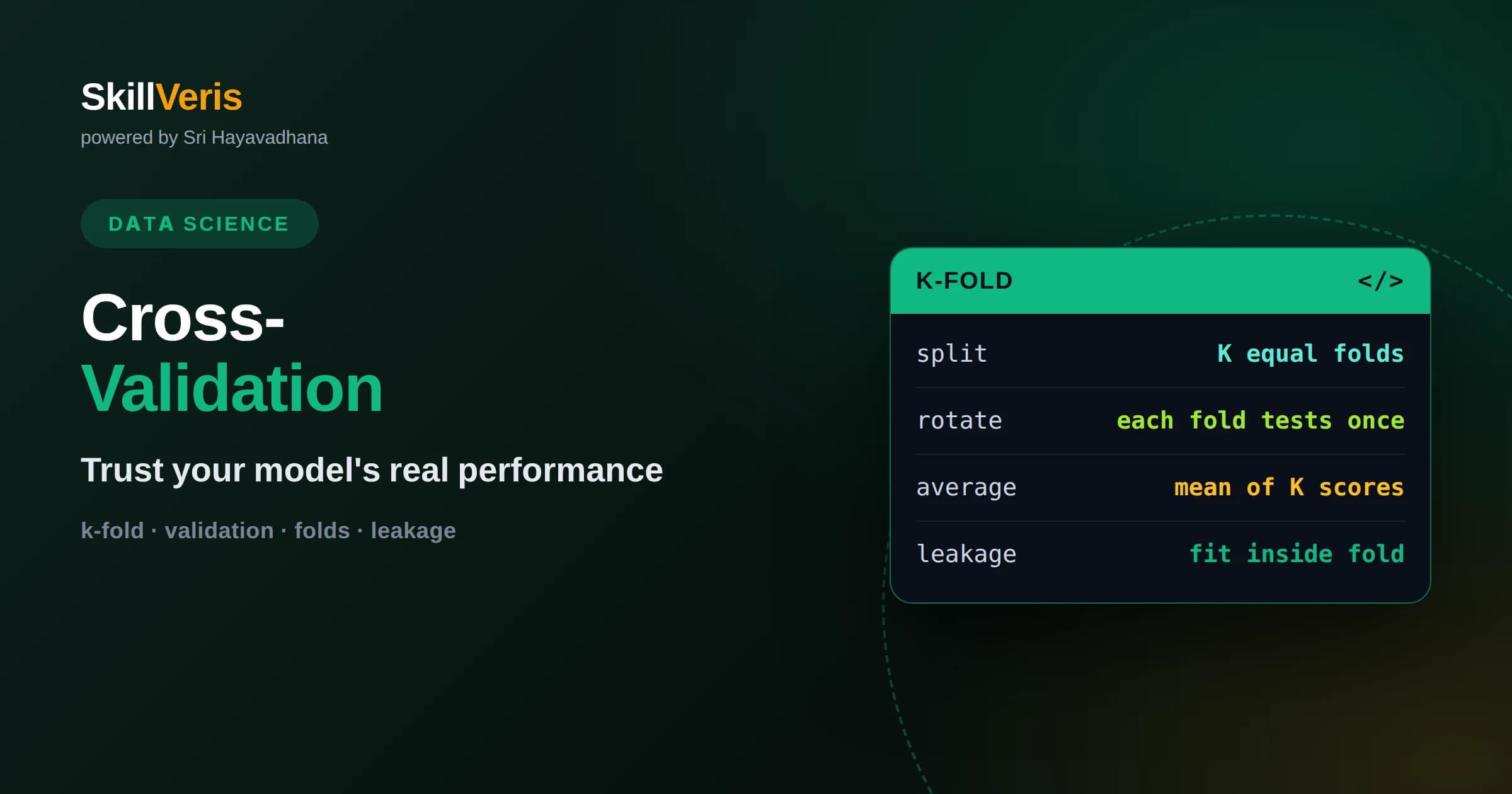
Cross-validation estimates how well a model generalizes by training and testing it on several different splits of the data, then averaging the results.
In this guide, you'll learn:
- K-fold cross-validation is the workhorse method, using every example for both training and testing across its folds.
- It gives a more trustworthy and less lucky performance estimate than a single train-test split, especially on smaller datasets.
- Avoiding data leakage means fitting all preprocessing inside each fold and respecting time order or group structure in the data.
1What Is Cross-Validation
Cross-validation is a technique for estimating how well a model will perform on new, unseen data by training and testing it on several different splits of the available data and averaging the results. Instead of trusting a single lucky or unlucky split, you rotate through many, so the final score reflects consistent performance rather than the quirks of one particular division.
The core idea is simple. You repeatedly hold out a different portion of the data as a test set, train on the rest, and record the score. After doing this several times so that every example has served as test data at some point, you average the scores into one estimate. That average, along with how much the scores vary, tells you both how good the model is and how stable that estimate is.
Cross-validation matters because a model's job is to perform on data it has never seen. Any estimate of that performance based on a single split can be misleadingly high or low by chance. Cross-validation smooths out that luck and gives you a number you can actually trust when deciding whether a model is good enough.
2The Problem With A Single Train-Test Split
The simplest way to evaluate a model is to split the data once into a training set and a test set, train on one and score on the other. This works, but it wastes information and it gambles on the split. If the test set happens to contain easy examples, the score looks too good; if it happens to contain hard ones, the score looks too harsh.
On small datasets the problem is worse, because setting aside a test set leaves little to train on, and the small test set produces a noisy, high-variance estimate. You could get very different results just by shuffling the data differently before splitting. Cross-validation addresses both issues at once: it uses the data more efficiently and averages away the luck of any single split.
None of this means the single split is useless. It remains the right choice for a quick sanity check or when the dataset is so large that one held-out chunk is already big enough to give a stable estimate. The point is to know its weakness and to reach for cross-validation whenever a decision, such as choosing between models or tuning a setting, hinges on the reliability of the number you report.
3K-Fold Cross-Validation
K-fold cross-validation is the standard method. You divide the data into K equal parts, called folds. Then you train the model K times. Each time, one fold is held out as the test set and the other K minus one folds are used for training. Every fold gets a turn as the test set exactly once, and you average the K resulting scores.
The elegance of this scheme is that every example is used for testing exactly once and for training K minus one times, so no data is wasted. A common choice is five or ten folds, which balances a reliable estimate against reasonable computational cost. More folds mean more training runs but a more thorough estimate.
The spread of the K scores is as informative as their average. If all folds produce similar scores, the model is stable and the estimate is trustworthy. If the scores swing widely from fold to fold, the model is sensitive to which data it sees, which is a warning that its real-world performance is uncertain.
4Stratified K-Fold For Classification
Plain k-fold splits the data randomly, which can be a problem in classification when the classes are imbalanced. If one class is rare, a random split might put too few of its examples in some folds, or even none, producing misleading scores. Stratified k-fold fixes this by ensuring each fold keeps roughly the same class proportions as the full dataset.
For most classification tasks, stratified k-fold is the right default rather than ordinary k-fold. It guarantees that each fold is a fair miniature of the whole, so every training and test set sees a representative mix of classes. The extra care costs nothing and makes the resulting estimate noticeably more reliable, especially when some categories are uncommon.
The imbalance problem is easy to underestimate. If a class appears in only a small fraction of your rows, an unlucky random split can hand one fold almost none of those examples, so the model is barely tested on the very case you care about most. Stratification removes that gamble entirely, which is why fraud detection, rare-disease prediction, and similar skewed problems lean on it by default.
5Leave-One-Out And Other Variants
Leave-one-out cross-validation takes k-fold to the extreme, setting K equal to the number of examples so that each fold holds out just a single data point. This uses the maximum possible data for training each time and is nearly unbiased, but it is very expensive because you train the model as many times as you have examples, and its estimates can be noisy.
Other variants suit particular needs. Repeated k-fold runs the whole k-fold process several times with different random shuffles and averages across them for an even steadier estimate. Group k-fold keeps related examples, such as multiple records from the same patient, together in the same fold so information does not leak across the split. Choosing the right variant depends on the size and structure of your data.
The common thread is that the split should never place near-duplicate or clearly related rows on both sides of the divide. When it does, the model is effectively tested on data it has already seen, and the score climbs for the wrong reason. Thinking carefully about what counts as a truly independent example, before choosing a variant, is often more important than which specific variant you land on.
6Cross-Validation For Time Series
Standard cross-validation shuffles data randomly, which quietly breaks when the data has a time order. If your goal is to predict the future from the past, training on future data to predict the past is cheating, and it produces optimistic scores that will never hold up in reality. Random shuffling would let exactly that happen.
Time-series cross-validation respects the arrow of time. It uses expanding or rolling windows where the training set always comes before the test set chronologically, mimicking how the model will actually be used: learn from the past, predict the next stretch, then move the window forward. Honoring time order is essential whenever your data has a meaningful sequence, or your evaluation will lie to you.
7The Danger Of Data Leakage
Data leakage is when information from outside the training fold sneaks into the model, inflating cross-validation scores that then collapse in production. The most common cause is preprocessing the entire dataset before splitting, for example scaling features or filling missing values using statistics computed from all the data, including the test folds.
The correct approach is to fit every preprocessing step using only the training portion of each fold and then apply it to that fold's test portion. Pipelines that bundle preprocessing and the model together make this automatic, so each fold is handled cleanly. Guarding against leakage is what separates a cross-validation score you can trust from one that merely looks good on paper.
Leakage also hides in features themselves. A column that was derived using future information, or that indirectly encodes the very answer you are predicting, will produce dazzling scores that evaporate in production. Before trusting any strong result, ask whether each feature would genuinely be available at prediction time, because the most dangerous leakage is the kind that never shows up as an obvious mistake in your code.
8Using Cross-Validation For Hyperparameter Tuning
Beyond estimating performance, cross-validation is the standard way to tune hyperparameters, the settings you choose before training such as regularization strength or tree depth. You try a range of settings, evaluate each with cross-validation, and keep the one with the best average score. This gives a fairer comparison than a single split, which might favor a setting just by luck.
There is a subtlety, though. If you use the same cross-validation to both tune settings and report final performance, the reported number is optimistic, because the settings were chosen to look good on exactly that data. The clean solution is nested cross-validation or a separate held-out test set: tune inside an inner loop, then measure final performance on data that played no part in the tuning.
The scale of the search matters too. Trying a handful of settings barely inflates the estimate, but sweeping across hundreds of combinations gives you many chances to get lucky, and one of them almost certainly will by accident. The more aggressively you tune, the more essential an untouched final test set becomes, because it is the only number that has not been quietly shaped by your own search for the best result.
9Interpreting Cross-Validation Results
A cross-validation result is more than a single average; it is a distribution. Report the mean score to summarize typical performance and the spread, such as the standard deviation across folds, to convey how confident you can be. A high mean with a small spread is the ideal: the model is both good and stable.
A high mean with a large spread should give you pause, because it signals that performance depends heavily on which data the model happens to see. When comparing two models, do not crown a winner over a difference smaller than the fold-to-fold variation, since that gap is likely noise rather than a real edge. Reading the spread keeps you honest about how much your comparison actually proves.
10Managing Computational Cost
Cross-validation multiplies training time, since a five-fold scheme trains the model five times and tuning across many settings multiplies that again. For quick models on modest data this is trivial, but for large models or big datasets the cost can become the bottleneck of your workflow.
Practical shortcuts help. Use fewer folds during rough exploration and more folds only for final evaluation. Sample down the data while iterating on ideas, then validate the finalists on the full set. And lean on parallelism, since the folds are independent and can train at the same time. Balancing thoroughness against cost is part of using cross-validation well rather than blindly.
11Choosing The Right Method
Match the method to the data. For general problems, five or ten fold cross-validation is a sound default. For classification, prefer the stratified version so class balance is preserved. For time-ordered data, always use time-series splits that respect chronology. For data with groups, use group folds so related records stay together.
For very small datasets, leave-one-out or repeated k-fold squeezes the most reliable estimate from limited examples. The unifying principle across all of these is that your evaluation should mimic how the model will actually be used. When it does, the score you get is a promise you can keep; when it does not, the score is a story that ends in disappointment.
12Build Trust In Your Models Through Practice
Cross-validation is one of those topics that feels abstract until you run it and watch the fold scores appear. Take a dataset, run a single split and note the score, then run k-fold and see how much the estimate moves and how the folds vary. That contrast makes the value of cross-validation immediately concrete.
On SkillVeris you can practice cross-validation hands-on, from basic k-fold to stratified, time-series, and leakage-free pipelines, with exercises that show how each choice changes your confidence in a model. Building this habit early means the models you ship will perform in the real world the way your evaluation promised they would.
Related Reading
Get The Print Version
Download a PDF of this article for offline reading.
About the Publisher
SkillVeris Team
Data Science Team
Our data team shares real-world analytics, ML, and SQL insights grounded in industry practice.
View all postsRelated Posts
Never miss an update
Get the latest tutorials and guides delivered to your inbox.
No spam. Unsubscribe anytime.