What Is ChatGPT? A Practical Guide to the AI Chatbot
SkillVeris Team
AI Research Team
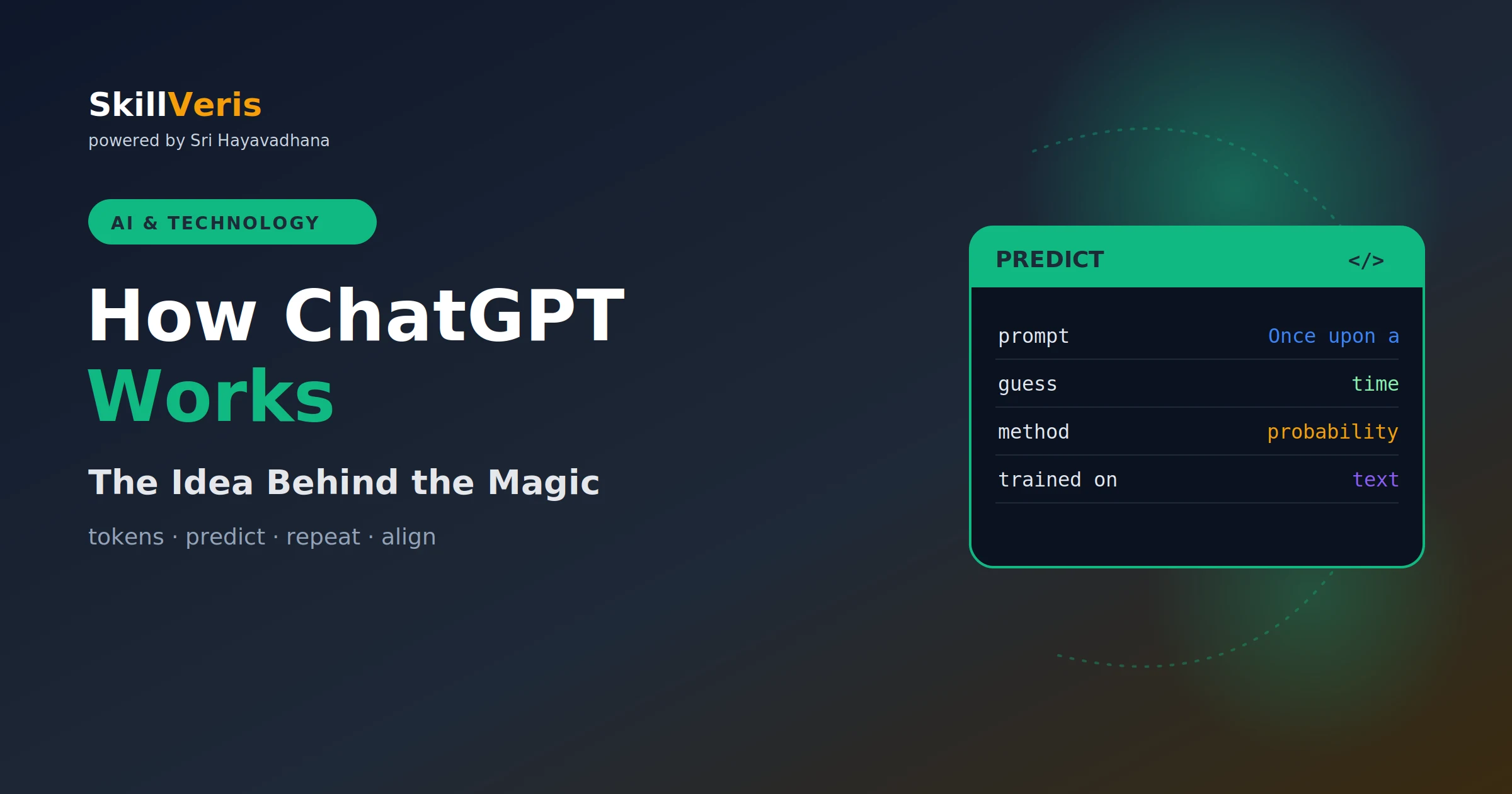
ChatGPT is a conversational interface built on top of a large language model (LLM) that predicts the next most likely word given everything typed so far.
In this guide, you'll learn:
- It was trained on huge amounts of text so it can write, summarize, explain, translate, and code, but it has no live connection to the world unless a tool or browsing feature is explicitly enabled.
- ChatGPT can produce confident-sounding but incorrect statements, known as hallucinations, so factual claims need independent verification.
- Prompting well, giving context, examples, and a clear task, changes output quality more than almost anything else.
- It does not "understand" in the human sense; it is pattern completion at scale, which explains both its strengths and its odd failure modes.
1What Is ChatGPT?
ChatGPT is a chatbot developed by OpenAI that generates text responses by predicting, one token at a time, the most statistically likely continuation of a conversation. It is a user-facing product built around a large language model (LLM), a type of neural network trained on enormous volumes of text.
Unlike a search engine, it doesn't look things up in a database of facts by default. It generates an answer fresh each time based on patterns learned during training, which is why the same question can produce slightly different wording on different runs.
2How ChatGPT Actually Works
Under the hood, ChatGPT runs on a transformer model trained in stages: first on a broad slice of text to learn general language patterns, then fine-tuned with human feedback to make its answers more helpful, honest, and safe.
When you send a message, the model breaks your text into tokens (word pieces), feeds them through many layers of the network, and repeatedly predicts the next token until it decides the response is complete. It has no persistent memory between separate chats unless a memory feature is turned on, and no built-in access to today's news unless browsing or a connected tool is active.
💡
3What It's Good At
ChatGPT excels at tasks where fluent, well-structured language is the main deliverable and some imprecision is tolerable.
- Drafting emails, outlines, and first-pass documents that you'll edit yourself
- Explaining unfamiliar concepts in plain language, at whatever depth you ask for
- Writing and debugging code snippets, especially in well-documented languages
- Summarizing long text into a shorter, structured form
- Brainstorming variations, options, or angles on a problem
- Translating and rephrasing text between languages and tones
4Where It Fails
The most important limitation is hallucination: ChatGPT can state a wrong fact, a fake citation, or a made-up API method with the same confident tone as a correct one, because it is optimizing for plausible language, not verified truth.
It also struggles with precise arithmetic on large numbers, up-to-the-minute information without browsing enabled, and tasks that require genuinely novel reasoning far outside its training patterns.
- Fabricated citations, quotes, or statistics that sound plausible
- Outdated information past its training cutoff unless browsing is used
- Inconsistent answers to the same question asked different ways
- Overconfidence when it should instead say "I don't know"
5How to Write Better Prompts
The single biggest lever for output quality is the prompt itself. A vague question gets a generic answer; a specific one with context and constraints gets a targeted one.
Treat it like briefing a competent colleague who wasn't in the room: give the goal, the audience, the format you want, and any facts it needs to know.
- State the task and desired format explicitly ("write a 3-bullet summary", not "summarize this")
- Give relevant context or constraints up front rather than after a bad answer
- Ask it to show its reasoning for anything you need to verify
- Iterate: treat the first answer as a draft, then refine with follow-up instructions
6ChatGPT vs Other AI Tools
ChatGPT is one of several conversational AI products built on large language models; the underlying idea is shared across the category even though products differ in their default behaviors, such as whether they browse the web live or cite sources by default.
The core skill of writing good prompts, understanding token-based generation, and verifying factual claims transfers across all of them.
7Using ChatGPT Responsibly
Treat every factual claim it makes as a draft to verify, especially for numbers, legal or medical topics, and anything you'll publish or act on.
Avoid pasting sensitive personal or proprietary data into a general-purpose chat unless you understand your organization's data handling policy for that tool.
8Getting Started and Next Steps
The fastest way to get real value from ChatGPT is to use it on a task you already understand well enough to judge the output, then gradually extend to less familiar territory as you learn its patterns of strength and weakness.
If you want to go beyond using the tool and actually understand how these models are built and fine-tuned, SkillVeris's Python for AI & ML and large language models courses walk through the mechanics behind tools like this one.
Related Reading
Get The Print Version
Download a PDF of this article for offline reading.
About the Publisher
SkillVeris Team
AI Research Team
Our AI team covers the latest in machine learning, generative AI, and emerging tech — clearly and accurately.
View all postsRelated Posts
Never miss an update
Get the latest tutorials and guides delivered to your inbox.
No spam. Unsubscribe anytime.