Chain-of-Thought Prompting: Make AI Reason Better
SkillVeris Team
AI Research Team
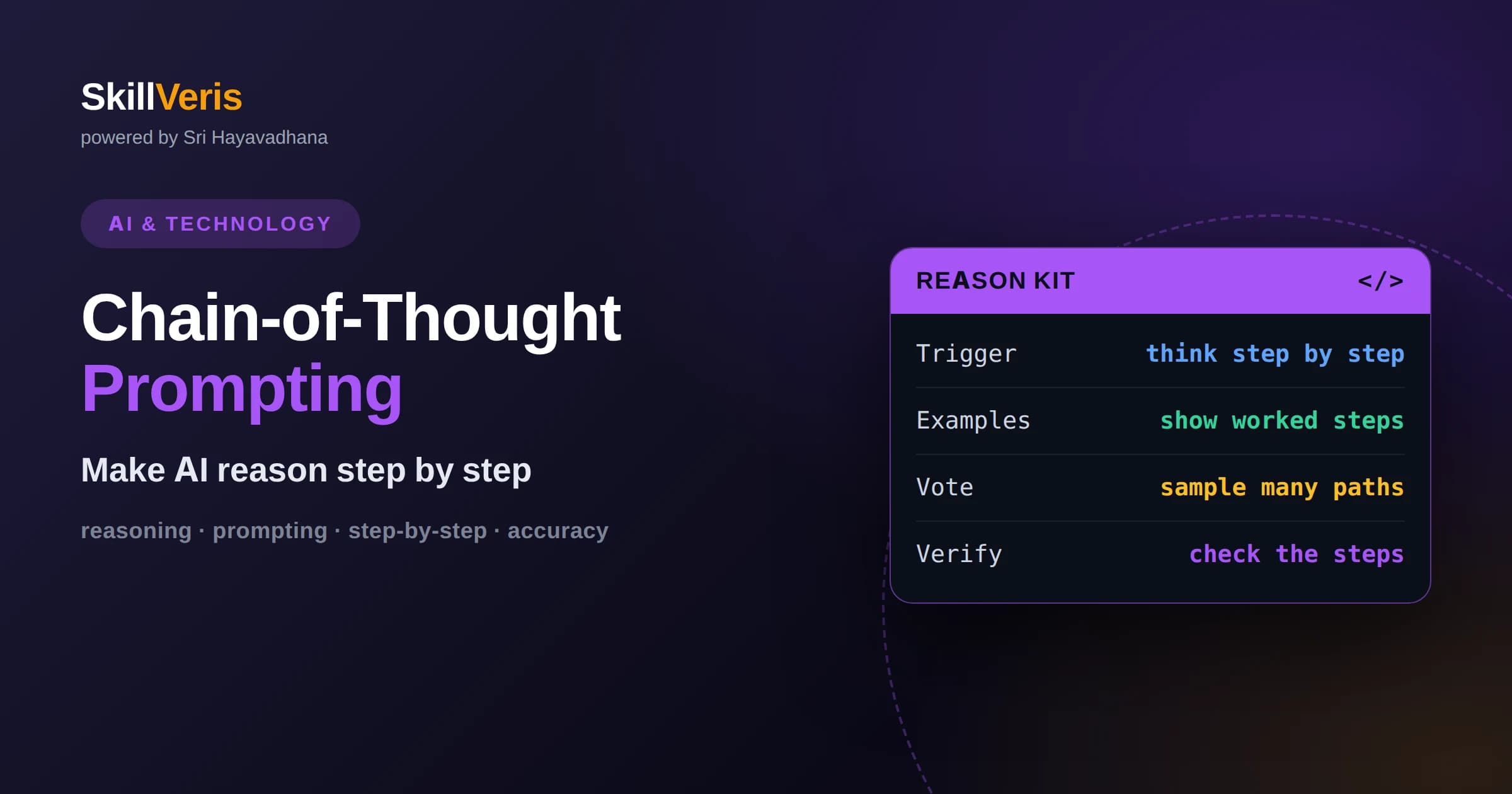
Chain-of-thought prompting tells the model to work through a problem step by step, which improves accuracy on multi-step reasoning tasks.
In this guide, you'll learn:
- It helps because generating intermediate steps gives the model room to compute, rather than forcing a single leap to the answer.
- You can trigger it with a simple instruction, with worked examples, or by asking the model to plan before it solves.
- It is not free: it uses more tokens, can still reason wrongly, and is unnecessary for simple lookups, so apply it where it earns its keep.
1What Chain-of-Thought Prompting Is
Chain-of-thought prompting is a technique where you ask a language model to reason through a problem step by step before giving its final answer, rather than jumping straight to a conclusion. By prompting the model to show its work, you often get substantially more accurate results on tasks that require multiple stages of logic, such as math word problems, multi-part questions, and careful analysis.
The core instruction can be as simple as asking the model to think step by step or to explain its reasoning before answering. This nudges the model to produce a sequence of intermediate steps, and those steps lead to a better final answer than a direct response would.
The technique became prominent because it dramatically improved performance on reasoning benchmarks without any change to the model itself, purely by changing how the model was prompted. It remains one of the highest-leverage prompting skills you can learn.
It is worth stressing that chain-of-thought changes the output, not the model. You are not retraining anything or unlocking a hidden mode; you are simply arranging the prompt so the model spends its generation producing useful intermediate work. That is why the same trick transfers across many models and tasks, and why learning it pays off broadly rather than for one narrow tool.
2Why It Works
The reason chain-of-thought helps comes back to how models generate text. A model produces one token at a time, and each token can only build on what came before. Forcing an immediate answer gives the model no space to work through a problem, so hard questions get a hurried guess. Intermediate steps give it room to compute.
When the model writes out its reasoning, each step becomes context the next step can rely on. A multi-part calculation is broken into pieces the model can handle one at a time, much as a person scribbling on paper solves a problem they could not do in their head. The written steps externalize the working memory.
This also means the benefit is largest on problems that genuinely require multiple stages. On such tasks the extra reasoning tokens carry real computation, whereas on trivial questions they add little. The technique works by giving the model the equivalent of thinking time expressed as text.
3Basic Ways to Trigger It
The simplest approach is a direct instruction added to your prompt, telling the model to reason step by step or to work through the problem carefully before answering. This zero-example method requires no special setup and often produces a noticeable improvement on reasoning tasks by itself.
A stronger approach provides worked examples in the prompt, showing the model a few problems solved with explicit reasoning followed by the answer. The model imitates this pattern on your new problem, reasoning in the same style. This is more effort to set up but can be more reliable for a specific task format.
A third variation asks the model to first make a plan or outline its approach, then execute it. Separating planning from solving can help on complex tasks where deciding how to tackle the problem is itself part of the difficulty. All three share the same principle of eliciting explicit intermediate steps.
4Structuring the Reasoning
You get better results when you guide the shape of the reasoning rather than just asking for steps. For a word problem you might ask the model to first identify the known quantities, then the goal, then the operations, then compute. Providing this scaffold keeps the reasoning organized and reduces skipped steps.
Being explicit about the final format helps too. Ask the model to reason first and then give the answer on a clearly marked final line, so you can reliably extract the conclusion. Without this, the answer can be buried in the reasoning and harder to parse programmatically.
Tailoring the scaffold to the task type pays off. Analytical questions benefit from listing considerations, comparisons benefit from evaluating each option against criteria, and diagnostic tasks benefit from ruling possibilities in or out. The right structure channels the model's reasoning productively.
5Sampling Multiple Reasoning Paths
A powerful extension is to have the model reason through the same problem several times with some randomness, then take the most common final answer. Different reasoning paths may reach the same correct conclusion while errors scatter, so a majority vote across attempts is often more reliable than any single run.
This works because a correct line of reasoning tends to be reachable by many paths, while mistakes are more idiosyncratic. Aggregating across attempts filters out one-off slips. The tradeoff is cost, since you are running the problem multiple times, so reserve it for high-value questions.
The general lesson is that reasoning is not deterministic, and treating a single answer as final can be fragile on hard problems. Sampling multiple paths trades compute for reliability, which is a worthwhile deal when correctness matters most.
6Chain-of-Thought and Reasoning Models
Newer models are specifically trained to reason before answering, effectively building chain-of-thought into their default behavior. With these models you may not need to prompt for step-by-step reasoning explicitly, because they already produce an internal chain of thought and then a final answer.
This does not make the technique obsolete, but it changes how you apply it. With reasoning-tuned models you focus more on clearly stating the problem and constraints and less on coaxing out steps. With standard models, explicit chain-of-thought prompting remains the main lever for better reasoning.
Understanding the principle still matters even when the model reasons automatically, because it explains why giving the model room to think improves results and why rushing it toward an immediate answer can hurt. The concept underlies both explicit prompting and built-in reasoning.
7Verifying the Reasoning, Not Just the Answer
A crucial caution is that visible reasoning can look convincing while being wrong. A model can produce a fluent, plausible chain of steps that contains a subtle error and still arrives at an incorrect answer with full confidence. The presence of reasoning is not proof of correctness.
This means you should treat the reasoning as something to check, not something to trust automatically. For important tasks, verify the steps, especially any arithmetic or factual claims, and consider having the model or a tool independently confirm the result. Reasoning improves accuracy but does not guarantee it.
There is also a subtlety that the written reasoning may not perfectly reflect how the model actually reached its answer. It is a useful artifact for catching mistakes and for transparency, but reading it as a literal trace of the model's internal process can be misleading.
8When Not to Use It
Chain-of-thought is not always the right choice. For simple lookups, single-step questions, or tasks where a direct answer is expected, adding reasoning wastes tokens, increases latency, and can even introduce errors by overcomplicating something straightforward. Match the technique to the difficulty of the task.
It also lengthens output, which matters for cost and for user experience when people want a quick answer. In interactive settings you may want the model to reason internally but show only the conclusion, keeping the benefit of step-by-step thinking without cluttering the response.
The skill is judgment: apply chain-of-thought where problems genuinely require multiple steps and skip it where they do not. Blindly adding think step by step to every prompt is a common overcorrection that trades efficiency for no gain on easy tasks.
9Showing or Hiding the Reasoning
In many applications you want the accuracy benefit of reasoning without exposing the raw steps to users. A common pattern is to have the model reason and then produce a clean final answer that your application extracts and displays, keeping the intermediate work behind the scenes.
This keeps the user experience tidy while still capturing the accuracy gains. You can log the reasoning for debugging and quality checks without cluttering the interface, giving you the best of both worlds: better answers and clean presentation.
Deciding whether to show reasoning depends on your users. For educational tools, showing the steps is valuable because the reasoning is the point. For a customer-facing answer, a concise result is usually better. Design the visibility around what your users actually need.
10Combining With Other Techniques
Chain-of-thought composes well with other methods. Paired with retrieval, the model reasons over real source documents rather than its own memory, improving both grounding and logic. Paired with tools, the model can reason about which tool to use and then call it, offloading precise steps like calculation.
It also combines with clear role instructions and structured output. You can ask the model to adopt an expert perspective, reason step by step, and then return its conclusion in a specified format, stacking techniques that each address a different weakness.
Thinking of prompting as a toolkit rather than a single trick is the mature approach. Chain-of-thought is one of the most valuable tools in that kit, and knowing how it interacts with retrieval, tools, and formatting lets you build genuinely capable systems.
11Common Pitfalls
One pitfall is assuming more reasoning is always better. Excessively long chains can wander, accumulate errors, or talk themselves out of a correct initial instinct. Encouraging focused, relevant reasoning beats prompting for endless elaboration.
Another pitfall is trusting the answer because the reasoning looks thorough. As noted, plausible reasoning can still be wrong, so verification remains essential for anything important. The confidence of a well-written chain of thought is not evidence of its correctness.
A final pitfall is applying the same reasoning style to every task. Different problems call for different structures, and a scaffold that helps with math may hinder a creative or open-ended task. Adapt the approach to the problem in front of you rather than reusing one template everywhere.
12Measuring Whether It Helps
It is easy to assume chain-of-thought improves your results and never check, but the honest move is to measure. Assemble a set of representative problems with known correct answers, run them with a direct prompt and again with step-by-step reasoning, and compare accuracy. Only then do you know whether the technique earns its extra tokens for your task.
Track more than a single accuracy number. Note how often reasoning fixed a wrong answer versus how often it introduced a new mistake, and watch the added latency and cost. A technique that lifts accuracy slightly while tripling response time may not be worth it in an interactive product, and only measurement reveals that tradeoff.
Rerun this comparison whenever you change models or prompts, since the benefit of chain-of-thought varies by task and by model. Reasoning-tuned models may show little gain from explicit prompting, while standard models may gain a lot. Treating the choice as an empirical question rather than an article of faith keeps your systems both accurate and efficient.
13Put It Into Practice on SkillVeris
The way to master chain-of-thought is to experiment on real problems. Take a task the model gets wrong with a direct prompt, then add step-by-step reasoning and watch the answer improve. Try worked examples and multiple sampled paths, and notice which problems benefit most.
As you practice, develop judgment about when to reason and when to answer directly, how to structure the steps for different task types, and how to verify results rather than trusting fluent reasoning. These skills turn a simple trick into reliable engineering.
On SkillVeris you can work through hands-on prompting lessons that let you apply chain-of-thought, self-consistency, and tool use on real tasks, building the judgment that comes only from practice. Try it on your own problems and let the results guide you.
Related Reading
Get The Print Version
Download a PDF of this article for offline reading.
About the Publisher
SkillVeris Team
AI Research Team
Our AI team covers the latest in machine learning, generative AI, and emerging tech — clearly and accurately.
View all postsRelated Posts

Never miss an update
Get the latest tutorials and guides delivered to your inbox.
No spam. Unsubscribe anytime.