JavaScript Projects for Beginners to Build a Portfolio
SkillVeris Team
Engineering Team
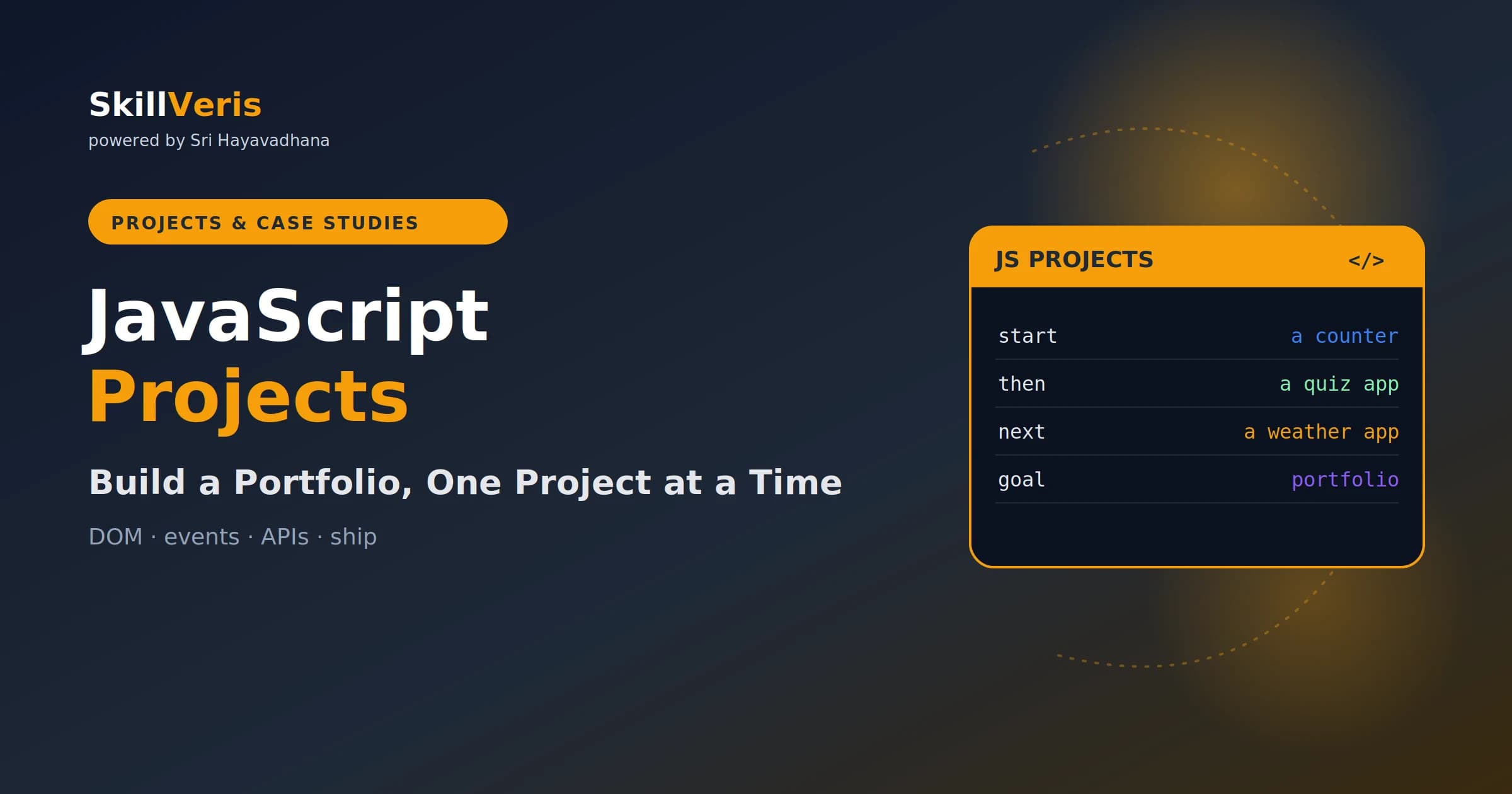
This guide provides a comprehensive, practical breakdown of javascript projects for beginners to build a portfolio.
In this guide, you'll learn:
- All concepts are explained with real-world examples and hands-on exercises.
- No prior experience required — this guide starts from the foundations.
- By the end, you will have a working project to add to your portfolio.
- Expert insights and current industry data are woven throughout.
1Introduction
Welcome to this comprehensive guide on JavaScript Projects for Beginners to Build a Portfolio. Whether you are a complete beginner or looking to solidify your understanding, this article will walk you through everything you need to know in a clear, structured way.
The Projects & Case Studies space has evolved rapidly, and staying current requires both foundational knowledge and awareness of the latest developments. This guide balances both — starting with the fundamentals you must master and building up to current best practices.
Every section includes practical examples, actionable advice, and links to further resources. Read it start to finish for the full picture, or jump to the sections most relevant to your current level.
2Core Concepts and Foundations
Before diving into the advanced aspects of JavaScript Projects for Beginners to Build a Portfolio, it is essential to have a firm grasp of the underlying principles. Like any complex skill, the ceiling of what you can build is determined by the strength of your foundations.
Industry professionals consistently report that the learners who progress fastest are those who resist the temptation to skip foundations and rush to the exciting parts. The exciting parts are genuinely exciting — but they only make sense once the fundamentals are solid.
This section covers the core concepts you need to understand before moving forward. Take time with each one. If something is not clear, revisit it before moving on. The investment in understanding now pays enormous dividends later.
🔑Key Concept
Mastering the fundamentals of projects & case studies is not the slow path — it is the fast path. Professionals who skip foundations spend years patching gaps in their knowledge.
3Practical Application
Theory without practice is incomplete. This section shifts from concepts to application — walking you through real examples that demonstrate how javascript projects for beginners to build a portfolio works in practice.
Each example is drawn from real-world scenarios that professionals in the Projects & Case Studies space encounter regularly. As you work through them, pay attention not just to the mechanics but to the reasoning — why this approach rather than another? That metacognitive awareness is what distinguishes expert practitioners from competent ones.
Feel free to experiment as you follow along. Modify the examples, break things intentionally, and try to fix them. This kind of active engagement accelerates learning far more effectively than passive reading.
4Advanced Topics and Best Practices
Once you have the fundamentals in hand and have applied them in practice, the next step is understanding the advanced patterns and best practices that separate good work from excellent work.
Best practices are not arbitrary conventions. They are accumulated wisdom from practitioners who have encountered and solved real problems. Understanding the reasoning behind a best practice is as important as knowing the practice itself — it allows you to adapt intelligently when context demands it.
This section covers the advanced topics and professional conventions that you will encounter as you progress in Projects & Case Studies. Some of these may not be immediately applicable at your current level — but having early exposure to them shapes how you think and prepares you for what is ahead.
- Write code and documentation for the next person who reads it, not just for the machine that runs it.
- Version control everything — not just code, but configurations, datasets, and analysis scripts.
- Test your assumptions explicitly, especially in data-heavy workflows where silent errors are common.
- Peer review and collaboration dramatically improve the quality of technical work in every domain.
- Never stop learning: the tools and best practices in this field evolve continuously.
5Your Next Steps
You have covered a lot of ground in this guide. Before moving on, take a moment to consolidate what you have learned by trying to explain the key concepts to someone else — or write them down in your own words. This "teach-back" technique is one of the most effective memory consolidation strategies known.
From here, the path forward is continued practice. Build projects. Contribute to open-source. Connect with professionals in the Projects & Case Studies community on LinkedIn and at meetups. Real-world application and professional community are the two accelerants that take learning from "I understand this" to "I can do this reliably under pressure".
SkillVeris has dedicated course tracks for Projects & Case Studies that pick up exactly where this article leaves off. The courses include interactive exercises, coding challenges, community discussion, and AI Mentor support — so you are never stuck and never learning alone.
💡Keep the Momentum
Set a specific goal for the next 7 days: build one small project using what you learned today. Even a simple script or analysis counts. Consistency over intensity is the real secret to learning new technical skills.
Get The Print Version
Download a PDF of this article for offline reading.
About the Publisher
SkillVeris Team
Engineering Team
Our engineering team documents real build journeys so you can learn by doing, not just reading.
View all postsRelated Posts
Never miss an update
Get the latest tutorials and guides delivered to your inbox.
No spam. Unsubscribe anytime.