AI vs Machine Learning vs Deep Learning
SkillVeris Team
AI Research Team
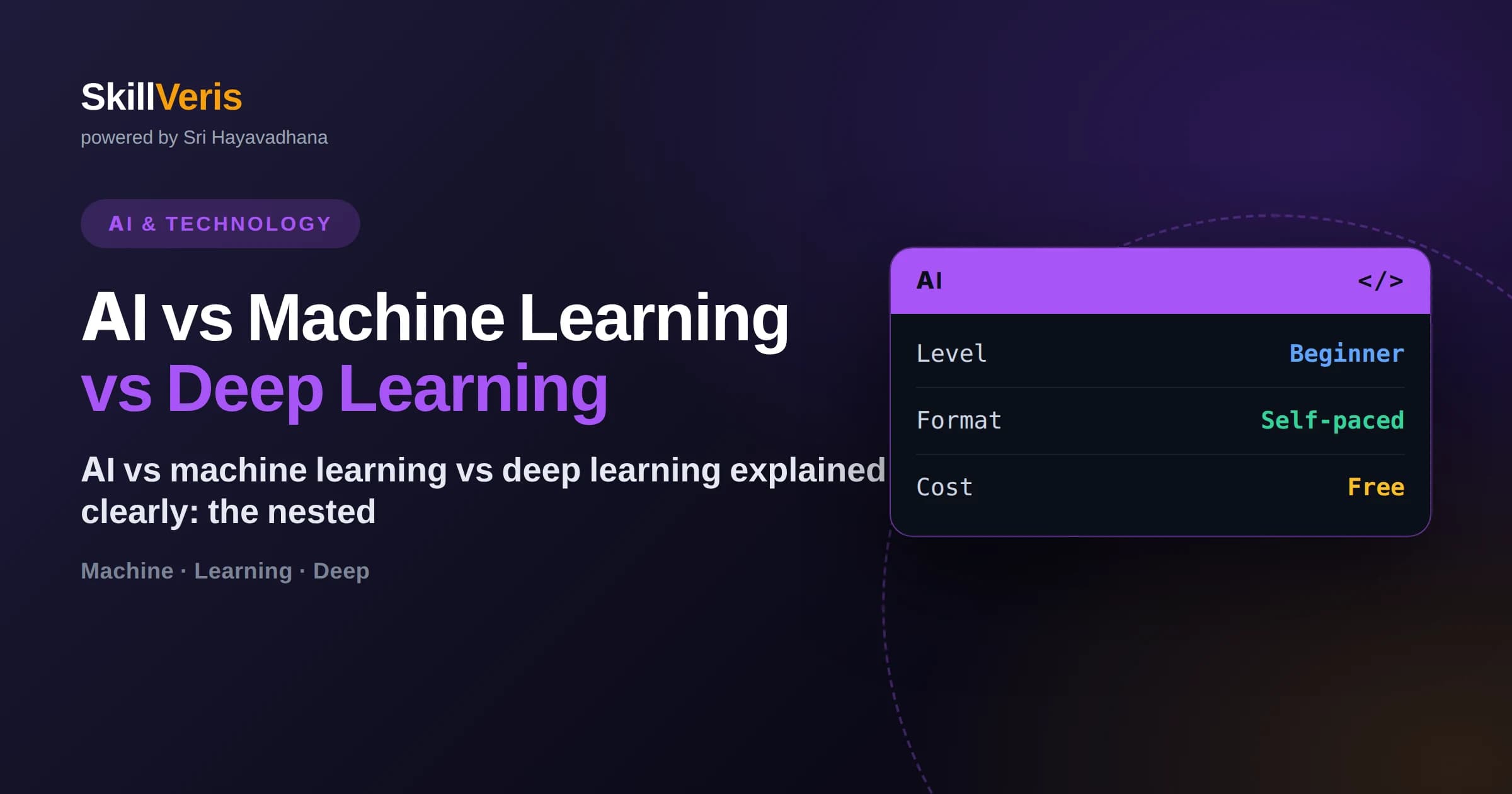
Artificial intelligence is the broad goal, machine learning is a way to achieve it, and deep learning is a specific machine-learning technique.
In this guide, you'll learn:
- The three form nested circles: all deep learning is machine learning, and all machine learning is AI, but not the reverse.
- Traditional AI can be rule-based, while machine learning learns patterns from data instead of following hand-written rules.
- Deep learning uses many-layered neural networks and excels at messy inputs like images, audio, and natural language.
- Choosing between classic machine learning and deep learning often comes down to data volume, problem complexity, and interpretability.
1What Is the Difference Between AI, Machine Learning, and Deep Learning?
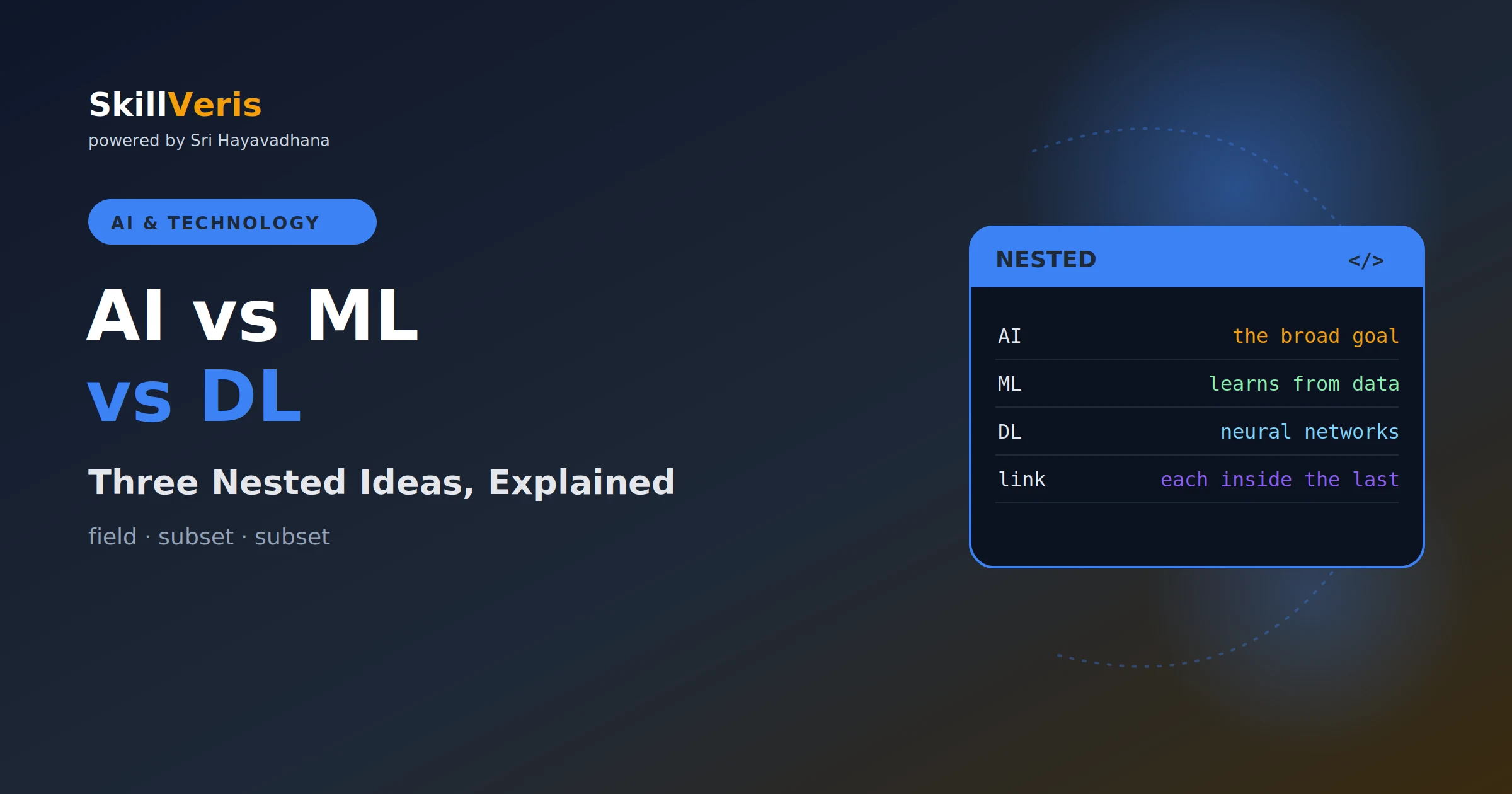
Artificial intelligence, machine learning, and deep learning are three nested ideas, not three competing ones. AI is the broad field of making machines act intelligently; machine learning is a subset of AI where systems learn from data; and deep learning is a subset of machine learning that uses many-layered neural networks. Picture three circles, one inside the next.
People confuse them because the terms are used loosely in marketing, where "AI" often means whatever is newest. But the relationship is precise and worth getting right: it tells you how a given technology works and what it needs to function. This guide clears up the hierarchy with concrete examples so you can place any tool correctly.
By the end you will be able to explain, without hesitation, why every deep-learning system is also machine learning and AI, but a rule-based chess program is AI without being either machine learning or deep learning.
2The Nested Relationship, Made Concrete
The cleanest way to hold this in your head is the containment rule. Deep learning sits inside machine learning, which sits inside artificial intelligence. Anything in the inner circle is automatically part of the outer ones, but the outer circles contain things the inner ones do not.
So a modern image recognizer is deep learning, and therefore also machine learning and AI. A spam filter using classic statistical methods is machine learning and AI, but not deep learning. And an old-fashioned expert system that follows hand-coded if-then rules is AI, but neither machine learning nor deep learning because it never learns from data.
- Artificial intelligence: the outermost circle, any technique that makes machines behave intelligently.
- Machine learning: the middle circle, systems that learn patterns from data rather than following fixed rules.
- Deep learning: the innermost circle, machine learning using deep neural networks.
3Artificial Intelligence: The Broad Goal
Artificial intelligence is the oldest and broadest term, dating back to the 1950s. It covers any approach that gets a machine to perform tasks we associate with human intelligence, such as reasoning, planning, perceiving, or understanding language. Crucially, AI does not have to learn; it can be entirely rule-based.
Classic examples include a chess program that searches through possible moves, a route planner that applies graph algorithms, or an expert system encoding a doctor's rules. These are genuinely AI, yet they contain no learning at all. Remembering that AI includes non-learning systems is the key to not collapsing all three terms into one.
4Machine Learning: Learning From Data
Machine learning is the subset of AI where, instead of writing the rules yourself, you show the system many examples and let it discover the patterns. A spam filter is not programmed with every spam phrase; it is trained on thousands of labeled emails and learns which features predict spam. Feed it new data and its performance improves.
This is a profound shift in how software is built. In traditional programming you write logic that turns inputs into outputs. In machine learning you provide inputs and desired outputs, and the system learns the logic. That is why machine learning shines on problems too messy or varied to capture in explicit rules.
The Main Kinds of Machine Learning
Machine learning itself splits into a few families you will hear about constantly.
Supervised learning: learning from labeled examples, like emails marked spam or not spam.
Unsupervised learning: finding structure in unlabeled data, like grouping customers by behavior.
Reinforcement learning: learning by trial and error through rewards, like an agent mastering a game.5Deep Learning: Layers That Learn Features
Deep learning is machine learning built on neural networks with many layers, which is where the "deep" comes from. Each layer transforms the data a little, and stacked together they learn increasingly abstract features. For an image, early layers might detect edges, middle layers shapes, and later layers whole objects, all learned automatically rather than hand-designed.
This automatic feature learning is deep learning's superpower and the reason it dominates tasks with rich, unstructured inputs: recognizing images, transcribing speech, translating languages, and generating text. It is also why the large language models behind today's chatbots are firmly a deep-learning technology.
🔑Why deep learning took over
Deep learning removed the need to hand-craft features for messy data. Given enough examples and computing power, it learns the useful features itself, which is why it excels at images, audio, and language.
6Classic Machine Learning vs Deep Learning: Which to Use
Deep learning is not always the answer, and choosing well is a real skill. Classic machine-learning methods often win on smaller, structured datasets, like a spreadsheet of numbers, where they are faster to train, easier to interpret, and need far less data. Deep learning pulls ahead on large datasets of unstructured inputs where its automatic feature learning pays off.
Interpretability matters too. A simple model can often tell you why it made a decision, which is vital in fields like lending or medicine, whereas deep networks are harder to explain. The mature choice weighs data size, problem complexity, available compute, and how much you need to understand the model's reasoning.
- Prefer classic machine learning: small or tabular data, need for speed, need for interpretability.
- Prefer deep learning: large datasets, unstructured inputs like images or text, complex patterns.
- Consider both: many real systems combine simple models with deep components.
7Placing Real Technologies in the Hierarchy
Putting familiar tools in their circles cements the idea. A chatbot built on a large language model is deep learning, and therefore machine learning and AI. A recommendation engine using classic collaborative filtering is machine learning and AI, but usually not deep learning. A GPS route planner running a shortest-path algorithm is AI, but not machine learning.
This placement is not pedantry; it predicts behavior. Deep-learning systems need lots of data and compute and are hard to interpret. Classic machine-learning systems need less data and are often explainable. Rule-based AI needs no data but cannot handle situations its authors did not foresee. The label tells you what to expect.
8Why Getting This Right Matters
Beyond sounding informed, understanding the hierarchy helps you make good decisions and see through hype. When a product claims to use "AI," you can ask the useful follow-up: is it learning from data, and if so, is it deep learning with all that implies for data hunger and opacity, or a simpler method?
It also guides your own learning. If you want to work in the field, you will start with machine-learning fundamentals, since deep learning builds directly on them. Trying to leap straight to deep learning without understanding what a model, a training set, and overfitting are is a common and frustrating mistake.
9Frequently Asked Questions
Is deep learning the same as machine learning? No, deep learning is a subset of machine learning that uses many-layered neural networks. All deep learning is machine learning, but machine learning also includes simpler methods that are not deep learning.
Is all AI machine learning? No, artificial intelligence is broader and includes rule-based systems that do not learn from data, like a classic chess program or an expert system. Machine learning is the subset of AI where systems learn from data.
Which should I learn first, machine learning or deep learning? Learn machine learning fundamentals first, because deep learning builds directly on concepts like models, training data, and overfitting. Jumping straight to deep learning without them is frustrating.
When is deep learning better than classic machine learning? Deep learning shines on large datasets of unstructured data like images, audio, and text, where it learns features automatically. Classic methods often win on small, structured data and when interpretability matters.
Is ChatGPT AI, machine learning, or deep learning? It is all three, because it is built on a large language model, which is a deep-learning technique, and deep learning is a form of machine learning, which is a form of AI.
Can I learn AI, machine learning, and deep learning for free? Yes, SkillVeris offers free courses and study notes covering all three, from foundations to hands-on projects, so you can build up the hierarchy in the right order.
10The Hierarchy, Settled
AI, machine learning, and deep learning are three nested circles, not rivals. AI is the broad goal of intelligent machines, machine learning is the powerful subset that learns from data, and deep learning is the neural-network technique inside machine learning that conquered messy inputs like images and language. Placing any technology in these circles instantly tells you how it works and what it needs.
With the relationship clear, the natural next move is to go deeper in the right order. You can learn AI foundations, machine learning, and deep learning free on SkillVeris through its courses and study notes, starting with the fundamentals and building toward the neural networks that power today's most impressive systems.
Related Reading
Get The Print Version
Download a PDF of this article for offline reading.
About the Publisher
SkillVeris Team
AI Research Team
Our AI team covers the latest in machine learning, generative AI, and emerging tech — clearly and accurately.
View all postsRelated Posts
Never miss an update
Get the latest tutorials and guides delivered to your inbox.
No spam. Unsubscribe anytime.