AI vs Generative AI: How They're Actually Different
SkillVeris Team
AI Research Team
Artificial intelligence is the broad field covering any system that performs tasks normally requiring human intelligence, from spam filters to recommendation engines.
In this guide, you'll learn:
- Generative AI is a subset of AI specifically focused on producing new content — text, images, audio, or code — rather than classifying or predicting from existing data.
- Traditional discriminative AI models typically answer questions like 'what category does this belong to,' while generative models answer 'what new content should come next.'
- Large language models are the most visible current example of generative AI, trained to produce coherent text one token at a time.
- Not every AI system is generative: fraud detection, recommendation systems, and many classification tools are AI but not generative AI.
1What Is Generative AI?
Generative AI refers to systems trained to produce new content — text, images, audio, or code — rather than to classify, rank, or predict a label from existing input.
It is a subset of the broader field of artificial intelligence, distinguished specifically by what the model outputs: new material rather than a decision about existing material.
2What Is Artificial Intelligence, Broadly?
Artificial intelligence is the umbrella field concerned with building systems that perform tasks normally requiring human intelligence, including perception, reasoning, and decision-making.
This includes a wide range of techniques far beyond generative models: rule-based expert systems, classic machine learning classifiers, recommendation engines, and computer vision systems that detect objects in images.
3The Core Distinction
The clearest way to separate the two is by what the system produces as output: a discriminative or predictive AI system answers a question about existing data, while a generative AI system creates new data.
A spam filter deciding whether an email is spam is doing AI but not generative AI; a model writing a draft reply to that email is doing generative AI.
- Discriminative/predictive AI: classifies, ranks, scores, or predicts from existing input (spam detection, fraud scoring, recommendation systems).
- Generative AI: produces new content resembling its training data (text generation, image synthesis, code completion, audio synthesis).
- Both fall under the broader umbrella of artificial intelligence, which also includes robotics, planning, and search-based systems.
4How Generative Models Work, at a High Level
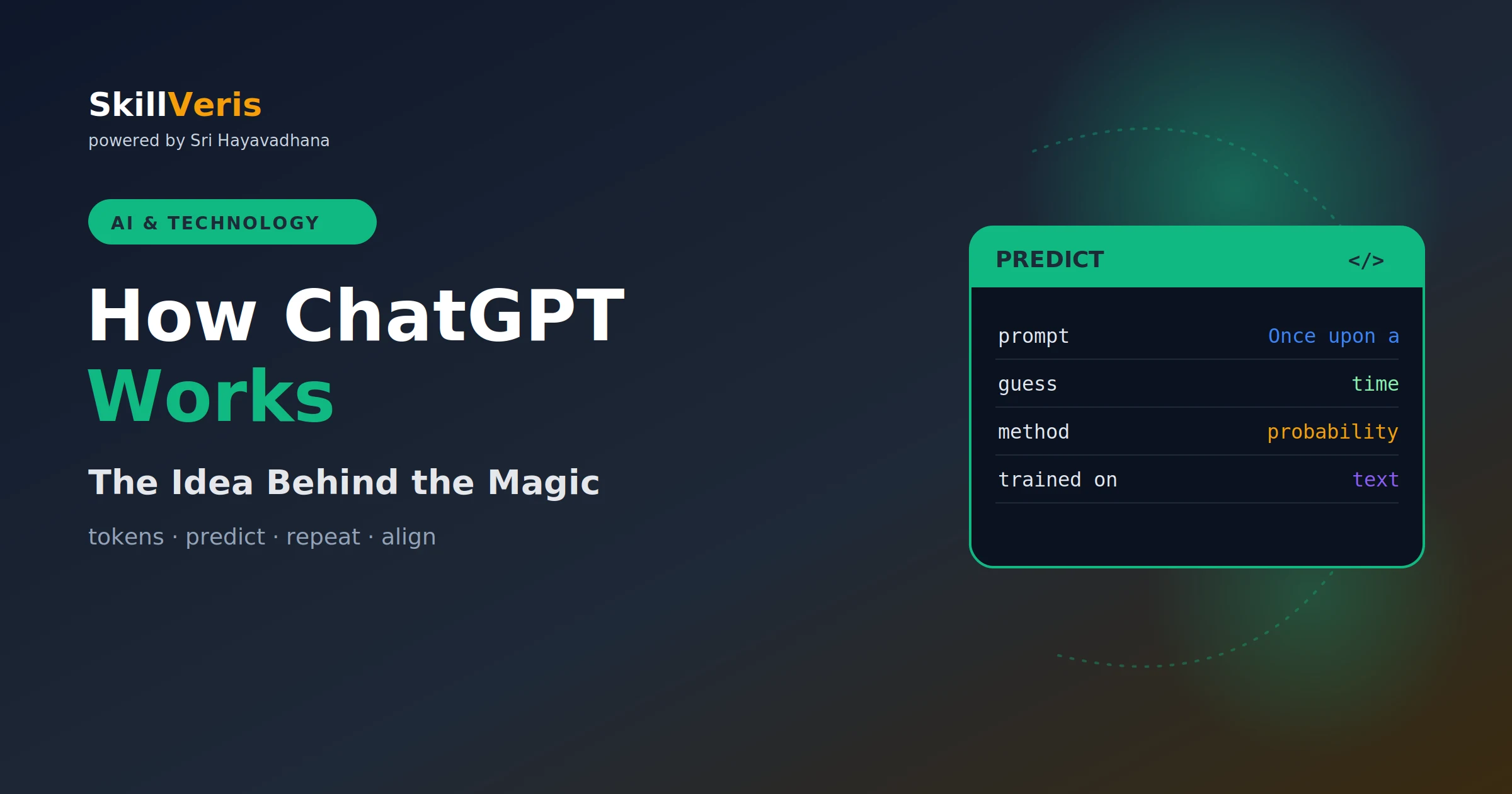
Large language models, the most visible form of generative AI today, are trained to predict the most likely next piece of text given everything that came before it, one token at a time.
Image generation models work on a related principle, learning to transform noise into a coherent image through a training process that has seen enormous numbers of example images.
5Where the Two Overlap
Many modern AI products blend generative and non-generative components in a single pipeline rather than relying purely on one approach.
Retrieval-augmented generation is a common example: a search or retrieval step (non-generative) finds relevant documents, and a generative model then writes an answer grounded in those documents, reducing the risk of the model fabricating information.
💡
6Common Misconceptions
A common misconception is treating 'AI' and 'generative AI' as synonyms, which causes confusion when discussing systems like fraud detection or recommendation engines that are AI but not generative.
Another misconception is assuming a generative model 'looks up' facts the way a search engine does; unless paired with retrieval, it is instead producing text based on patterns learned during training, which can include confident-sounding errors.
7Agentic Workflows and What Comes Next
Beyond single-turn generation, AI agents chain generative model calls together with tools, memory, and multi-step reasoning to complete tasks that require several actions in sequence.
This agentic layer sits on top of generative AI rather than replacing it — the underlying model still generates each step's text or decision, but a surrounding framework manages the overall task.
8Learning the Fundamentals
Understanding the difference between AI broadly and generative AI specifically is foundational before diving deeper into large language models, RAG, or agentic systems.
Courses covering Python for AI and ML, large language models, and retrieval-augmented generation build on exactly this distinction, moving from core concepts to applied, hands-on systems.
Related Reading
Get The Print Version
Download a PDF of this article for offline reading.
About the Publisher
SkillVeris Team
AI Research Team
Our AI team covers the latest in machine learning, generative AI, and emerging tech — clearly and accurately.
View all postsRelated Posts
Never miss an update
Get the latest tutorials and guides delivered to your inbox.
No spam. Unsubscribe anytime.