AI Terminology Explained: 30 Terms Beginners Confuse
SkillVeris Team
AI Research Team
Most AI jargon describes a handful of simple ideas dressed in intimidating words, and clear definitions dissolve the confusion quickly.
In this guide, you'll learn:
- Knowing the difference between a model, a parameter, and a token lets you read almost any AI article without getting lost.
- Terms like training, inference, and fine-tuning describe distinct stages of a model's life that people frequently mix up.
- Understanding hallucination, bias, and alignment is essential for using AI tools responsibly rather than trusting them blindly.
- Words like prompt, context window, and temperature are the practical controls you actually use when working with AI day to day.
1Why AI Terminology Feels So Confusing
AI terminology feels overwhelming mainly because the same simple ideas hide behind several fancy names, and beginners assume each word must mean something profound. In reality, most of the vocabulary describes a small set of concepts: what a model is, how it learns, how you talk to it, and how it can go wrong. Once you have plain-English definitions, the fog clears fast.
This guide defines thirty terms that trip up newcomers, grouped so related ideas sit together. Read them in order and each one builds on the last, so by the end you will be able to follow AI articles, product announcements, and conversations without reaching for a translator.
2The Core Building Blocks
Start with the words that everything else depends on. Get these five straight and the rest fall into place.
- Model: the trained system that takes an input and produces an output, such as a chatbot or image generator.
- Parameter: an internal number the model adjusts during training; billions of them together store what the model has learned.
- Token: a small chunk of text, often a word piece, that a language model reads and predicts one at a time.
- Neural network: the layered mathematical structure, loosely inspired by the brain, that most modern AI models are built from.
- Weights: essentially another word for the parameters, the learned values that determine how the network responds.
3How Models Learn: Training and Beyond
People constantly confuse the stages of a model's life. Training is when the model learns; inference is when it answers you. Fine-tuning is an extra round of training on specialized data. Keeping these separate makes news about AI far easier to parse.
- Training: the compute-heavy process of adjusting parameters by showing the model huge amounts of data.
- Inference: running the finished model to get an answer; this is what happens every time you send a prompt.
- Fine-tuning: further training a pretrained model on a narrower dataset to specialize its behavior.
- Pretraining: the initial, general training phase before any specialization.
- Dataset: the collection of examples used to train or evaluate a model, whose quality shapes everything downstream.
4Families of AI You Will Hear About
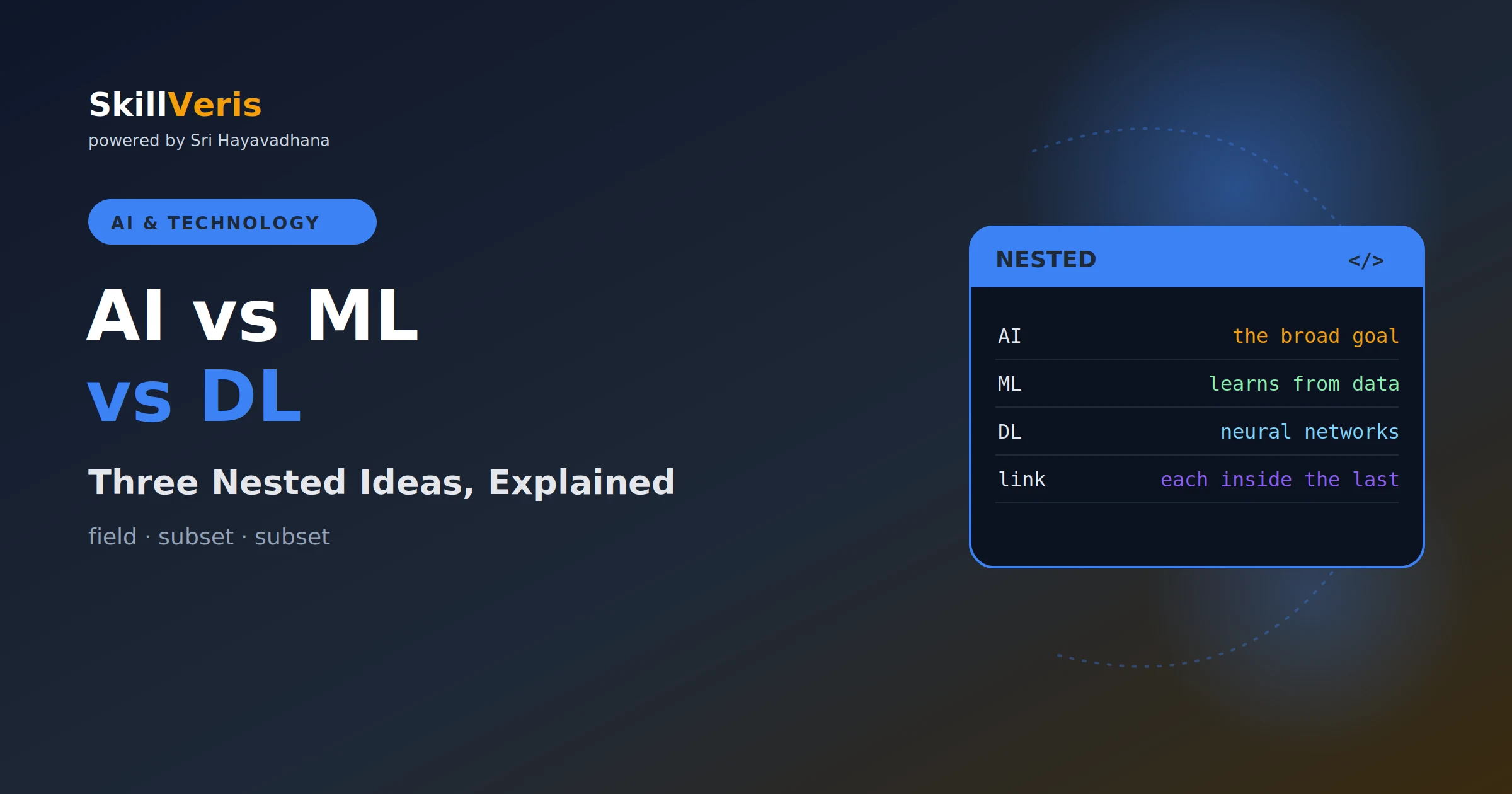
Several umbrella terms describe kinds of AI, and beginners often use them interchangeably when they should not. Machine learning is the broad field of systems that learn from data. Deep learning is a subset using many-layered neural networks. A large language model is a specific deep-learning model trained on text.
Generative AI overlaps with these but is defined by output: it creates new content rather than only classifying. And the transformer is the particular architecture underneath most modern language and multimodal models, valued for its attention mechanism that tracks context across long inputs.
- Machine learning: systems that improve at a task by learning from data instead of being explicitly programmed.
- Deep learning: machine learning using neural networks with many layers.
- Large language model (LLM): a deep-learning model trained on vast text to generate and understand language.
- Generative AI: AI defined by producing new content such as text, images, or code.
- Transformer: the architecture, based on attention, behind most current LLMs and multimodal models.
5The Words You Use Every Day
These are the practical controls and concepts you touch whenever you use an AI tool. Understanding them turns you from a passive user into someone who can steer the output deliberately.
The prompt is what you type in. The context window is how much text the model can consider at once, including your prompt and its own reply. Temperature controls randomness: low values make output focused and repeatable, high values make it varied and creative. Getting comfortable with these three gives you real control over results.
- Prompt: the input instruction or question you give the model.
- Context window: the maximum amount of text the model can attend to in one exchange.
- Temperature: a setting controlling how random or deterministic the output is.
- System prompt: hidden instructions that set the model's role and rules before your message.
- Few-shot prompting: including a few examples in your prompt to show the model the pattern you want.
6Techniques That Extend a Model
As you go deeper you will meet terms for making models more capable or grounded. These describe methods rather than the model itself, which is a distinction beginners often miss.
- Retrieval-augmented generation (RAG): fetching relevant documents and feeding them to the model so it answers from real sources.
- Embedding: a numerical representation of text or data that captures meaning, used for search and comparison.
- Agent: a system that uses a model to plan and take actions, such as calling tools or browsing.
- Multimodal: able to handle more than one type of input or output, such as images plus text.
- Reinforcement learning from human feedback (RLHF): tuning a model's behavior using human preference judgments.
7Terms for When AI Goes Wrong
This group matters most for using AI responsibly, because it names the failure modes. Hallucination is when a model states something false with confidence. Bias is systematic unfairness inherited from training data. Alignment is the effort to make a model's behavior match human intentions and values.
Understanding these is not academic. They are exactly the concepts you invoke when you decide to double-check a model's claim, question an odd recommendation, or worry about an application's fairness. Fluency here separates careful users from credulous ones.
- Hallucination: a confident but false or fabricated output.
- Bias: systematic skew in outputs reflecting imbalances in training data.
- Alignment: making a model act in accordance with human intentions and safety goals.
- Overfitting: when a model memorizes training data and fails to generalize to new inputs.
- Knowledge cutoff: the date after which a model has no built-in information about the world.
⚠️Hallucination is the term to remember
If you learn only one risk word, make it hallucination. Knowing that models can be fluently, confidently wrong is the single most important habit for using them safely.
8How to Actually Remember These
Definitions fade unless you use them, so anchor each term to a concrete moment. When a chatbot invents a fake citation, say to yourself, that is a hallucination. When you shorten a long instruction to fit, note that you are managing the context window. Attaching the word to an experience is how it sticks.
It also helps to explain the terms to someone else in your own words, since teaching exposes the gaps in your understanding. If you can define token, inference, and fine-tuning without notes, you already understand AI conversations better than most casual users.
💡Test yourself
Cover the definitions and try to explain each term aloud. The ones you stumble on are exactly the ones to review, which is far more efficient than rereading everything.
9Frequently Asked Questions
What is the difference between AI and machine learning? AI is the broad goal of making machines behave intelligently, while machine learning is a specific approach where systems learn from data. Machine learning is currently the dominant way people build AI.
What does a token mean in AI? A token is a small chunk of text, often a word or word-piece, that a language model reads and generates one at a time. Model limits and pricing are frequently measured in tokens.
What is a parameter in an AI model? A parameter is one of the many internal numbers a model adjusts during training to store what it has learned. Modern large models have billions of them working together.
What does hallucination mean in AI? Hallucination is when a model produces a confident answer that is false or made up. It happens because models generate plausible text rather than verified facts, so you should check important claims.
Do I need to memorize all these AI terms? No, but knowing the core dozen makes reading and discussing AI far easier. Focus first on model, token, training, inference, prompt, and hallucination.
Can I learn AI concepts for free? Yes, SkillVeris offers free courses, study notes, and a glossary that define these terms with examples and build them into practical skills.
10From Confused to Fluent
AI terminology is intimidating only until someone defines it plainly, and now you have thirty terms grouped so the connections are visible. The building blocks, the learning stages, the everyday controls, and the risk words together cover almost everything you will meet in an AI article or conversation. Use them, and the vocabulary becomes second nature within weeks.
To go further, pair this glossary with hands-on practice. You can explore free AI courses, study notes, and a fuller glossary on SkillVeris, where each of these terms connects to worked examples and real projects that turn definitions into genuine understanding.
Related Reading
Get The Print Version
Download a PDF of this article for offline reading.
About the Publisher
SkillVeris Team
AI Research Team
Our AI team covers the latest in machine learning, generative AI, and emerging tech — clearly and accurately.
View all postsRelated Posts
Never miss an update
Get the latest tutorials and guides delivered to your inbox.
No spam. Unsubscribe anytime.