AI Guardrails: Making LLM Apps Safe and Reliable
SkillVeris Team
AI Research Team
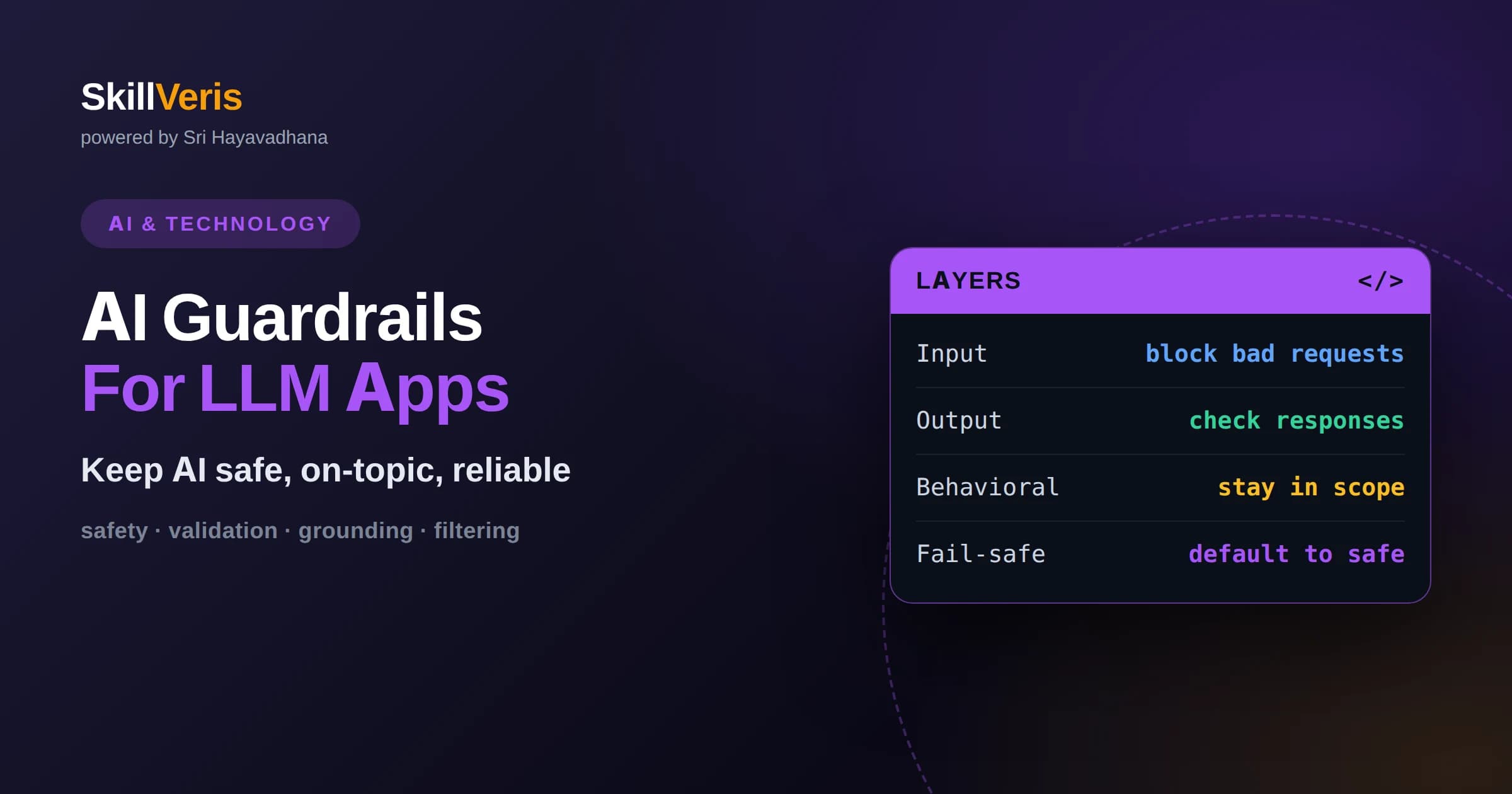
Guardrails are validation layers that sit around a language model to constrain its inputs and outputs and keep behavior safe and predictable.
In this guide, you'll learn:
- They come in input, output, and behavioral forms, from filtering harmful requests to validating structure and blocking unsafe responses.
- No single guardrail is enough; layered defenses that fail safely are what make production LLM apps trustworthy.
- Good guardrails balance safety with usefulness, avoiding both harmful outputs and an over-restricted, frustrating experience.
1What Are AI Guardrails?
AI guardrails are the checks and controls placed around a language model to keep its behavior safe, relevant, and reliable, by validating what goes into the model and what comes out. Because a language model on its own will attempt to answer almost anything and can produce incorrect or harmful text, guardrails act as the safety system that keeps an application within acceptable bounds.
Think of them the way you think of guardrails on a mountain road. They do not drive the car, but they prevent the worst outcomes when something goes wrong. In an LLM application they catch harmful requests, block unsafe responses, enforce structure, and keep the assistant focused on its intended job.
Guardrails are not a single feature but a layered practice. A production application typically combines several checks at different points, because relying on any one control creates a single point of failure.
Crucially, guardrails are external to the model itself. You do not have to retrain or modify the model to add them; you wrap logic around it, which means you can strengthen safety quickly and adapt your defenses as you learn how the application is actually used.
2Why LLM Apps Need Them
Language models are powerful precisely because they are flexible, but that flexibility is also a liability. Without constraints a model can wander off topic, reveal information it should not, follow malicious instructions hidden in user input, or generate content that is offensive, false, or unsafe.
These are not rare edge cases in the real world. Users make unusual requests, adversaries deliberately probe for weaknesses, and the model itself sometimes produces confident nonsense. An application shipped without guardrails is one surprising input away from an embarrassing or dangerous failure.
Guardrails convert an unpredictable component into a dependable one. They do not make the model perfect, but they bound its behavior so that failures are caught and handled gracefully rather than reaching the user.
The stakes rise with reach. An internal tool used by a few colleagues can tolerate rough edges, but a public application exposed to unpredictable and sometimes adversarial users needs guardrails from day one, because someone will eventually test its limits.
3Input Guardrails
Input guardrails inspect what the user sends before it reaches the model. They can detect and block harmful or abusive requests, strip out attempts to manipulate the system, and confirm that a request falls within the application's intended scope.
A common threat they defend against is prompt injection, where a user embeds instructions designed to override the application's rules. Input checks can flag suspicious patterns and refuse to pass along content that tries to hijack the model's behavior.
Input guardrails also improve reliability by validating that a request has the information the model needs. Catching a malformed or off-topic query early is cheaper and safer than letting the model improvise an answer to a question it should not handle.
Handling problems at the input stage is also efficient. Rejecting a bad request before it reaches the model saves the cost of generating a response you would have thrown away, so input checks improve both safety and economy at once.
4Output Guardrails
Output guardrails examine the model's response before it reaches the user. They can block unsafe or policy-violating content, redact sensitive information that slipped through, and reject answers that fail to meet quality or accuracy checks.
A particularly useful category is structural validation. When your application expects the model to return data in a specific format, an output guardrail verifies the structure and can request a correction if it is malformed, preventing downstream code from breaking on unexpected output.
Output checks are your last line of defense, so they matter even when input checks are strong. A model can produce an unsafe response to a perfectly innocent question, and only an output guardrail will catch it before it is shown.
Because output checks are the final gate, they deserve special care and thorough testing. It is the one place where a mistake is directly visible to the user, so investing in reliable output validation yields an outsized return in trust.
5Behavioral And Topical Guardrails
Behavioral guardrails keep the assistant acting within its defined role and scope. A customer support assistant should discuss the product and politely decline unrelated requests, and topical guardrails enforce exactly that boundary.
These controls protect both users and the business. They prevent the assistant from being used for purposes it was not designed for, reduce the risk of embarrassing off-brand responses, and keep conversations productive and on task.
Scoping also improves quality. An assistant that stays in its lane can be tuned and tested for that lane, whereas one that tries to answer everything is harder to make reliable at anything.
Setting a clear scope early also simplifies every later decision. When you know exactly what the assistant is and is not meant to do, writing its instructions, choosing its guardrails, and testing its behavior all become more straightforward.
6Grounding And Factual Reliability
One of the biggest reliability challenges is that models can state false information convincingly. Grounding guardrails address this by tying responses to trusted sources, so the model answers from provided documents rather than from memory alone.
A grounding check can verify that a response is actually supported by the retrieved source material and flag or block answers that stray beyond it. This dramatically reduces confident fabrication in applications where accuracy matters, such as support, legal, or medical contexts.
Grounding is not a guarantee of truth, but it shifts the model from open-ended guessing toward answering from evidence, which is far more trustworthy and easier to audit.
Grounding also makes an application auditable. When every answer traces back to a specific source, you can show why the system said what it said, which is invaluable for building confidence and for diagnosing problems when something does go wrong.
7Protecting Sensitive Information
Applications often handle personal or confidential data, and guardrails help keep it protected. Input filters can detect and mask sensitive details before they are sent to the model, and output filters can catch cases where private information appears in a response.
This matters both for user privacy and for regulatory compliance. Leaking personal data, even accidentally, can cause real harm and legal consequences, so treating sensitive information as something to detect and control is a baseline responsibility.
Redaction and masking let you keep the useful parts of a request while removing the risky parts, so the application remains helpful without exposing data it does not need to reveal.
Treating sensitive data as a first-class concern from the start is far easier than retrofitting protection later. Building detection and redaction into the request flow early means privacy is a property of the system rather than a patch applied after an incident.
8Layered, Fail-Safe Design
The guiding principle of good guardrails is defense in depth. No single check catches everything, so combining input, output, and behavioral controls means a failure in one layer is likely caught by another. Redundancy is a feature, not waste.
Equally important is failing safely. When a guardrail is uncertain or a check fails, the application should default to a safe response, such as a polite refusal or a fallback message, rather than passing questionable content through. A safe default beats a risky guess.
Designing for failure also means logging and monitoring. When a guardrail blocks something, recording it lets you understand real-world misuse and improve your defenses over time.
9How Guardrails Are Implemented
Guardrails are implemented with a mix of techniques. Simple rules and pattern matching catch obvious cases cheaply, classifiers trained to detect specific categories handle fuzzier judgments, and sometimes a separate model call evaluates whether a response meets your policy.
Many teams use a combination, applying fast cheap checks first and reserving more expensive model-based evaluation for the cases that need it. This keeps latency and cost reasonable while still catching subtle problems.
There are also open frameworks and libraries that provide ready-made guardrail components, so you do not have to build every check from scratch. Understanding the categories helps you choose and configure them for your specific risks.
Whatever mix you choose, keep each guardrail simple and testable on its own. A collection of small, well-understood checks is easier to reason about and to debug than one sprawling rule that tries to catch everything at once.
10Balancing Safety And Usefulness
Guardrails involve a genuine tradeoff. Too few, and the application is unsafe and unreliable; too many or too strict, and it becomes frustrating, refusing reasonable requests and annoying legitimate users. The art is in calibration.
Overly aggressive filtering is a common failure mode. An assistant that refuses harmless questions because they superficially resemble forbidden ones erodes trust just as surely as one that says something harmful. Tuning against real usage data is how you find the balance.
The right level of restriction depends on the stakes. A public-facing tool touching sensitive topics warrants tighter controls than an internal utility, so match your guardrails to the actual risk profile of the application.
The calibration is never finished. As you gather real usage, you will find both harmful outputs that slipped through and reasonable requests that were wrongly blocked, and steadily adjusting against those real examples is how you converge on the right balance.
11Testing And Monitoring Guardrails
Guardrails must be tested like any other critical system. Adversarial testing, where you deliberately try to break your own defenses with tricky and malicious inputs, reveals gaps before real users or attackers find them.
Because model behavior and user creativity evolve, guardrails need ongoing monitoring rather than one-time setup. Watching what gets blocked, what slips through, and where users get frustrated tells you where to tighten or loosen controls.
Treat your guardrail suite as a living part of the product. The threats and the model both change, and defenses that are never revisited slowly fall behind.
Make adversarial testing a routine, not a one-off. Scheduling regular attempts to break your own defenses, ideally with fresh eyes, keeps your guardrails honest as both the model and your users evolve.
12The Cost Of Guardrails
Guardrails are not free. Every check adds some processing time and, when it involves an extra model call, some expense. In an application where responsiveness matters, stacking many heavy checks can noticeably slow the experience.
The practical answer is to order checks by cost. Fast, cheap rules run first and reject obvious problems, so that expensive evaluation only runs on the smaller set of cases that reach it. This keeps most requests fast while still catching hard cases.
Budgeting for guardrails as part of the application's performance, rather than treating them as an afterthought, ensures safety and speed can coexist rather than fighting each other.
13Keeping Humans In The Loop
Automated guardrails handle scale, but for high-stakes decisions a human reviewer remains the strongest safeguard. Routing uncertain or sensitive cases to a person, rather than forcing the system to decide alone, prevents the worst automated failures.
This does not mean reviewing everything, which would defeat the purpose of automation. It means designing the system to recognize when it is unsure and to escalate those specific cases while handling the routine majority automatically.
Human oversight also feeds improvement. The cases people review reveal where the automated guardrails fall short, providing exactly the examples you need to make the system better over time.
14Get Hands-On With SkillVeris
The best way to understand guardrails is to build a small LLM application and then try to break it, adding checks as you discover failure modes. That cycle of attack and defense builds real intuition for what matters.
SkillVeris provides guided, hands-on lessons on building safe and reliable LLM applications, walking you through input and output validation, grounding, and fail-safe design with practical exercises. Learning to think like both a builder and an adversary is what makes your applications genuinely trustworthy.
Start by adding one guardrail at a time and testing it against realistic misuse. Layer by layer, you will turn a fragile prototype into an application you can confidently put in front of users.
Related Reading
Get The Print Version
Download a PDF of this article for offline reading.
About the Publisher
SkillVeris Team
AI Research Team
Our AI team covers the latest in machine learning, generative AI, and emerging tech — clearly and accurately.
View all postsRelated Posts
Never miss an update
Get the latest tutorials and guides delivered to your inbox.
No spam. Unsubscribe anytime.