How AI Agentic Workflows Work in 2026
SkillVeris Team
AI Research Team
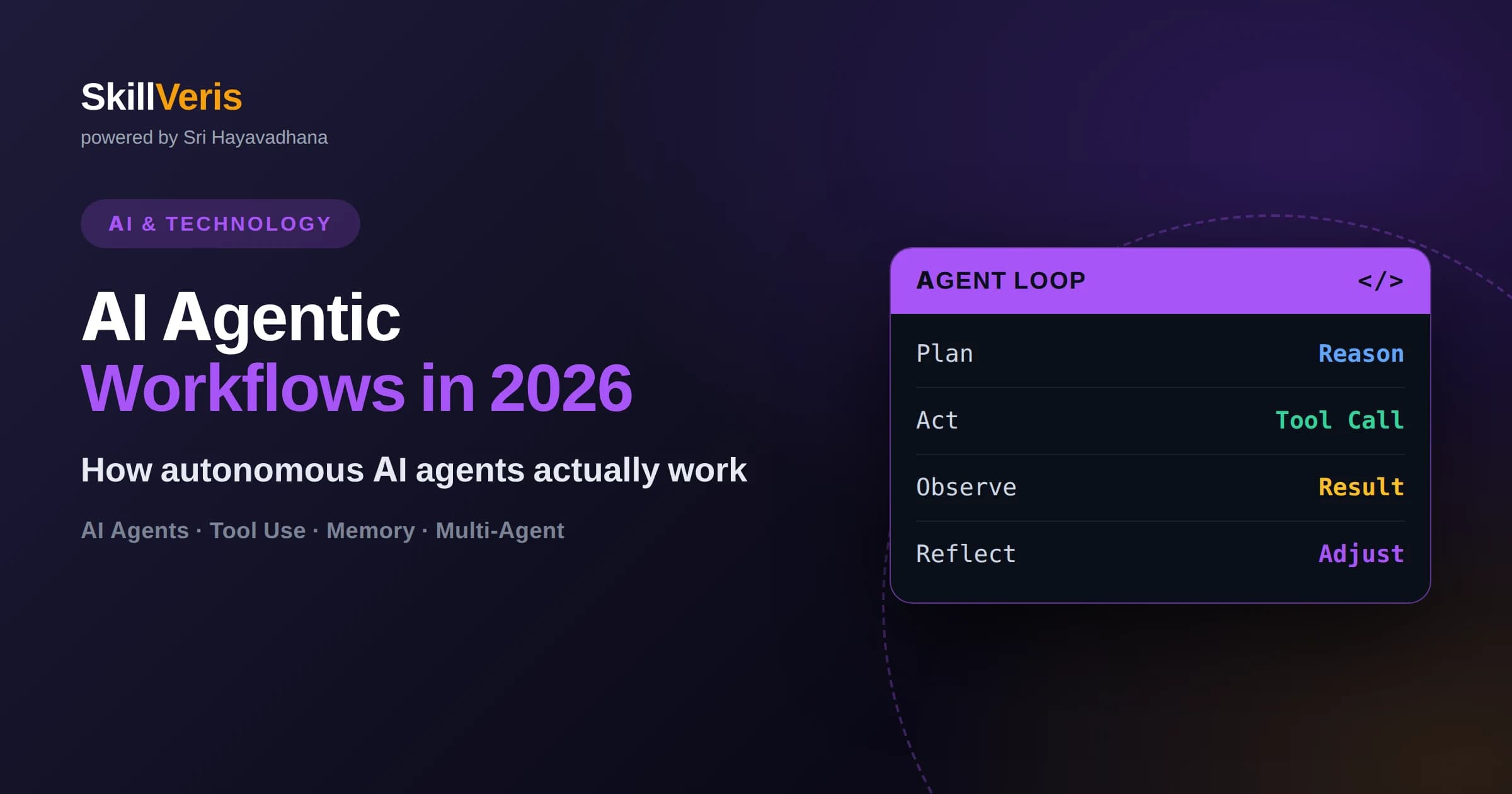
An agentic workflow is a loop of planning, acting, observing, and reflecting, not a single prompt-response exchange.
In this guide, you'll learn:
- The defining trait of an agent versus a chatbot is the ability to take actions in the world, not just generate text.
- Tool use, also called function calling, lets an agent query APIs, run code, or search the web mid-task.
- Memory systems give agents continuity across steps and sessions, ranging from short-term scratchpads to long-term vector stores.
- Multi-agent orchestration splits complex work across specialized agents coordinated by a planner or supervisor.
1How Do AI Agentic Workflows Actually Work in 2026?
AI agentic workflows work by chaining an AI model's reasoning together with real actions in a repeating loop: the system plans a step, executes it using a tool, observes the result, and decides what to do next until the overall goal is met.
This is a fundamentally different shape from the request-and-response pattern most people associate with AI chatbots. A chatbot receives a prompt and returns text. An agentic system receives a goal — 'reconcile this spreadsheet against last month's invoices' or 'triage these support tickets and draft replies' — and then autonomously breaks that goal into steps, calls whatever tools it needs (a database query, a web search, a code interpreter), checks whether each step actually worked, and adjusts course when it didn't.
By 2026, agentic AI has moved from research demos into production systems handling customer support triage, code review, data pipeline monitoring, and research synthesis. The underlying mechanics are consistent across nearly all of them, and understanding that mechanic — not memorizing any single vendor's framework — is what actually transfers as tools change.
2What Makes an AI System 'Agentic' Instead of Just a Chatbot?
An AI system is agentic when it can take autonomous, multi-step actions toward a goal without a human specifying each step, rather than only producing a single text response to a single prompt.
A standard chatbot is stateless in the sense that matters here: you ask a question, it generates an answer, and the interaction is complete. It has no ability to check whether its answer was correct, no ability to go do something in response, and no persistent objective it is working toward across multiple turns unless a human keeps steering it.
An agent, by contrast, is given latitude. You might tell it 'find the three cheapest reliable suppliers for this part and draft a comparison,' and it decides how many searches to run, which sources to trust, when it has enough information, and how to structure the output — checking its own work along the way. The autonomy is the point: the human specifies the destination, not the turn-by-turn directions.
- Chatbot: one prompt in, one response out, no self-checking
- Agent: a goal in, a sequence of self-directed steps out, with built-in verification
- Chatbot: cannot use external tools mid-conversation by default
- Agent: calls tools, reads the results, and changes its plan based on them
- Chatbot: forgets everything not in the current context window
- Agent: often maintains structured memory across an entire task or session
3What Is the Core Agent Loop: Plan, Act, Observe, Reflect?
The core agent loop is a four-stage cycle — plan, act, observe, reflect — that an autonomous AI agent runs repeatedly until it judges the task complete or hits a stopping condition.
In the plan stage, the model reasons about the current state of the task and decides on the next concrete step, rather than trying to solve the entire problem in one leap. This is usually where you see the model 'thinking out loud' about what it knows, what it still needs, and which action makes sense next.
The act stage is where the agent actually does something: calling a tool, running a piece of code, querying a database, or sending a message. This is the step that separates agentic systems from pure text generators — the model's output isn't the final product, it's an instruction to go do something.
Observe means the agent reads back whatever the action produced: a search result, an error message, a row of data, a status code. Reflect is the often-skipped but critical stage — the agent evaluates whether that observation actually advances the goal, updates its internal plan, and either loops back to plan the next step or concludes the task is done. Systems that skip reflection tend to charge ahead on bad information and compound small errors into large ones.
4How Do AI Agents Use Tools and Function Calling?
AI agents use tools through function calling: the underlying language model is given a list of available functions with descriptions and expected parameters, and it outputs a structured request to invoke one, which the surrounding system executes and feeds back as a result.
Crucially, the model itself never touches a database, browser, or filesystem directly. It only ever produces text — but that text can be a precisely formatted instruction like 'call search_web with query X' or 'call run_sql with this statement.' A runtime layer parses that instruction, executes the real action outside the model, and returns the output as a new piece of context the model can read.
This is what lets an agent search the live web, execute code, look up account records, or send an email as part of completing a task, rather than being limited to whatever it memorized during training. Tool descriptions matter enormously here: an agent can only use a tool well if its name, parameters, and constraints are described clearly, which is why well-designed agentic systems spend real engineering effort on tool interfaces, not just on the prompting.
- Tools are typically defined with a name, a description, and a parameter schema
- The model chooses which tool to call and with what arguments, based on the current plan step
- A runtime executes the actual call and returns the result as new context
- Good tool design constrains what an agent can do, which is also a safety mechanism
5Why Do Agentic AI Systems Need Memory and State?
Agentic AI systems need memory and state because a multi-step task can span far more information than fits in a single prompt, and without it an agent would forget its own earlier decisions between steps.
Short-term memory is usually just the running transcript of the current task: the goal, the steps taken so far, and the results observed. This is enough for tasks that finish in a handful of steps. Longer or more complex workflows need something more durable — a structured scratchpad the agent writes intermediate conclusions to, or a summary that gets refreshed as the transcript grows too long to keep in full.
Long-term memory goes further, persisting information across separate sessions entirely. This is commonly implemented with a vector database that stores embeddings of past interactions, documents, or facts, letting an agent retrieve relevant history even when it wasn't part of the immediate conversation. A customer-support agent, for instance, might recall a user's prior tickets weeks later, not because they're in the current context window but because they were retrieved from a memory store based on relevance.
6How Does Multi-Agent Orchestration Work?
Multi-agent orchestration works by splitting a complex task across several specialized agents, each handling a narrower piece of the problem, coordinated by a planner or supervisor agent that assigns work and merges results.
Rather than asking one agent to research, write, fact-check, and format a report end to end, an orchestrated system might use a planner agent to break the task into subtasks, a researcher agent to gather information, a writer agent to draft content, and a critic agent to review it before final output. Each sub-agent can have its own tools, its own prompt, and even its own model, tuned specifically for its slice of the work.
This pattern trades some overhead — more coordination, more places for errors to occur — for better reliability on complex tasks, because each agent's job is narrow enough to reason about well. Common orchestration shapes include a central supervisor that delegates and checks in on workers, a pipeline where output flows linearly from one agent to the next, and a debate or critique pattern where two agents review each other's work before it's finalized.
7What Are the Real-World Use Cases and Current Limitations of Agentic AI?
Agentic AI is currently used for coding assistance, customer support triage, data analysis, research synthesis, and IT operations monitoring — tasks with clear success criteria and tool access, but it still struggles with long-horizon reliability and unpredictable costs.
On the use-case side, coding agents that read a codebase, write a patch, run tests, and iterate are among the most mature deployments, because 'did the tests pass' is an unambiguous success signal. Support agents that triage tickets, pull account data, and draft responses for human approval are common in production. Research and analysis agents that gather sources, cross-check facts, and produce structured summaries are widely used for internal knowledge work.
The limitations are just as real. Agents can drift off-task over long sequences of steps, accumulating small misinterpretations into a badly wrong final answer — a failure mode often called compounding error. Tool failures, rate limits, and ambiguous instructions can cause an agent to loop unproductively or take unintended actions if guardrails are weak. Because each step may involve a model call, costs and latency scale with the number of steps a task takes, which makes tightly-scoped agents far more practical than open-ended ones. Most production deployments today still keep a human in the loop for consequential actions, treating full autonomy as a target rather than a default.
SkillVeris offers a free, hands-on AI Agents & Agentic Workflows course that walks through building these systems step by step, from a single tool-calling agent to a coordinated multi-agent pipeline.
8Frequently Asked Questions
Q: What is an AI agentic workflow, in one sentence? A: It's a repeating cycle where an AI system plans a step, takes an action using a tool, observes the outcome, and decides what to do next, continuing until a goal is met.
Q: Is agentic AI the same thing as AGI? A: No. Agentic AI refers to a workflow pattern — planning, tool use, and iteration — built on today's language models; it does not imply general intelligence or human-level reasoning across all domains.
Q: Do AI agents need a specific model to work? A: No single model is required; agentic behavior comes from the surrounding loop, tool integrations, and memory system, and can be built with various underlying language models depending on the task.
Q: What's the difference between an AI agent and a script with an API call? A: A script follows a fixed sequence of steps written in advance; an agent decides its own sequence of steps at runtime based on what it observes, which lets it handle situations the original author didn't explicitly anticipate.
Q: How do agents know when a task is finished? A: Through the reflect stage of the loop, where the agent evaluates its latest observation against the original goal and either continues, retries, or concludes the task meets a defined stopping condition.
Q: What's the biggest practical risk with autonomous agents today? A: Compounding errors over long task sequences and taking real-world actions on faulty assumptions, which is why most production systems keep human approval on consequential steps.
Related Reading
Get The Print Version
Download a PDF of this article for offline reading.
About the Publisher
SkillVeris Team
AI Research Team
Our AI team covers the latest in machine learning, generative AI, and emerging tech — clearly and accurately.
View all postsRelated Posts
Never miss an update
Get the latest tutorials and guides delivered to your inbox.
No spam. Unsubscribe anytime.