Zero Trust Security Explained
SkillVeris Team
Cloud & Security Team
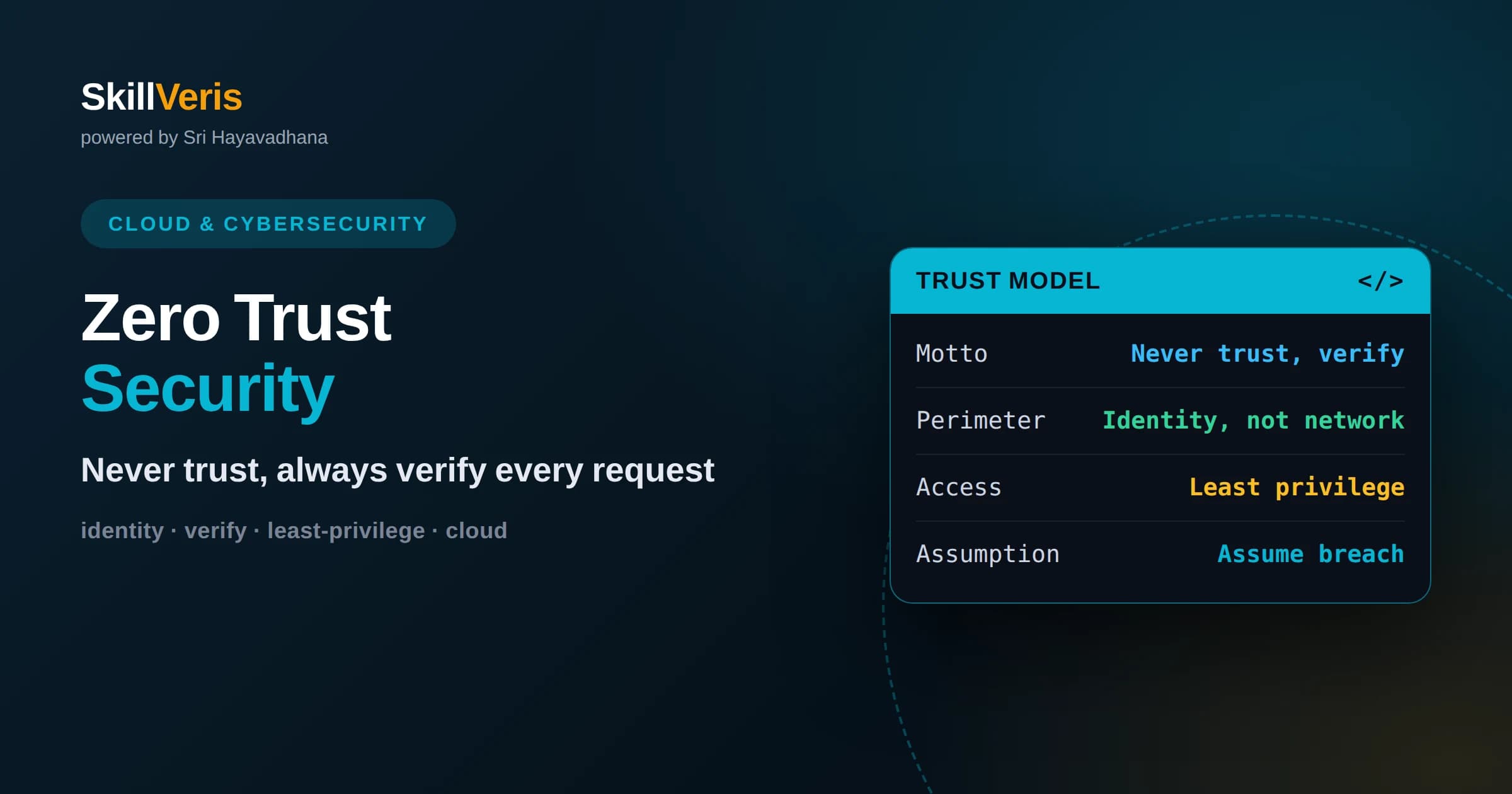
Zero Trust assumes no user, device, or network is trustworthy by default and verifies every request explicitly.
In this guide, you'll learn:
- It replaces the outdated castle-and-moat perimeter model that trusted anything already inside the network.
- Core pillars include strong identity, device health checks, least-privilege access, and continuous monitoring.
- You can adopt Zero Trust incrementally by starting with identity and one critical application rather than a full rebuild.
1What Zero Trust Security Actually Means
Zero Trust is a security model built on one simple rule: never trust, always verify. Instead of assuming that anything inside your corporate network is safe, Zero Trust treats every user, device, and connection as potentially hostile until it proves otherwise, checking identity and context on every single request.
This is a sharp departure from how security worked for decades. The old approach trusted location: if you were inside the office network, you were assumed to be a legitimate employee. Zero Trust discards that assumption entirely. Being on the network grants you nothing. Access is earned request by request through verification.
The phrase itself can sound extreme, but the intent is practical. Attackers who steal a password or compromise a laptop should not automatically gain the run of your systems. By verifying continuously and granting the minimum access required, Zero Trust shrinks the damage any single breach can cause.
It also reframes what security is protecting. The old goal was to keep bad actors off the network. The Zero Trust goal is to protect resources directly, wherever they live and whoever is reaching for them. That shift in focus is what makes the model work across offices, homes, and clouds alike.
2Why The Old Perimeter Model Failed
Traditional security followed a castle-and-moat design. A strong firewall formed the moat around the network, and anyone who crossed it was treated as trusted. This worked reasonably well when employees sat in offices and applications ran in company data centers.
The modern world broke that model. Employees now work from home, coffee shops, and airports. Applications live in public clouds run by third parties. Data flows to phones, tablets, and contractor laptops. There is no longer a clean boundary between inside and outside, so a moat around nothing protects nothing.
Worse, the perimeter model gave attackers a devastating advantage. Once they slipped past the firewall through a phishing email or a stolen credential, they could move sideways across the network almost unchecked. Zero Trust exists precisely to remove that free movement.
3The Core Principles Of Zero Trust
Zero Trust rests on three foundational ideas. First, verify explicitly: authenticate and authorize every request using all available signals, including user identity, device health, location, and the sensitivity of what is being accessed. Nothing is waved through on trust alone.
Second, use least-privilege access. Give each user and service only the permissions they need to do their job, and only for as long as they need them. This limits how far an attacker can reach if they compromise an account.
Third, assume breach. Design your systems as if an attacker is already inside. Segment networks, encrypt data, and monitor everything so that a single compromised device cannot cascade into a full breach. These three principles guide every Zero Trust decision.
These principles reinforce one another. Explicit verification limits who gets in, least privilege limits what they can touch, and assuming breach ensures you are watching and contained even when the first two fail. No single control has to be perfect because the others catch what it misses.
4Identity As The New Foundation
In a Zero Trust world, identity becomes the primary control point. Because you can no longer trust the network, you must trust a verified identity instead. This is why strong authentication sits at the heart of every Zero Trust program.
Multi-factor authentication is the practical starting point. Requiring a second factor beyond a password, such as an authenticator app or a hardware key, dramatically reduces the value of stolen credentials. Even if an attacker knows the password, they cannot pass the second check.
Centralizing identity through a single provider also simplifies control. When every application authenticates through one trusted source, you can enforce consistent policies, revoke access instantly when someone leaves, and see a complete picture of who is accessing what. Scattered logins across dozens of systems make that impossible.
Beyond login, modern identity systems evaluate context on an ongoing basis. If a user suddenly signs in from an unusual country or an unrecognized device, the system can demand extra verification or block access. Identity is not a one-time gate; it is a continuous conversation.
5Device Trust And Health Checks
Verifying the user is only half the picture. Zero Trust also asks whether the device making the request is trustworthy. A valid employee logging in from a malware-infected laptop is still a serious risk.
Device trust means checking that a machine meets your security standards before granting access. Is the operating system up to date? Is disk encryption enabled? Is endpoint protection running? Devices that fail these checks can be denied access or given limited, quarantined access until they are fixed.
This creates a healthy feedback loop. Users are motivated to keep their devices patched and compliant because non-compliant devices lose access to the tools they need. Security becomes something enforced automatically rather than something people have to remember.
6Least Privilege And Microsegmentation
Least privilege is the discipline of granting the smallest set of permissions necessary. A support agent does not need access to source code. A developer does not need access to payroll. When access is tightly scoped, a compromised account can only touch a small corner of your systems.
Microsegmentation extends this idea to the network itself. Rather than one large flat network where every machine can talk to every other machine, you divide the environment into small isolated zones with strict rules about what may communicate. If an attacker lands in one segment, they hit a wall trying to reach the next.
Together these techniques attack the lateral movement problem directly. Modern breaches rarely stop at the first compromised machine; attackers pivot from system to system looking for valuable data. Least privilege and microsegmentation make each pivot difficult and noisy.
7Continuous Verification And Monitoring
Zero Trust is not a one-time login decision. Trust is re-evaluated continuously as conditions change. A session that was safe a moment ago can become suspicious if the device posture degrades or the behavior looks anomalous.
This requires strong visibility. Logs, telemetry, and analytics feed a picture of normal behavior so that unusual activity stands out. When something looks wrong, the system can step up authentication, restrict access, or terminate the session automatically.
The goal is to catch problems in progress rather than in a post-mortem weeks later. Continuous monitoring turns security from a locked door into an alert, adaptive system that responds as threats unfold.
This adaptive quality is what makes Zero Trust resilient. Static defenses eventually fail against a determined attacker, but a system that keeps re-checking trust as context shifts can revoke access the moment something looks wrong, cutting an intrusion short before it becomes a full breach.
8Zero Trust In Cloud And Remote Work
Zero Trust fits the cloud era naturally because the cloud has no traditional perimeter to defend. Your applications run on infrastructure you do not own, accessed by people you cannot see. Verifying every request is not just a good idea here; it is the only workable model.
For remote work, Zero Trust often replaces or supplements the traditional VPN. Rather than dropping a remote worker onto the whole corporate network, a Zero Trust access broker connects them directly to only the specific applications they are authorized to use, verifying identity and device each time.
This application-level access is both more secure and often faster for users. There is no broad network tunnel to exploit, and each connection is scoped and monitored. It is a better experience wrapped around stronger security.
Cloud providers reinforce this model with fine-grained identity and access management built in. You can specify precisely which service may talk to which resource and under what conditions, expressing least privilege directly in configuration. Zero Trust and cloud infrastructure grew up together, which is why they fit so naturally.
9Common Misconceptions About Zero Trust
The biggest myth is that Zero Trust is a single product you can buy. It is an architecture and a philosophy, implemented through many tools working together: identity providers, device management, access brokers, and monitoring platforms. No vendor sells Zero Trust in a box.
Another misconception is that Zero Trust means distrusting your employees. It does not. It means removing implicit trust from the system so that honest mistakes and stolen credentials cause less harm. Good Zero Trust is usually invisible to well-behaved users.
Finally, some believe Zero Trust is only for large enterprises. In reality, small teams often benefit the most because they lack the layered defenses of big organizations. Cloud-based identity and access tools make Zero Trust accessible at any scale.
A related myth is that Zero Trust is a destination you reach and finish. It is really an ongoing posture. Threats change, your systems change, and your controls must adapt with them. Treating Zero Trust as continuous improvement rather than a one-time project is what keeps it effective over the long run.
10How To Start Adopting Zero Trust
You do not need to rebuild everything at once. The most successful Zero Trust journeys start small and expand. Begin with identity, because it is the foundation everything else depends on. Roll out multi-factor authentication and consolidate logins through a single identity provider.
Next, pick one important application and put strong access controls in front of it. Require verified identity and healthy devices to reach it. Learn from that first project, then apply the same pattern to the next application and the next.
Throughout, invest in visibility. You cannot protect what you cannot see, so logging and monitoring should grow alongside your controls. Incremental, measured progress beats a risky all-at-once overhaul every time.
11Challenges And Trade-Offs To Expect
Zero Trust is powerful but not free. Adding verification steps can introduce friction if it is done clumsily. The art is applying strong checks where risk is high while keeping everyday access smooth, so security does not train users to seek workarounds.
Legacy systems present a real hurdle. Old applications that assume a trusted network may not support modern identity protocols. Bridging them into a Zero Trust model can require additional tooling or gradual replacement.
There is also an organizational dimension. Zero Trust touches identity, devices, networks, and applications, which means teams that once worked separately must coordinate. Success depends as much on shared ownership as on technology.
12The Future Of Zero Trust
Zero Trust has moved from a niche idea to a mainstream expectation, and it continues to deepen. Access decisions are becoming more automated and context-aware, weighing dozens of signals in real time to decide how much to trust a given request.
As artificial intelligence handles more security analysis, systems will detect subtle anomalies faster and respond with less human effort. The direction is toward security that continuously adapts rather than relying on static rules.
For anyone building a career in cloud or cybersecurity, understanding Zero Trust is now essential. It is the organizing principle behind how modern organizations think about protecting data in a borderless world.
13Put Zero Trust Into Practice
The fastest way to understand Zero Trust is to build with it. Set up multi-factor authentication on your own accounts, experiment with an identity provider, and try scoping access to a single application. Concepts click when you configure them yourself.
On SkillVeris you can work through hands-on cloud and cybersecurity courses that turn these ideas into practical skills, from identity management to secure access design. Start experimenting, make mistakes in a safe environment, and build the instincts that employers value.
Related Reading
Get The Print Version
Download a PDF of this article for offline reading.
About the Publisher
SkillVeris Team
Cloud & Security Team
Our cloud and security experts break down complex infrastructure topics into practical, beginner-friendly guides.
View all postsRelated Posts
Never miss an update
Get the latest tutorials and guides delivered to your inbox.
No spam. Unsubscribe anytime.