What Is Test-Driven Development (TDD)?
SkillVeris Team
Engineering Team
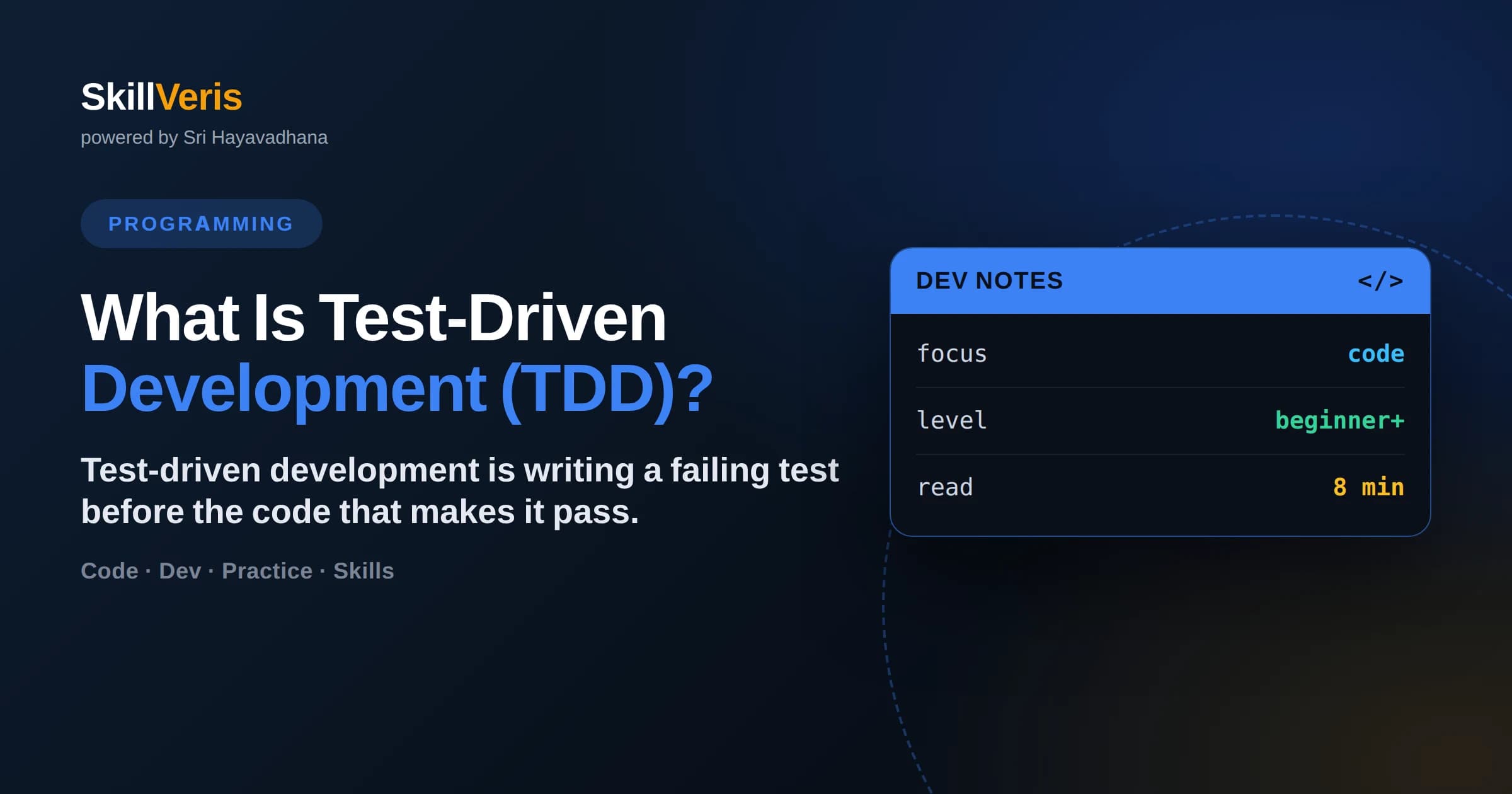
Test-driven development (TDD) is a practice where you write a failing test first, then write just enough code to make it pass, then refactor.
In this guide, you'll learn:
- The cycle is red-green-refactor: red for the failing test, green for passing code, refactor to clean it up safely.
- Writing the test first forces you to define the expected behavior before implementing it, clarifying the design.
- The tests you accumulate form a safety net that lets you change code with confidence that nothing broke.
- TDD encourages small, testable units and tends to produce simpler, better-structured code.
1What Is Test-Driven Development?
Test-driven development, or TDD, is a way of writing software where you write a test before you write the code that makes it pass. You first describe the behavior you want as a small automated test, watch it fail, then write just enough code to make it pass, and finally clean up the result. The tests come first and drive the design — hence the name.
This reverses the usual order, and that reversal is the whole point. By defining what 'correct' means before implementing, you clarify the requirement, avoid writing code you do not need, and build up a suite of tests that guards against future mistakes. TDD is a discipline more than a tool, and it applies in any language with a testing framework.
2The Red-Green-Refactor Cycle
TDD runs in a tight three-step loop repeated for each small piece of behavior. Each pass through the loop takes minutes, not hours, keeping progress steady and feedback constant.
- Red: write a small test for behavior that does not exist yet, and run it — it fails.
- Green: write the simplest code that makes the test pass, even if it is ugly.
- Refactor: improve the code's structure now that a passing test protects it.
- Repeat: pick the next small behavior and go around again.
🔑Why Start With a Failing Test
A test that fails first proves the test actually checks something. A test written after the code might pass for the wrong reason and give false confidence.
3A Concrete Walkthrough
Suppose you need a function that adds two numbers. In TDD you write the test before the function exists, so the test names the behavior you expect and fails because there is nothing to call yet.
Red, Then Green
Write the assertion first, run it to see it fail (red), then write the minimal function to satisfy it (green). Only once it passes do you add more cases or clean up. This keeps each step tiny and verifiable.
def test_add(): assert add(2, 3) == 5  # write this first — it fails, no add() yet
def add(a, b): return a + b  # simplest code to go green
# then add edge cases: negatives, zero, floats — one test at a time4Why Teams Use TDD
TDD's benefits go beyond catching bugs. Because tests are written first, they shape the code toward being modular and testable, and they double as living documentation of what the code should do.
- Confidence to change: a green suite tells you a refactor broke nothing.
- Better design: hard-to-test code is a signal of tight coupling to fix early.
- Living documentation: tests show exactly how each unit is meant to behave.
- Fewer bugs reach production: behavior is verified before you move on.
- Focused scope: you write only the code a test requires, avoiding gold-plating.
5What TDD Is Not
TDD is often misunderstood, so it helps to clear up what it does not mean. It is not about achieving a coverage percentage, and it does not replace all other kinds of testing.
- Not a coverage target — TDD is a design practice, not a metric chase.
- Not a replacement for integration or end-to-end tests, which check the whole system.
- Not writing every test up front — you write one small test at a time.
- Not slower overall — time lost writing tests is regained in debugging avoided.
💡Test Behavior, Not Implementation
Assert on what a function returns or does, not on its internal steps. Tests tied to implementation break every time you refactor, defeating the safety net TDD is meant to provide.
6How to Start With TDD
The easiest way to begin is on small, pure functions — code with clear inputs and outputs and no side effects. These are simple to test, so the cycle feels natural before you tackle harder cases like database or network code.
- Pick a testing framework: pytest for Python, Jest for JavaScript, JUnit for Java.
- Start with a pure function — a calculator or a string formatter.
- Write one failing test, make it pass, refactor, repeat.
- Keep tests fast so you run them constantly.
- For code with dependencies, learn mocking to isolate the unit under test.
7Common Mistakes to Avoid
TDD has a learning curve, and newcomers tend to stumble on the same points.
- Writing the code first, then backfilling tests — that is not TDD and misses the design benefit.
- Testing too much at once — keep each test focused on a single behavior.
- Skipping the refactor step, so the codebase slowly rots despite passing tests.
- Testing private implementation details instead of observable behavior.
- Writing brittle tests that break on any change, discouraging refactoring.
- Giving up on the first hard-to-test function instead of learning mocks.
8Key Takeaways
TDD rewards a little discipline with lasting confidence.
- TDD means writing a failing test before the code that makes it pass.
- The cycle is red (failing test), green (passing code), refactor (clean up).
- Writing tests first clarifies requirements and improves design.
- The accumulated tests form a safety net for fearless refactoring.
- Start on small pure functions before applying TDD to complex systems.
9Frequently Asked Questions
Q: Does TDD slow down development? A: It feels slower at first because you write tests before code, but teams typically make it back through less debugging, fewer regressions, and safer refactoring. Over the life of a project, the accumulated test suite tends to speed work up rather than slow it down.
Q: What is the red-green-refactor cycle? A: It is the core TDD loop. Red means you write a test that fails because the feature does not exist. Green means you write the simplest code to make it pass. Refactor means you clean up that code while the passing test guards against breaking it.
Q: Do I have to use TDD for everything? A: No. TDD shines for logic with clear inputs and outputs, but it is less practical for exploratory prototyping or pure UI tweaks. Many teams apply it selectively to core business logic and rely on other testing styles elsewhere.
Q: What is the difference between TDD and just writing tests? A: The order. In TDD the test comes first and drives what you build, so it also shapes the design. Writing tests after the code verifies existing behavior but misses the design feedback and the guarantee that the test can actually fail.
Related Reading
Get The Print Version
Download a PDF of this article for offline reading.
About the Publisher
SkillVeris Team
Engineering Team
Our engineering writers turn abstract code concepts into hands-on, project-driven learning experiences.
View all postsRelated Posts
Never miss an update
Get the latest tutorials and guides delivered to your inbox.
No spam. Unsubscribe anytime.